
Alexei Navalny
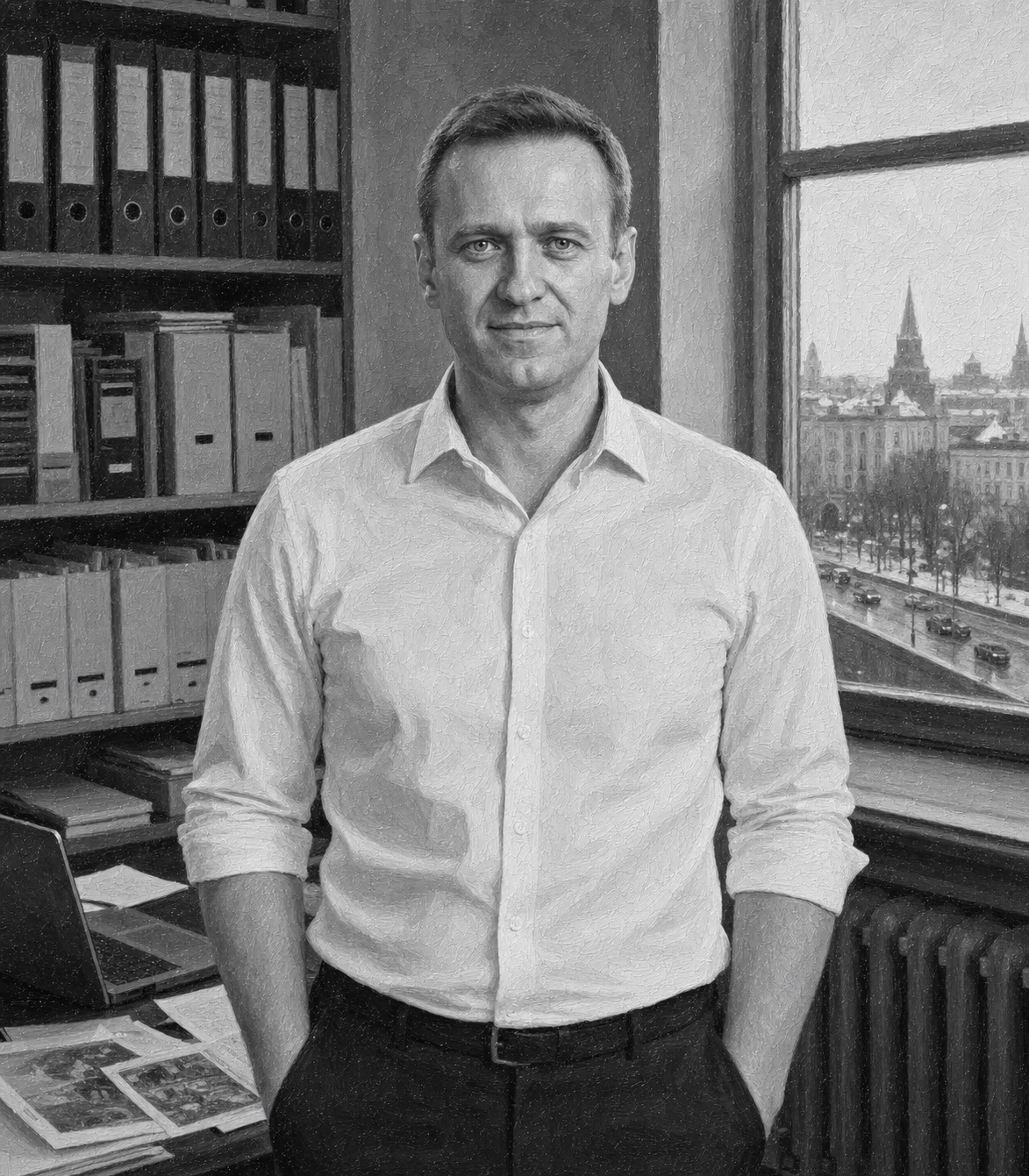
The Man Who Returned, 1976–2024
“From the moment I opened my eyes, I knew I had to return.” [to Russia]
—Navalny, after surviving an assassination attempt
A passenger jet descends toward Moscow on a dark January evening in 2021. Inside sits Alexei Navalny beside his wife, Yulia. Five months earlier, Alexei nearly died after being poisoned with the nerve agent Novichok. German doctors saved him, and he could have remained safely in Europe. Instead, Navalny returned to Russia.
Authorities diverted his plane away from supporters waiting at the original airport. At passport control, officers surround him. Navalny kisses Yulia goodbye and walks away with the police, displaying the buoyant, faintly mocking composure that has become his armor.
Alexei Anatolievich Navalny was born in Butyn, west of Moscow, on June 4, 1976. He would become a lawyer, political organizer, anti-corruption investigator, presidential candidate, prisoner, and the most formidable Russian opponent of Vladimir Putin.
Navalny didn’t set out to become Russia’s leading dissident. He arrived there step by step—first questioning the rules around him, then following the money, and finally challenging the system that made theft a method of governance.
Navalny was the older son of Anatoly and Lyudmila Navalny. His father was a Soviet army officer whose assignments moved the family among military settlements. His mother trained in economics and worked in electronics and accounting.
Soviet garrison towns were tightly controlled enclaves of checkpoints, passes, uniforms, and regulations. Yet Navalny recalled that the strict pass system was routinely circumvented through a hole in the fence. Visitors without passes slipped through, often with young Alexei serving as guide.
The contradiction stayed with him. Authority presented itself as absolute while quietly depending on people to work around its absurdities. Rules mattered greatly for ordinary citizens and very little for those who controlled them.
His parents taught him to distinguish between the country and the state. Russia was its people, language, landscape, and common life. Loving Russia didn’t require submitting to the state.
Navalny’s father came from Zalissia, a Ukrainian village near Chornobyl, where Alexei spent time with his grandmother. He remembered the village as a childhood paradise of woods, rivers, and freedom. Then, in April 1986, a nuclear reactor exploded.
Soviet authorities initially concealed the extent of the catastrophe. Citizens were left uninformed as radiation spread. Only later were Navalny’s relatives evacuated, and Zalissia became part of the exclusion zone.
Alexei was ten years old—old enough to understand that something precious was lost and that the government had lied. Chornobyl became more than a family tragedy. It was an early lesson that official deception could poison real soil and real bodies.
Other cracks appeared in the Soviet system. Veterans returned damaged from the war in Afghanistan. Shortages contradicted the promises of state propaganda. Adults spoke one way in public and another at home.
Mikhail Gorbachev’s reforms transformed Navalny’s adolescence. Glasnost opened newspapers and public debate to previously forbidden truths. Gorbachev became an important influence: an imperfect leader who loosened his control and didn’t use his office simply to enrich himself.
Boris Yeltsin initially offered another image of courage. Navalny watched him resist the attempted coup of 1991 and confront the old Soviet order. But the optimism surrounding Russia’s new democracy gave way to inflation, gangster capitalism, and the transfer of public wealth into private hands. Oligarchs accumulated fortunes while familiar institutions collapsed.
From Gorbachev, Navalny learned that the character of a leader could open a political system. From Yeltsin, he learned that democratic promises without lawful conduct could discredit democracy and prepare the way for authoritarianism.
Navalny studied law at the Peoples’ Friendship University of Russia and later finance at the Financial Academy. Together, the two disciplines gave him the tools he would use as an anti-corruption investigator: the ability to interpret laws and corporate records, identify financial irregularities, and trace public money into private hands.
In 1998, Navalny joined Yabloko, Russia’s liberal opposition party, where he organized campaigns and rose within its Moscow branch. He eventually became frustrated with a movement he considered detached from ordinary Russians and politically ineffective. Seeking a message that could reach beyond Russia’s urban liberal minority, he tried to combine democratic reform with Russian nationalism. He participated in nationalist marches, advocated restrictive immigration policies, and appeared in inflammatory videos. These political choices alienated many Russian democrats and members of ethnic minorities, and led to his expulsion from Yabloko in 2007.
Navalny’s language moderated over time, his later programs emphasizing equal citizenship and democratic institutions, but the controversy remained.
His breakthrough came when he focused on an issue nearly every Russian understood: powerful officials stealing public money.
Navalny purchased small amounts of stock in large state-controlled corporations. As a minority shareholder, he could request records, attend meetings, and ask questions executives didn’t want to answer. Who benefited from government contracts? Where had the money gone?
The companies resisted him. Navalny sued, obtained documents, and published what he discovered online. His legal training helped him identify the mechanisms of corruption; his humor and clarity helped ordinary Russians understand the offense.
Corruption, in his telling, wasn’t an abstract failure of administration. It was the mechanism by which rulers converted public losses into their own private gains. Your road crumbled because an official purchased a villa. Your hospital lacked equipment because someone’s relative controlled the contract.
The internet allowed Navalny to bypass television networks dominated by the Kremlin. On his blog, he combined evidence with jokes, outrage with practical instructions. He didn’t merely tell readers that officials were stealing. He showed them the paperwork and invited them to help expose the theft.
In 2000, Navalny married Yulia Abrosimova, whom he had met while vacationing in Turkey. Their daughter, Daria, was born in 2001 and their son, Zakhar, in 2008. Yulia became his closest adviser, emotional ballast, and sternest judge. His public confidence could make him appear self-sufficient; his family life revealed how much strength he drew from their partnership.
In 2010, Navalny launched RosPil, which investigated suspicious government contracts. The following year he established the Anti-Corruption Foundation. Its lawyers, researchers, and volunteers turned financial records into widely watched investigations of Russia’s political elite.
Navalny called Putin’s United Russia the party of “crooks and thieves.” The phrase reduced an entire political system into three words.
After disputed parliamentary elections triggered mass demonstrations in 2011, Navalny moved from the internet to the protest stage. Arrest increased his prominence. The Kremlin could keep him off national television, but it could no longer make him invisible.
In 2013 he ran for mayor of Moscow. Volunteers raised small donations, staffed sidewalk kiosks, and knocked on doors. Navalny officially won 27 percent of the vote—a remarkable result for an opposition candidate denied meaningful television coverage.
The campaign revealed his central political insight: people trained to regard politics as a distant performance could become citizens if someone gave them a practical role.
It also taught the Kremlin how dangerous he could be.
Criminal prosecutions followed. Navalny and his brother, Oleg, were convicted in cases widely criticized as politically motivated. Oleg was imprisoned, which Alexei regarded as the state taking his family hostage. Navalny was later barred from challenging Putin for the presidency.
He continued investigating. His team built a network of campaign offices across Russia and exposed the immense hidden wealth associated with senior officials. The government responded with arrests, raids, frozen accounts, and violence.
On August 20, 2020, Navalny became violently ill aboard a flight from Siberia to Moscow. The pilot made an emergency landing, and medical workers kept him alive. Tests in Europe identified Novichok in his body.
While recovering in Germany, Navalny helped investigate the security officers suspected of following him. He then telephoned one of the men, pretending to be a Russian official and obtained details about the poisoning operation. It was the purest expression of Navalny’s character: an assassination plot answered with research, nerve, and a prank call.
Then he returned to Russia.
Navalny understood fear too well to be without it. He loved Yulia, his children, travel, jokes, and the pleasures of ordinary life. That love made his choice harder, not easier. He believed a politician asking Russians to overcome their fear couldn’t direct the struggle from safety abroad.
Everything he had learned converged in that decision. The garrison boy recognized the absurdity behind official power. The child of Chornobyl understood the cost of lies. The lawyer knew how to turn rules against those who considered themselves above the law. The blogger understood how humor could puncture authority. Yulia gave him a foundation from which to take risks. His volunteers taught him that courage becomes politically meaningful when others can join it.
Navalny was arrested at the airport and never again lived as a free man. He endured punishment cells, sleep deprivation, inadequate medical care, and increasingly severe sentences. In December 2023 he was transferred to an Arctic penal colony.
Returning to Russia made Navalny’s argument more powerfully than any speech could. He spent years insisting that fear was the Kremlin’s most reliable instrument of power, and that Russians could only reclaim their country by refusing to be cowed. His return showed that he intended to live by the standards he asked of others.
On February 16, 2024, Russian authorities announced that Alexei Navalny had died. He was forty-seven.
Navalny didn’t free Russia from fear, but he did stand as powerful proof that fear hadn’t conquered everyone.
###
Profile written August, 2026.
Resources
Some resources are linked through our affiliate program with Amazon.com. Buying these items is a simple way to support our work while expanding your own knowledge base.
Books
Patriot: A Memoir — Alexei Navalny
Navalny’s posthumously published memoir recounts his childhood, political awakening, poisoning, return to Russia, and final years in prison.
The Dissident: Alexey Navalny—Profile of a Political Prisoner — David M. Herszenhorn
Journalist David Herszenhorn provides a detailed, independent biography of Navalny as a lawyer, anti-corruption investigator, opposition leader, provocateur, poisoning victim, and political prisoner.
Navalny: Putin’s Nemesis, Russia’s Future? — Jan Matti Dollbaum, Morvan Lallouet, and Ben Noble
Three scholars offer a balanced examination of Navalny’s development as an anti-corruption activist, politician, and protest leader, including the controversies surrounding his nationalism.
Murder in the Gulag: The Life and Death of Alexei Navalny — John Sweeney
Investigative journalist John Sweeney examines Navalny’s death in an Arctic penal colony and what it reveals about political repression in Putin’s Russia.
Documentaries
Navalny — Directed by Daniel Roher
This Academy Award-winning documentary follows Navalny’s recovery from poisoning and the remarkable investigation that identified members of the suspected assassination team.
Navalny: The Man Putin Couldn’t Kill — BBC
This 2021 documentary reconstructs the plot to poison Navalny and examines his confrontation with Putin, the Kremlin, and Russia’s security apparatus.
Websites
The official memorial archive presents Navalny’s biography, investigations, speeches, interviews, photographs, and political work.
The organization founded by Navalny continues publishing investigations into corruption and abuses of power among Russian officials and political elites.
This extensive profile places Navalny’s rise, political organization, poisoning, return, and imprisonment within the larger struggle over Russia’s future.
Associated Press: Navalny’s Life and Career
The Associated Press provides a concise, independently reported account of Navalny’s activism, political campaigns, persecution, imprisonment, and death.