
Captain James Cook
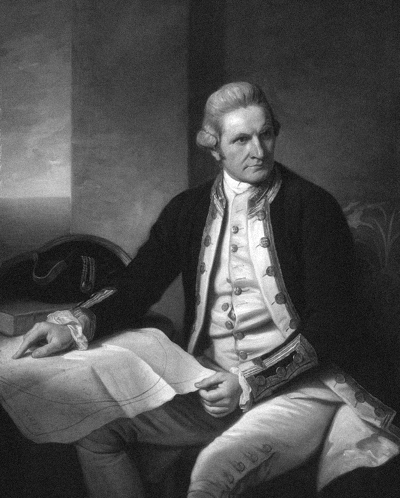
Royal Navy navigator, cartographer, and leader of three Pacific voyages, 1728—1779
“I now once more hoisted English Colours and in the Name of His Majesty King George the Third, took possession of the whole Eastern Coast [of New Holland] by the name of New South Wales.”
James Cook was born in Marton-in-Cleveland, Yorkshire, on October 27, 1728 (Julian Calendar; Old Style), the son of a farm labourer, James Cook Sr., and Grace Pace. His early life mattered: Cook grew up in the work discipline of fields and barns, but he also benefited from a rare lift for a labourer’s son—schooling funded and encouraged by local patrons and employers who noticed his aptitude. That combination of working-class toughness and strong numeracy became a signature. He would later run ships like moving laboratories, with routines, standards, logs, and measurements closer to engineering than romance.
As a teenager he briefly worked for a shopkeeper in the coastal village of Staithes, where the sea was impossible to ignore. He soon apprenticed into the Whitby coal trade under John Walker, learning seamanship the hard way in the North Sea: cold, cramped, dangerous, and unforgiving of mistakes. Whitby mattered in another way as well. Cook gained access to practical navigation and mathematics in an environment that respected competence more than birth. He read, practiced, and improved. By the time he volunteered for the Royal Navy in 1755—an unusual move when he had a secure merchant career path—he brought with him a mature skill set and a seriousness that senior officers recognized quickly.
Cook’s rise accelerated during the Seven Years’ War. He proved himself not only as a sailor but as a surveying and chart-making specialist, producing work that commanders could trust with lives and fleets. His Newfoundland surveys in the 1760s were especially important. They trained him to measure coastlines precisely, manage crews through long seasons, and convert raw observation into navigational truth. These years also placed him inside a widening scientific network linking the Royal Navy, the Royal Society, and Britain’s strategic competition with rival powers.
In 1768 the Admiralty selected Cook—then a lieutenant—to command HMS Endeavour on a scientific expedition to Tahiti to observe the 1769 Transit of Venus. The public mission was astronomy; the practical goal was better measurement of the solar system’s scale. Cook’s selection reflected confidence in his discipline, navigation, and temperament. He could run a ship, maintain order, and still execute precise scientific observation on schedule. From Tahiti, he carried sealed instructions that expanded the mission into exploration—searching for a hypothetical southern continent and returning with charts, observations, and strategic knowledge.
That first Pacific voyage (1768–1771) made Cook a world figure. He circumnavigated New Zealand, mapping it with unprecedented accuracy, and then surveyed the eastern coast of Australia (then commonly called New Holland in European usage), charting harbours and hazards with the same precision that had served him in Newfoundland. He also carried a scientific cohort associated with Joseph Banks, embedding the voyage in the Enlightenment project of collecting, classifying, and describing the world. These encounters—and the power imbalance behind them—are inseparable from Cook’s legacy. For Indigenous communities across the Pacific, Cook’s arrival is tied to later expansion, settlement, disease, and displacement.
Cook commanded a second voyage (1772–1775) aboard HMS Resolution, pushing farther south than any previous European navigator and repeatedly entering Antarctic waters. The results were decisive. He failed to find the temperate “great southern continent” long imagined by geographers, and his routes transformed the Pacific from myth into mapped ocean. During this period Cook also became famous for something quieter but far more consequential: crew health. Scurvy had historically killed sailors in devastating numbers. Cook enforced cleanliness, ventilation, and disciplined diet, ensuring crews consumed anti-scorbutic foods whenever possible. His success was recognized by the Royal Society and remains one of the major operational breakthroughs in long-distance seafaring.
The third voyage (1776–1779), again aboard Resolution and accompanied by Discovery, sought a navigable Northwest Passage from the Pacific. In 1778 Cook became the first European known to have recorded contact with the Hawaiian Islands. He then sailed north along the coast of North America into the Arctic, where ice halted further progress. Returning to Hawaiʻi, tensions escalated at Kealakekua Bay. In February 1779, during a violent confrontation following an attempt to detain the ruling chief as leverage for stolen property, Cook was killed. The event has been debated ever since, but it clearly shows how quickly relations could collapse when cultures collided under stress, misunderstanding, and coercion.
Cook’s adult identity is inseparable from the people and institutions around him: naval patrons who promoted him, scientific societies that validated his work, crews who executed his routines, and Pacific communities whose lives were disrupted by European arrival. He was, at once, a technician of empire and a technician of truth—committed to making charts match reality. Both can be true. His journals, maps, and expedition records remain foundational documents for the history of navigation, science at sea, and the complex legacy of exploration in the Pacific.
###
Profile originally written October 1995 | Revised January 2026
Resources
Some resources are linked through our affiliate program with Amazon.com. Purchasing these items is a simple way to support our work while expanding your own knowledge base.
Books
Captain James Cook — Richard Hough
A highly readable full biography that places Cook inside Britain’s naval and scientific world while tracking the three voyages in detail. Strong on leadership under pressure and the psychological wear of the final expedition.
Cook: The Extraordinary Voyages of Captain James Cook — Nicholas Thomas
A modern synthesis that draws on long research into the voyages and their documentation. Particularly useful for balancing exploration, science, and the contested human legacy of Pacific contact.
The Journals of Captain Cook — James Cook (ed. Philip Edwards)
Cook in his own voice: practical, observant, and relentlessly specific. The journals show how a disciplined navigator became a world-mapper—and how daily decisions accumulated into history.
Explorations of Captain James Cook in the Pacific — James Cook (ed. A. Grenfell Price)
A compact way into the voyages via selected journal passages. Best for readers who want the arc of discovery without committing to multi-volume primary sources.
Videos
The controversial legacy of Captain James Cook — Discussion of achievements and contested memory
Captain Cook: Encounters That Changed History — Lecture-style framing of Pacific encounters
Captain James Cook: The Man Who Mapped the World — Documentary-style biography
Websites
Captain Cook Society — Specialist society, articles, and research community.
Royal Museums Greenwich: Captain James Cook timeline — Clean chronology and key milestones.
Royal Museums Greenwich: Research Guide (Cook) — Archival orientation and research pathways.
NASA: Cook’s View of the Transit of Venus — Ties Cook’s 1769 observation to modern science communication.
State Library of New South Wales: Cook’s voyages — Primary-source-driven narrative and maps context.
National Museum of Australia: Cook and the Royal Society — Strong documentation on scurvy prevention, medals, and networks.