
Deng Xiaoping
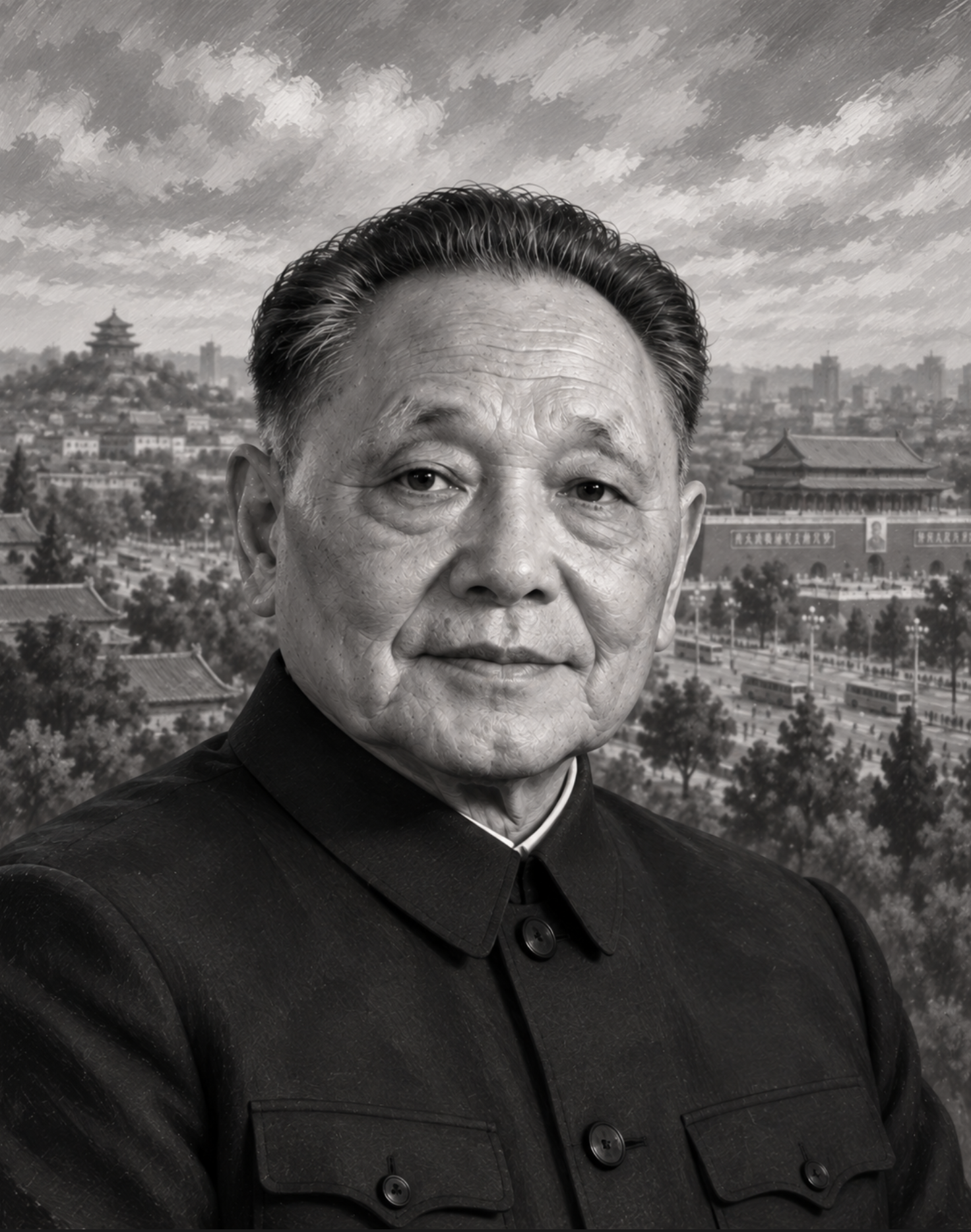
Chinese revolutionary, military leader, Communist Party statesman, and architect of China’s reform era. 1904–1997
“It doesn’t matter whether a cat is black or white, as long as it catches mice.”
War taught Deng to think in terms of objectives, organization, and acceptable costs. Victory did not belong automatically to the side with the purest ideas. It belonged to the side able to adapt while holding its forces together.
When the People’s Republic of China was established in 1949, Deng moved from revolutionary command into government. He administered the southwest, became finance minister, and in 1956 became general secretary of the Communist Party. Mao valued his intelligence, efficiency, and ability to turn policy into action.
That ability served destructive policies as well as constructive ones. During the Anti-Rightist Campaign of 1957, Deng helped direct the persecution of intellectuals, officials, and citizens accused of opposing socialism. Hundreds of thousands were denounced, dismissed, imprisoned, or sent to labor camps.
Deng was not simply a moderate waiting to correct Mao. He was a committed revolutionary who helped build and operate the coercive party-state he would later reform.
Mao’s Great Leap Forward tested that commitment. Beginning in 1958, rural communes, impossible production targets, distorted reporting, and state grain procurement contributed to a famine in which tens of millions died. Political enthusiasm could not produce the harvests officials had promised, while a system organized around fear concealed the evidence of failure.
Deng and President Liu Shaoqi helped restore production by allowing material incentives, smaller units of responsibility, and greater flexibility in the countryside. It was in this setting that Deng repeated the Sichuan saying that became attached to his name: "a cat’s color mattered less than whether it caught mice." The remark did not reject communism. It rejected the idea that a policy’s ideological appearance mattered more than its consequences.
Mao saw the recovery policies as a retreat from revolution. When he launched the Cultural Revolution in 1966, Liu became its most prominent political victim and died after abuse and medical neglect. Deng was denounced as the country’s “number-two capitalist roader,” stripped of authority, and forced to undergo public criticism.
His family suffered with him. Red Guards persecuted his children. His eldest son, Deng Pufang, fell or was thrown from an upper-story window while in detention and was permanently paralyzed. In 1969, Deng and his wife, Zhuo Lin, were sent to Jiangxi province, where he worked mornings at a tractor-repair factory.
Deng left no diary explaining what he thought during these years. He spent long periods walking in the courtyard of the house where the family lived. His later actions suggest one conclusion hardened during exile: Mao’s campaigns had endangered China, but the Communist Party remained the only institution capable of holding the country together. He separated the party from the disasters committed in its name.
This distinction would shape everything that followed. Leaders, policies, slogans, and institutions could be discarded if they threatened China’s future. Party rule could not.
Zhou Enlai helped bring Deng back into national leadership in 1973. By 1975, as Mao and Zhou weakened, Deng was again managing much of the government. He restored examinations, empowered specialists, demanded order in factories and railways, and tried to make officials answerable for performance.
Mao soon turned against him again. After public mourning for Zhou became a protest against the Cultural Revolution’s radicals in April 1976, Deng lost his positions for a second time.
Mao died that September. The arrest of the Gang of Four ended the Cultural Revolution, but Mao’s chosen successor, Hua Guofeng, initially inherited the leadership. Deng did not replace him through a dramatic seizure of power. He gathered support, encouraged debate over Mao’s legacy, and allowed Hua’s adherence to Maoist formulas to appear increasingly inadequate to the country’s needs.
By the end of 1978, Deng had become China’s paramount leader without assuming the party’s or government’s highest formal titles. Authority mattered more to him than ceremony.
The China he inherited was politically traumatized, technologically backward, and economically constrained. Universities had been disrupted. Managers had learned to fear initiative. Rural communes weakened the connection between effort and reward. The country possessed enormous human capacity, but Maoist orthodoxy restricted the ways it could be used.
Deng did not arrive with a complete plan for a market economy. His method was to permit experiments, examine their results, and expand the ones that worked.
In Anhui province, farming families secretly divided collective land among households. They agreed to meet state quotas but kept what they produced beyond them. Similar experiments appeared elsewhere. Deng did not invent these practices, but he protected them when ideological opponents wanted them stopped. The household responsibility system spread, agricultural production increased, and rural incomes rose.
Under Deng, China established special economic zones, welcomed foreign investment, restored educational standards, and sent students abroad. Township enterprises expanded. Factories received greater freedom to make decisions and retain earnings. Places such as Shenzhen became laboratories in which methods once condemned as capitalist could be tested in the service of a socialist state.
Deng surrounded himself with officials capable of turning experiments into policy. Hu Yaobang led the rehabilitation of people persecuted under Mao and helped restore confidence in the party. Zhao Ziyang brought experience from agricultural reform in Sichuan and became one of the central architects of economic change. Wan Li supported rural experimentation in Anhui. Chen Yun supplied caution, warning against instability and arguing that markets still required a strong framework of state control.
Deng’s achievement was not to design every successful reform. It was to give successful experiments room to survive.
The changes released energy throughout the country. Farmers produced more when they could benefit directly from their labor. Entrepreneurs found opportunities at the edges of the state economy. Overseas Chinese investors brought capital and commercial relationships. Foreign companies brought technology, management practices, and access to markets.
China’s transformation rested on the work of millions of people and on foundations laid before Deng came to power, including advances in literacy, public health, infrastructure, and basic industry. Yet Deng supplied the political protection without which local initiative could have been condemned as ideological error.
His willingness to break with Maoist economics did not extend to Communist Party rule.
When activists associated with the Democracy Wall movement demanded civil liberties and political reform in 1978 and 1979, Deng initially found their criticism of the Cultural Revolution useful. Once the movement challenged the party itself, he shut it down. Wei Jingsheng, who argued that democracy should become a “Fifth Modernization,” received a fifteen-year prison sentence.
Deng defined Four Cardinal Principles that reform would not be permitted to overturn: socialism, the people’s democratic dictatorship, Communist Party leadership, and Marxism-Leninism-Mao Zedong Thought.
The cat could be black or white. It still belonged to the party.
Deng accepted other costs in pursuit of national strength. In 1979, China invaded Vietnam in an attempt, as he put it, to “teach Vietnam a lesson.” The brief war caused heavy casualties on both sides and failed to produce a clear military victory.
At home, Deng supported strict population controls that developed into the one-child policy. The policy helped slow population growth, but enforcement intruded deeply into family life. Coercive abortions and sterilizations, abandoned children, unequal treatment between urban and rural families, and a widening imbalance between the sexes became part of its legacy.
Economic reform created new possibilities while removing old securities. Some people became wealthy; others lost the guarantees associated with collective agriculture and state employment. Corruption grew where political power and commercial opportunity met. Deng accepted inequality as a stage in development, arguing that some people and regions would become prosperous before others.
His pragmatism was not gentle. It measured policies by whether they advanced the future he had chosen, and it expected people living through the transition to absorb its disruptions.
Deng could be equally unsentimental toward colleagues. Hu Yaobang’s rehabilitation of Cultural Revolution victims made him widely admired, but Deng came to believe that Hu had been too tolerant of student demonstrations and demands for liberalization. Hu was forced to resign as general secretary in 1987.
When Hu died in April 1989, public mourning grew into a national protest movement. Students occupied Tiananmen Square. Workers created independent organizations. Demonstrators called for action against corruption, greater freedom of expression, government accountability, and political reform.
The movement contained different groups and competing objectives, but it created something Deng had spent his life learning to fear: organized political power outside the Communist Party.
China’s leaders divided over how to respond. Zhao Ziyang urged negotiation and warned against treating the students as enemies. Deng saw the unrest through the history he had lived—warlord conflict, foreign invasion, civil war, the Cultural Revolution, and the weakening of Communist governments elsewhere. He concluded that the movement threatened both the party and the modernization the party had directed.
Deng supported martial law and the use of the People’s Liberation Army. During the night of June 3–4, troops and armored vehicles moved through Beijing. Soldiers fired on civilians, many of them in streets surrounding Tiananmen Square. Hundreds, and possibly thousands, were killed. Thousands more were wounded or detained.
Deng believed that suppressing the movement protected China from disorder. But the decision also revealed the danger within his understanding of stability: he treated the survival of the Communist Party as inseparable from the survival of China.
Zhao Ziyang was removed from power and spent the remaining sixteen years of his life under house arrest. Political reform receded. Economic reform slowed as conservative officials gained influence.
Then, in 1992, at eighty-seven, Deng acted once more.
Traveling through southern China, he visited Shenzhen and other centers of experimentation, praised faster development, and warned that officials unwilling to reform should be removed. Though formally retired, he still possessed enough authority to break the post-Tiananmen paralysis. His southern tour renewed market reform and accelerated China’s integration into the world economy.
The journey brought the central pattern of his leadership into view. Deng had suppressed a movement demanding political change, then defeated resistance to further economic change. In each case, he imposed his judgment of what China required: greater prosperity, greater openness to commerce and technology, and continued Communist Party control.
Deng died on February 19, 1997, a few months before sovereignty over Hong Kong passed from Britain to China under the “one country, two systems” formula he had promoted. He left behind no cult comparable to Mao’s. He had encouraged retirement rules, collective leadership, and the advancement of younger officials, hoping to make the state less dependent on the life of a single ruler.
He also left a political system in which decisions of enormous consequence remained concentrated among a small group of leaders, beyond public accountability.
The boy who left Sichuan for France had learned to look past appearances and ask whether a system worked. The factory laborer became an organizer. The organizer became a soldier and administrator. The official twice purged by Mao became the leader willing to dismantle much of Mao’s economic legacy without surrendering the party Mao had built.
Deng’s experiences taught him that ideas could become traps, that institutions could fail, and that hesitation could carry costs of its own. They also taught him to associate disorder with national weakness and national weakness with suffering. He would not leave China’s survival to political enthusiasm, inherited doctrine, or public sentiment.
One of Deng Xiaoping’s essential virtues was ruthlessness: the capacity to impose painful costs when he believed survival, stability, or long-term progress required them. It enabled him to discard policies that had acquired the authority of sacred doctrine, protect experiments that contradicted official ideology, and redirect China toward economic growth. It also enabled him to silence opponents, sacrifice colleagues, and send soldiers against citizens whose demands challenged the system he was determined to preserve.
Ruthlessness is not cruelty for its own sake, nor indifference to suffering. Properly bounded, it is the willingness to make a necessary decision even when that decision carries a real and unavoidable cost. Leadership without that capacity can allow failing institutions, comforting illusions, and delayed choices to produce still greater harm.
But ruthlessness cannot determine its own limits. A leader who becomes practiced at imposing necessary costs may begin to assume that every cost he chooses is necessary. Deng’s life demonstrates both the power of this difficult virtue and the danger of allowing it to stand alone. Ruthlessness may belong among the tools of effective leadership, but only when restrained by accountability, proportion, humility, and regard for the people required to bear its consequences.
###
Written October 11, 2026
Resources
Some resources are linked through our affiliate program with Amazon.com. Buying these items is a simple way to support our work while expanding your own knowledge base.
Books by and about Deng Xiaoping
Deng Xiaoping and the Transformation of China by Ezra F. Vogel
The most substantial English-language account of Deng’s mature career. Vogel is particularly valuable on the relationships, bureaucratic struggles, foreign encounters, and incremental experiments behind reform, though his admiration for Deng’s accomplishments should be balanced with more critical accounts.Deng Xiaoping: A Revolutionary Life by Alexander V. Pantsov with Steven I. Levine
A political biography of Deng’s entire life that draws on Russian as well as Chinese sources and gives close attention to his revolutionary formation, loyalty to the party, and participation in Communist coercion.Prisoner of the State: The Secret Journal of Premier Zhao Ziyang by Zhao Ziyang
The posthumously published recollections of the reformist general secretary removed during the 1989 crisis. Zhao provides an indispensable countervoice to accounts that treat Deng’s decisions as inevitable.The People’s Republic of Amnesia: Tiananmen Revisited by Louisa Lim
A humane investigation of the crackdown, its victims, the state’s suppression of memory, and the different ways Chinese citizens have lived with the event.Mao’s Great Famine by Frank Dikötter
An archival history of the Great Leap Forward and the famine that followed. It provides essential context for understanding why Deng came to distrust ideological mobilization detached from observable results.Selected Works of Deng Xiaoping
Speeches and writings spanning Deng’s revolutionary and governing careers. They allow readers to follow his changing language about economic experimentation, modernization, party authority, political limits, and stability.
Documentaries & Profiles
China: A Century of Revolution — directed by Sue Williams
This three-part documentary uses archival footage and eyewitness testimony to place Deng within revolution, civil war, Maoist rule, the Cultural Revolution, reform, and the 1989 crackdown. Its third installment, Born Under the Red Flag, concentrates on the Deng era.“Deng Xiaoping” — Commanding Heights — PBS
A concise biographical profile particularly useful on Deng’s years in France, military apprenticeship, repeated purges, and economic pragmatism.“Deng Xiaoping: The Years in France” by Nora Wang
A carefully researched study drawing partly on French archival records. It distinguishes the historical young worker and organizer from the simplified origin story later constructed around him.
Lectures, Interviews, and Conversations
Interview of Vice-Premier Deng Xiaoping by American television commentators, January 31, 1979
Walter Cronkite, Jim Lehrer, Frank Reynolds, and David Brinkley question Deng during his landmark American visit. The exchange captures both the diplomatic opening and the strategic calculations surrounding it.Deng Xiaoping’s 1979 White House welcoming ceremony — The American Presidency Project
The official record of Jimmy Carter and Deng speaking at the beginning of normalized relations between the United States and the People’s Republic of China.Ezra Vogel discusses Deng Xiaoping and the Transformation of China — Fairbank Center for Chinese Studies
Background on Vogel and the decade of research behind his biography, with connections to the broader scholarly study of modern China.
Websites and Archives
Tiananmen Square, 1989: The Declassified History — National Security Archive
Declassified diplomatic reporting and government documents reconstructing the protest movement, leadership crisis, military mobilization, crackdown, and international response.The U.S. Tiananmen Papers — National Security Archive
A collection focused on decision-making within the Chinese leadership and the decisive role of Deng and other party elders.China’s 40 Years of Reform and Development, 1978–2018 — Australian National University Press
An open-access scholarly collection examining agriculture, industry, trade, institutions, inequality, and the complicated distribution of credit for China’s economic transformation.World Bank overview of China
Economic and development data useful for measuring the scale of China’s reduction in extreme poverty while distinguishing long-term national outcomes from the actions of any single leader.