
Elon Musk
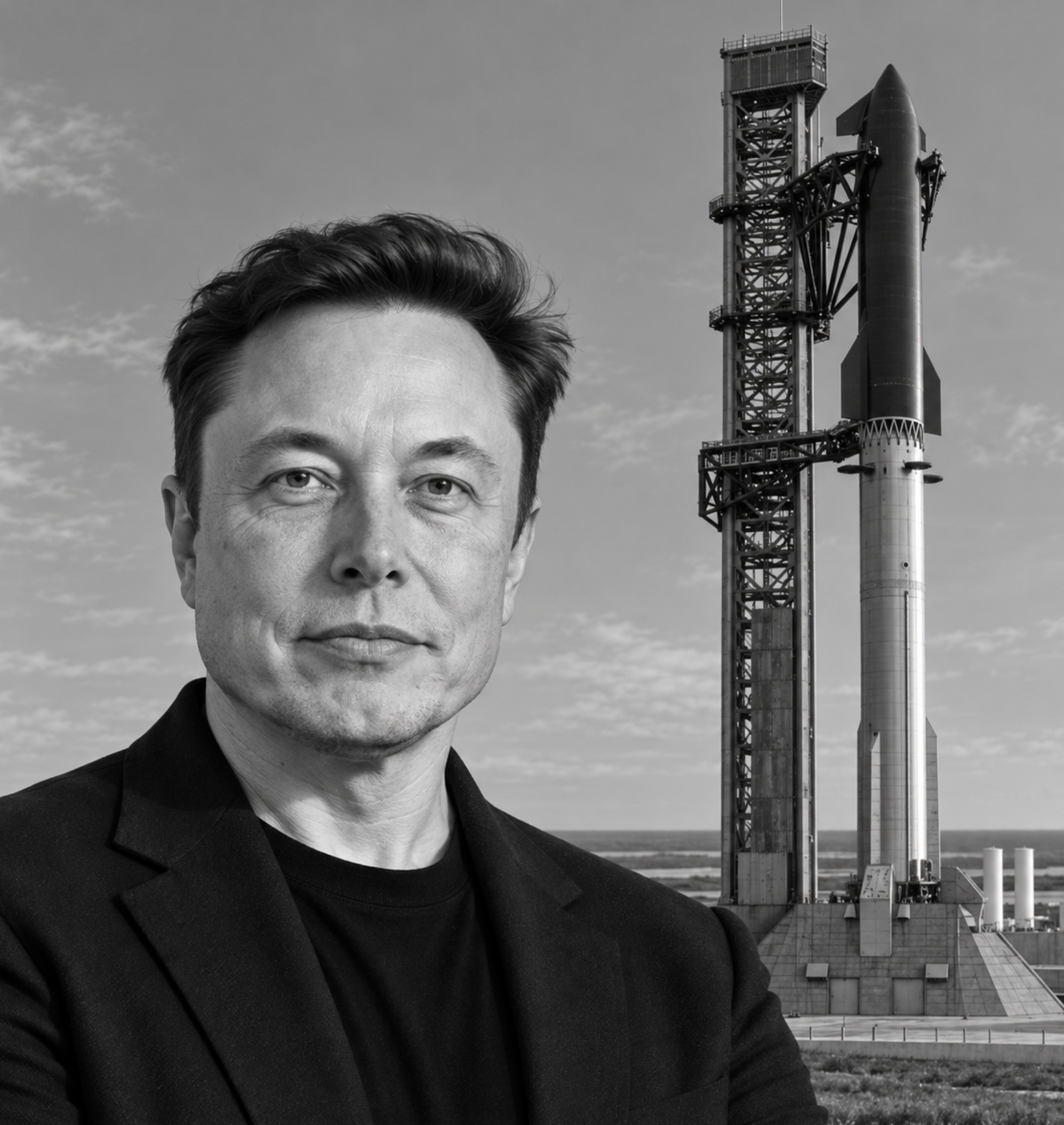
Software entrepreneur, industrialist, automotive executive, spaceflight pioneer, and technology magnate. Born: 1971
“There are just times when something is important enough, and you believe in it enough, that you do it in spite of fear.”
Elon Reeve Musk was born on June 28, 1971, in Pretoria, South Africa. His mother, Maye, was a Canadian-born model and dietitian. His father, Errol, was an engineer and property developer. Elon was the oldest of three children, followed by his brother, Kimbal, and sister, Tosca.
The South Africa of Musk’s childhood was governed by apartheid. He grew up within its privileged white minority, but privilege did not make his private world secure. His parents’ marriage was turbulent, and after they divorced, Musk eventually chose to live with his father. He later described that decision as a mistake and portrayed his father as emotionally abusive. Errol Musk has disputed parts of his son’s account.
At school, Musk was small, socially awkward, and absorbed in his own thoughts. Other children bullied him, once beating him so badly that he was hospitalized. Books offered both refuge and enlargement. He read science fiction, fantasy, encyclopedias, and philosophy, sometimes for hours at a time. Isaac Asimov’s Foundation series presented civilization as something that could collapse—and intelligence and planning as forces that might preserve it.
This became a recurring structure in Musk’s imagination. Humanity faced large dangers; technology offered a way through them; waiting for established institutions to act was itself a risk.
At ten, Musk encountered a computer in a Johannesburg electronics store. He taught himself to program and, at twelve, sold the code for a simple space-themed game called Blastar. The achievement was modest, but the pattern was already present: faced with a new system, Musk tried to understand it from the inside and make it do something tangible.
Musk left for Canada in 1989, shortly before his eighteenth birthday, using his mother’s Canadian citizenship to obtain a passport. The move carried him away from compulsory military service in apartheid South Africa and toward his eventual destination, the United States.
He stayed with relatives, worked temporary jobs, and studied at Queen’s University in Ontario. There he met Justine Wilson, a fellow student and aspiring writer whom he later married. After two years, he transferred to the University of Pennsylvania, where he studied physics and economics. The combination suited him. Physics asked what was possible. Economics asked what people and capital could build.
In 1995, Musk entered a graduate program in applied physics and materials science at Stanford University. The commercial internet was moving beyond universities and specialist communities, and Musk concluded that the opportunity would not wait for a degree. He left Stanford almost immediately and joined Kimbal in starting Zip2, which helped newspapers place maps and local business information online.
The brothers worked with little money. Musk wrote code at night and sometimes slept in the office, showering at a nearby recreation center. His programming was energetic but undisciplined, and experienced engineers later had to reorganize portions of it. This, too, anticipated a pattern: Musk could drive a project from improbability into existence, but others often had to make his projects sustainable.
Outside investors brought professional management to Zip2 and rejected Musk’s effort to become chief executive. When Compaq acquired the company in 1999, Musk received roughly $22 million from the sale.
He placed much of it into X.com, an attempt to move banking onto the internet. The idea met resistance because money depends upon trust, and the internet still appeared unfamiliar and insecure to much of the public. X.com merged with Confinity, whose payment service became PayPal. Musk briefly led the combined company, but disagreements over technology and management intensified. In 2000, while he was traveling, the board removed him as chief executive and installed Peter Thiel.
Musk had now been pushed aside at two companies he helped create. He remained a major shareholder, however, and when eBay bought PayPal in 2002, he emerged with a fortune of roughly $175 million after taxes.
Musk had long been disappointed that human exploration of space had lost momentum. He first considered sending a small greenhouse to Mars as a spectacle intended to revive public interest. Attempts to buy an affordable rocket led him to a more fundamental conclusion: space launches cost too much because the industry had accepted methods, suppliers, and prices that could be reconsidered.
In 2002, he founded Space Exploration Technologies—SpaceX—with the eventual goal of making human civilization multiplanetary.
Musk was not an aerospace engineer, and SpaceX was never the achievement of one person. Early colleagues including Tom Mueller, who led rocket-engine development, and Gwynne Shotwell, who became the company’s president and operating leader, transformed an improbable proposal into a functioning organization. NASA supplied expertise, oversight, contracts, and a customer whose support proved indispensable.
Musk’s contribution was to hold the objective steady. He urged engineers to question requirements, remove unnecessary parts, bring manufacturing in-house, and test quickly enough that failure produced information rather than paralysis.
The first three launches of SpaceX’s Falcon 1 rocket failed.
Each failure consumed money as well as machinery. By 2008, SpaceX had nearly exhausted its funds. Musk was also deeply involved with Tesla Motors, an electric-car company founded by Martin Eberhard and Marc Tarpenning. Musk joined as its leading early investor and chairman in 2004, helped shape the Roadster, and eventually became chief executive.
Tesla’s strategy was to begin with an expensive electric sports car, use the proceeds to develop a more affordable vehicle, and continue moving toward the mass market. But the Roadster suffered delays and cost overruns. The global financial crisis made new financing difficult. Musk’s marriage to Justine ended amid the strain, and both Tesla and SpaceX approached collapse.
Musk had enough remaining capital to support one company. He divided it between the two.
On September 28, 2008, the fourth Falcon 1 rocket reached orbit—the first privately developed, liquid-fueled launch vehicle to do so. In December, NASA awarded SpaceX a contract to carry cargo to the International Space Station. Tesla closed a crucial financing round during the same period.
SpaceX went on to develop the larger Falcon 9 and the Dragon spacecraft. In 2012, Dragon became the first commercial spacecraft to deliver cargo to the International Space Station. The company then achieved something the established launch industry had largely considered uneconomical: landing and reusing orbital-class rocket boosters.
The spectacle of rockets descending upright could obscure the more significant achievement: reusability changed the economics and rhythm of launching payloads. SpaceX became a central NASA partner, restored the ability to launch astronauts into orbit from the United States in 2020, and built Starlink, a vast network of satellites providing internet service around the world.
At Tesla, the Model S demonstrated that an electric car could be fast, desirable, and capable of long-distance travel. The company built battery factories, a charging network, and manufacturing plants on several continents. The Model 3 and Model Y carried electric vehicles further into the mass market.
Tesla didn't invent the electric car, and Musk didn't personally design every technology associated with the company. What Tesla did was move electric vehicles from the periphery and make them a competitive necessity. Established manufacturers committed billions of dollars to batteries, software, and new production systems partly because Tesla made inaction look more dangerous than change.
Musk drove this urgency by setting deadlines others considered unrealistic. Many were missed. Some promises—particularly about fully autonomous vehicles—remained unfulfilled long after he predicted their arrival. Yet the deadlines concentrated labor and attention around problems that conventional schedules might have allowed to drift.
During the Model 3 production crisis of 2017 and 2018, Musk slept at Tesla’s factory and involved himself in minute manufacturing decisions. He had pushed for extreme automation, only to discover that an elegant vision of robotic production could fail amid the variability of an assembly line. Tesla improvised new processes, erected an additional line inside a temporary structure, and eventually solved the production problems.
The episode revealed both Musk’s strength and his limitation. He could admit that a technical strategy had failed and redirect enormous resources at unusual speed. But the emergency had been intensified by his forecasts, his confidence, and his preference for operating near the edge of what an organization could endure.
Employees across his companies have described exhilarating periods in which small teams solved problems thought to require a much larger effort. Others have described volatile decisions, abrupt dismissals, punishing hours, workplace injuries, and a culture in which objections could be treated as obstacles rather than warnings. Allegations of discrimination and retaliation have led to lawsuits and regulatory action, while the companies have contested many of the claims.
His public behavior created a similar tension. In August 2018, Musk tweeted that he was considering taking Tesla private and had “funding secured.” The transaction did not occur. The United States Securities and Exchange Commission charged him with securities fraud, alleging that the statement lacked an adequate basis. Musk settled without admitting or denying the allegations, paid a financial penalty, and stepped down as Tesla’s chairman while remaining chief executive.
As his companies grew, Musk continued starting new ones. Neuralink pursued interfaces between brains and computers. The Boring Company developed tunneling projects. He helped establish OpenAI before separating from the organization and later founded the artificial-intelligence company xAI. Not every undertaking matched the achievements of Tesla or SpaceX. Some produced striking demonstrations without fulfilling their original promises.
In 2022, Musk acquired Twitter for approximately $44 billion after trying unsuccessfully to withdraw from the agreement. He renamed the platform X, dismissed much of its workforce, altered its verification and moderation systems, and presented the changes as a defense of free expression.
Under Musk, X became more closely identified with his political views. Critics argued that reduced staffing and altered moderation allowed misinformation, harassment, and hateful content to spread more easily. Musk maintained that the platform was correcting ideological bias and permitting speech its previous management had suppressed. His enormous audience allowed him to intervene directly in political debate, magnifying his influence.
The man who challenged concentrated power in aerospace and automobiles had himself become a center of private power—in transportation, communication, artificial intelligence, satellites, and access to space.
Starlink made the contradiction especially vivid. Its terminals provided vital communications after natural disasters and during Russia’s invasion of Ukraine. Decisions about coverage also showed how governments and military forces could become dependent upon infrastructure controlled by one company and, ultimately, one unusually powerful individual.
Musk’s central projects arose from dangers he believed humanity was failing to confront. Sustainable energy might reduce the risks of climate change. A settlement beyond Earth might protect civilization from extinction. Brain interfaces might help humans contend with advanced artificial intelligence, while xAI sought to compete in building that intelligence. Musk repeatedly committed money, reputation, and years of effort when success looked improbable, often beating the odds.
His relationships have borne the strain. Musk’s first son with Justine died of sudden infant death syndrome at ten weeks. The couple later had five children before divorcing. Musk went on to have children with other partners. One of his older children, Vivian Jenna Wilson, became publicly estranged from him. The man preoccupied with preserving humanity across centuries hasn't always been able to preserve intimacy within his own family.
No single childhood experience explains the adult Elon Musk. Pain doesn't automatically produce ambition, and accomplishment doesn't redeem cruelty. Yet the continuities are difficult to ignore: the bullied boy who withdrew into books, the immigrant who kept moving toward a larger arena, the chief executive who treated emergencies as clarifying, and the industrialist who organized companies around threats to civilization. Across these different lives runs a recognizable response to vulnerability: understand the system, master it, and turn the source of fear into a problem that can be solved. What began as refuge became method; what became method eventually became power.
Musk learned to answer doubt with work, opposition with greater commitment, and failure with another attempt. Those habits helped produce rockets that return from space and cars that forced an industry to reconsider its future.
Resolution in Musk’s life isn't simply persistence. It is the power to hold an objective steady while money disappears, machinery explodes, colleagues object, and the likelihood of success narrows. Musk’s resolve has expanded the boundaries of private spaceflight, accelerated the adoption of electric vehicles, and made technological possibilities visible before institutions were ready to pursue them. Musk’s life suggests that determination is most constructive when joined to proportion, accountability, and care for those who bear its costs.
Taken together, Musk’s enterprises are pieces of an audacious vision: a self-sustaining, multiplanetary civilization. If those pieces ultimately come together, they may open the greatest possibility of all—a future in which human life extends beyond Earth.
###
Written September 20, 2026
Resources
Some resources are linked through our affiliate program with Amazon.com. Buying these items is a simple way to support our work while expanding your own knowledge base.
Books by or about Elon Musk
Elon Musk by Walter Isaacson — Based on two years of close access to Musk, his family, colleagues, and critics. Especially useful for observing how his engineering methods, appetite for crisis, and personal volatility interact.
Elon Musk: Tesla, SpaceX, and the Quest for a Fantastic Future by Ashlee Vance — A broad account of Musk’s childhood and the formative years of Zip2, PayPal, SpaceX, and Tesla, written before his later political transformation and acquisition of Twitter.
Power Play: Tesla, Elon Musk, and the Bet of the Century by Tim Higgins — A detailed, independently reported history of Tesla that restores engineers, executives, investors, and production workers to a story frequently centered on Musk alone.
Liftoff: Elon Musk and the Desperate Early Days That Launched SpaceX by Eric Berger — A focused history of the small team that developed Falcon 1, illuminating the technical and organizational struggle behind SpaceX’s breakthrough.
Documentaries & Profiles
Elon Musk: The Evening Rocket — “Planet B” — In this episode of Jill Lepore’s historical podcast series, she examines Silicon Valley’s fascination with existential catastrophe and the stories of progress, science fiction, masculinity, and power surrounding Musk’s public identity.
Elon Musk’s Crash Course — Official Sneak Peek — An official FX and New York Times Presents preview of the investigation into Tesla’s driver-assistance technology, its marketing, and the human consequences of promises that outpace reliable performance. The complete documentary does not appear to be officially available free on YouTube.
Return to Space — Official Trailer — Netflix’s official preview of the documentary following SpaceX and NASA’s effort to return human orbital launches to the United States. The complete film remains on Netflix.
Lectures, Interviews, and Conversations
Stanford Entrepreneurial Thought Leaders Lecture, 2003 — An unusually early record of Musk explaining Zip2, X.com, PayPal, and the logic behind SpaceX before his public persona became inseparable from his companies.
Stanford eCorner Conversation, 2015 — Musk discusses engineering, risk, the fourth Falcon 1 launch, and the financing crisis of 2008.
Walter Isaacson on Musk’s motivations and contradictions — A concise PBS conversation about the access, evidence, and interpretive choices behind Isaacson’s biography.
Websites
Tesla Master Plans — Musk’s successive public statements of Tesla’s strategy provide a direct record against which the company’s achievements and unfinished promises can be compared.
NASA’s history of commercial orbital transportation — An institutional account of the NASA program that enabled SpaceX and other commercial providers to develop cargo transportation to the International Space Station.
NASA Commercial Crew Program — Background on the partnership through which SpaceX began carrying astronauts to the International Space Station.
SEC settlement concerning Musk and Tesla — The Securities and Exchange Commission’s account of the 2018 “funding secured” case, its findings, and the resulting governance requirements.
Tesla: Elon Musk — Tesla’s official summary of Musk’s corporate roles and business history; useful as a primary source, though not an independent assessment.