
Jonas Salk
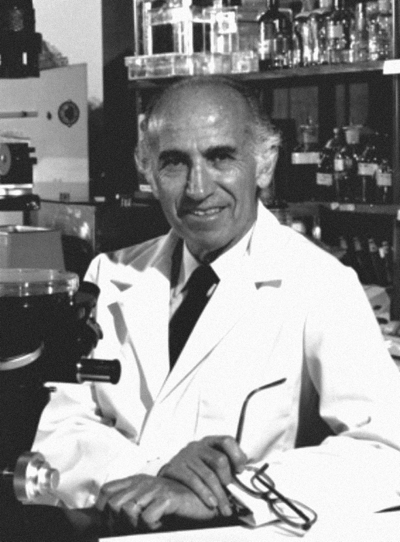
Physician-scientist and developer of the first successful polio vaccine, 1914-1995
“Intuition will tell the thinking mind where to look next.”
Jonas Edward Salk was born on October 28, 1914, in New York City, the eldest of three sons of Russian-Jewish immigrants. His father worked in the garment industry; his mother pushed relentlessly for her children’s education. Salk grew up in a world where higher learning was not inherited tradition but hard-won aspiration. He was a serious student, drawn to questions of purpose as much as to grades, and he carried a quiet conviction that science should serve human life directly—not simply win arguments inside a laboratory.
After excelling in New York public schools, Salk attended City College of New York, where he leaned into chemistry and biology while many peers aimed for more conventional professional routes. He entered New York University School of Medicine and chose a path that was unusual at the time: rather than focusing primarily on clinical practice, he was pulled toward research. Even as a medical student, he gravitated to the scientific foundations of disease and the possibility of prevention. That orientation—the physician as investigator, the investigator as public servant—became the consistent thread of his life.
World War II accelerated the urgency of infectious-disease research, and in 1942 Salk joined influenza-vaccine work at the University of Michigan under the demanding epidemiologist Thomas Francis, Jr. Francis shaped Salk’s professional character: rigorous methods, careful controls, and a refusal to confuse hope with proof. Salk learned that the highest form of scientific courage is not bravado but disciplined verification—the ability to keep testing your own idea until it either survives or collapses.
In 1947, Salk became director of the Virus Research Laboratory at the University of Pittsburgh. The United States was then living with periodic polio epidemics that terrified parents and filled hospitals. Polio could strike quickly and unpredictably, leaving paralysis, respiratory failure, or death. Communities closed pools and canceled gatherings each summer. The emotional climate mattered: Salk was not trying to solve an abstract puzzle; he was trying to stop a recurring national trauma.
Salk made a controversial technical choice. Many researchers believed the only workable polio vaccine would be a live (weakened) virus. Salk pursued an inactivated (“killed”) virus vaccine, designed to trigger immunity without risking infection. The approach demanded precision: the virus had to be grown in volume, reliably inactivated, and tested to ensure no live virus remained. Salk was also unusually attentive to the realities beyond the bench: manufacturing consistency, public trust, and the ethical weight of placing a medical innovation into the arms of children.
The vaccine trials became one of the largest medical undertakings in U.S. history. In 1954, nearly two million children participated in field trials; many were celebrated as the “Polio Pioneers.” On April 12, 1955, after analysis overseen by Francis in Ann Arbor, the results were announced to the world: the vaccine was safe, effective, and potent. The impact was immediate and dramatic. Polio rates in the United States began to fall sharply, and Salk’s name became synonymous with scientific relief—the moment a modern society felt the power of preventive medicine at scale.
Fame created its own pressures. Salk was praised as a hero, criticized by rivals, and pulled into public debates about credit, safety, and strategy. The vaccine era also brought hard lessons about quality control and industrial responsibility, including the 1955 Cutter incident, when improperly inactivated vaccine from one manufacturer caused cases of polio and temporarily shook confidence. Salk’s central achievement still held, but the episode reinforced a permanent truth: in public health, scientific success is inseparable from manufacturing discipline and institutional oversight.
Rather than retreat into celebrity, Salk focused on building a long-term platform for discovery. In the late 1950s he began pursuing a second dream: an institute where elite scientists could work collaboratively on foundational biological questions without constant distraction. That vision became the Salk Institute for Biological Studies in La Jolla, California, founded in 1963. Salk left the University of Pittsburgh in 1964 to devote himself to the institute, believing that the next breakthroughs would come not just from brilliant individuals but from environments designed for sustained, high-level thinking.
Salk led the institute for decades and remained intellectually active well beyond the polio years, thinking about influenza, immunity, and the broader relationship between science and human flourishing. He died on June 23, 1995, at age 80. His legacy is not merely a vaccine. It is a model of the scientist as a builder: formed by family ambition and immigrant grit, refined by methodological discipline, and expressed through an insistence that knowledge must cash out into real protection for ordinary lives.
###
Profile originally written October 1995 | Revised January 2026
Resources
Some resources are linked through our affiliate program with Amazon.com. Purchasing these items is a simple way to support our work while expanding your own knowledge base.
Books
Splendid Solution: Jonas Salk and the Conquest of Polio — Jeffrey Kluger
A readable narrative of the polio years, Salk’s lab work, the March of Dimes, and the trial that reshaped public health in America.
Polio: An American Story — David M. Oshinsky
Top-tier material; the epidemics, Roosevelt and the March of Dimes, the science, and the politics that framed Salk’s breakthrough.
Jonas Salk: A Life — Charlotte DeCroes Jacobs
The most comprehensive modern biography, strong on Salk’s personal development, professional conflicts, and the long arc beyond the vaccine.
A shorter, accessible biography that tracks Salk from schooling through the vaccine and the founding of the Salk Institute.
Videos
The Polio Crusade | Full Documentary | American Experience | PBS — A strong, watchable overview of the epidemic years and the vaccine race.
Salk Institute (Official YouTube Channel) — Institute talks, research explainers, and institutional history.
Websites
Jonas Salk — Salk Institute (Official Bio) — Top-tier institutional biography and context for his later life.
Jonas Salk Interview (May 16, 1991) — Academy of Achievement — Full interview and transcript material.
Polio & the CDC Story — CDC Museum — Clear, credible public-health context (including the Polio Pioneers).
April 12, 1955 Announcement — University of Michigan School of Public Health — The First Press Release on Polio Vaccine Evaluation Results.
History of Polio Vaccination — World Health Organization — Global vaccination timeline and impact.