
Lee Kuan Yew
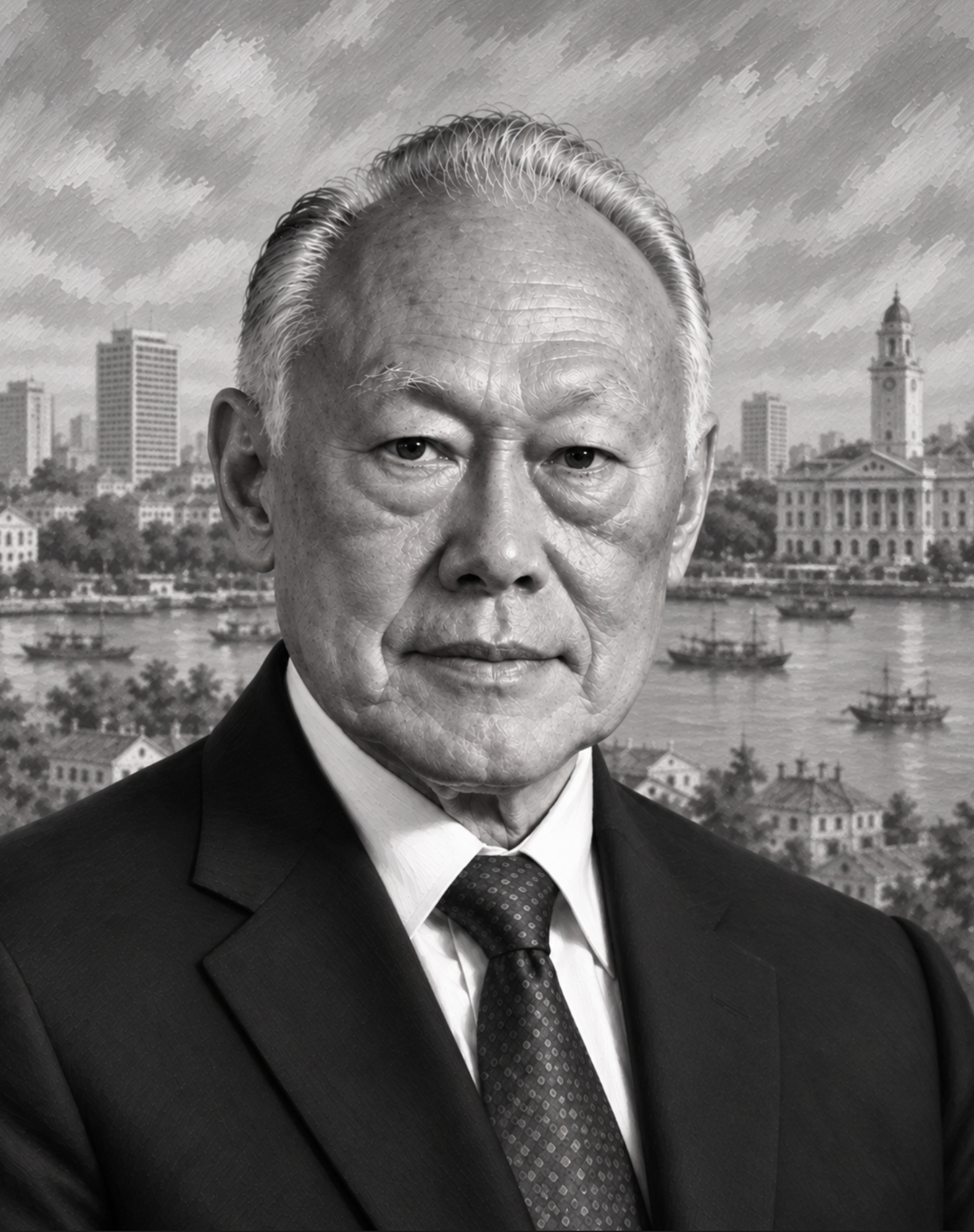
Founding prime minister of Singapore, lawyer, anticolonial leader, and nation-builder. 1923 - 2015
“The acid test is in performance, not promises.”
Lee Kuan Yew was born in Singapore on September 16, 1923, into a prosperous, English-speaking Straits Chinese family—Chinese long settled along the Malay Peninsula and influenced by Malay and British colonial culture. His parents named him Kuan Yew—“light and brightness”—but his grandfather added Harry, evidence of a household accustomed to British rule. Lee grew up speaking English, absorbing British manners, and regarding the colonial order as durable. Nothing in his comfortable childhood suggested he’d devote his life to dismantling that order—or become the principal builder of the nation that followed it.
His mother, Chua Jim Neo, recognized Kuan Yew’s intelligence early and made his education a priority, even when the Depression strained the family’s finances. Her determination taught him that ability mattered only when given the opportunity—and discipline—to develop.
His paternal grandfather, Lee Hoon Leong, represented another influence. Having worked for a shipping company, he admired British efficiency and insisted his grandson learn English. The boy encountered a world of ships and offices, examinations and rules—one that rewarded those able to master them. Lee excelled at school. In the 1940 Senior Cambridge examinations, he placed first among candidates from Singapore and Malaya.
Then the system collapsed.
When Japanese forces captured Singapore in February 1942, British prestige disappeared in seventy days. Lee watched bewildered British soldiers marched away by Asian captors. As he later remembered, the occupation shattered the assumptions beneath colonial society: the British had panicked and fled, and the people they’d governed would never see them the same way again. The experience helped turn an ambitious student into an anticolonial politician.
Lee narrowly escaped a Japanese screening operation associated with Sook Ching, in which thousands of Chinese civilians were killed. He survived through alertness and improvisation. He traded on the black market, manufactured glue, and eventually worked as an English-language specialist in the Japanese propaganda department. These weren’t heroic acts of resistance. They were the accommodations of a young man learning to recognize danger before circumstances eliminated every choice.
The occupation showed him how quickly an established order could collapse—and how brutally another could replace it. Japan’s victory also shattered what Lee called “the legend of white superiority in Asia.” The British were neither invincible nor uniquely qualified to govern Singapore; their authority rested on power, organization, and the belief that they couldn’t be defeated.
Lee emerged with two lasting convictions: no ruling power had a natural right to govern, and public order couldn’t be taken for granted. His experiences of conquest, scarcity, arbitrary arrest, and mass killing would shape his politics for decades. But they also made him less willing to trust the disorder through which free societies sometimes correct themselves.
One person who could meet him as an equal was Kwa Geok Choo. She competed with Lee academically before the war, at times surpassing him. Their courtship continued during the occupation. Lee left for England in 1946, and Kwa followed on a Queen’s Scholarship the next year. They secretly married in Stratford-upon-Avon in December 1947, then married publicly in Singapore in 1950.
At Cambridge, both earned first-class honors in law; Lee achieved a rare double first. Kwa later became a formidable lawyer and co-founded Lee & Lee with her husband and his brother in 1955. She read Lee’s speeches, tested his reasoning, and provided an intellectual partnership largely hidden behind the conventions of political marriage.
Britain completed Lee’s political education. Campaigning for the Labour Party introduced him to democracy at street level. The Malayan Forum, a group of Southeast Asian students committed to ending colonial rule, connected Singapore’s future to the wider movement of Asian independence.
After returning to Singapore in 1950, Lee practiced law, but the courtroom opened his path into politics. Representing trade unions and defending students and activists brought him public attention, especially during a successful postal workers’ strike in 1952. Still, he knew he couldn’t mobilize the Chinese-speaking working-class majority alone. He needed organizers such as Lim Chin Siong and Fong Swee Suan, whose language skills, union networks, and popular authority connected him to a Singapore his English education hadn’t prepared him to lead.
This alliance revealed a pattern that would recur throughout his career. Lee sought out people with abilities he lacked, joined forces with them against a common obstacle, and learned from their knowledge. But when alliances broke down, he could treat former partners as threats to the project he’d set out to complete.
In 1954, Lee co-founded the People’s Action Party (PAP). The coalition joined English-educated democratic socialists with Chinese-speaking labor leaders and left-wing organizers. Lee supplied legal intelligence, strategic calculation, and a voice capable of confronting the British on their own ground.
The PAP won the 1959 election, and Lee became prime minister at thirty-five. His government inherited severe overcrowding, unemployment, labor unrest, poor sanitation, and settlements without adequate services. Nearly seventy percent of the population lived in slums or badly overcrowded conditions. Lee didn’t answer these problems chiefly with speeches about national greatness. He built a government capable of acting on them.
His answer was to create institutions that could turn policy into results. The Housing and Development Board began constructing apartments at scale in 1960. The Economic Development Board, established the next year, drove industrialization and attracted foreign manufacturers. The government strengthened the Corrupt Practices Investigation Bureau, making clean administration central to the new state.
Lee didn’t run these institutions himself. He set priorities, surrounded himself with capable people, and gave them the authority to act. His achievement was a government in which decisions didn’t remain promises—they acquired momentum.
Yet even as these institutions took shape, Lee didn’t believe Singapore could survive as an independent country. The island lacked natural resources, a domestic market, and control of its water supply. He described independence as a political, economic, and geographical absurdity and campaigned for merger with Malaya.
The struggle split the PAP. Lim Chin Siong and much of its left wing departed to form Barisan Sosialis, which became the government’s strongest opposition. In February 1963, Operation Coldstore detained more than one hundred left-wing politicians, trade unionists, and activists without trial. Lee, the British, and the Malayan government defended the arrests as necessary to prevent communist subversion. Critics argue that the operation also destroyed the PAP’s most powerful democratic challenger and cleared the way for long-term one-party dominance.
The communist movement was a real presence in Southeast Asia, and the Cold War setting can’t be dismissed. Neither can the political advantage Lee gained or the years of freedom taken from people who were never tried. The relative weight of security and political calculation remains one of the central disputes in Singaporean history.
Singapore entered Malaysia on September 16, 1963, but the union lasted less than two years. Lee’s insistence on a “Malaysian Malaysia,” in which citizenship wouldn’t be governed by Malay political primacy, brought him into conflict with leaders in Kuala Lumpur. Economic disagreements deepened the breach, while communal tensions contributed to deadly race riots in 1964. On August 9, 1965, Singapore separated from Malaysia.
At the televised press conference announcing the separation, Lee began to cry. Merger had been the strategy on which he’d staked Singapore’s security, economy, and future. He’d built his political career arguing that the island couldn’t stand alone. Now he had to prove himself wrong.
Singapore would need to become a sovereign city-state connected to the world. The objective remained survival, but nearly every means of achieving it had to be reconsidered.
The new country faced basic questions of survival. It depended on Malaysia for much of its water, had only two infantry battalions and no air force, and relied heavily on Britain’s military presence for jobs and economic activity. Singapore joined the United Nations in September 1965, began building its armed forces, and introduced National Service in 1967. Britain announced plans to withdraw its forces, then accelerated the timetable in 1968, adding urgency to the effort.
The country also needed an identity that didn’t reduce citizenship to ancestry. “We are going to be a multi-racial nation in Singapore,” Lee declared at the separation press conference. “We will set an example. This is not a Malay nation; this is not a Chinese nation; this is not an Indian nation. Everyone will have his place.”
Economic policy turned outward. Instead of protecting small domestic industries indefinitely, Singapore invited multinational corporations to manufacture for global markets. English became the principal working language, connecting the island to international commerce while offering a bridge among Chinese, Malay, Indian, and Eurasian communities. Schools emphasized literacy, mathematics, science, and bilingual education. The port was modernized, Jurong became an industrial center, and investments in infrastructure and technical training attracted international business.
Housing served more than the need for shelter. The Home Ownership for the People Scheme began in 1964, and from 1968 Singaporeans could use Central Provident Fund savings to buy apartments. Many tenants became owners with a material stake in the country’s future. In 1989, ethnic quotas were introduced to discourage racial enclaves and promote integration within public housing estates.
Construction on this scale required sweeping land-acquisition powers and the relocation of villages, smallholders, and trades. Families gained sanitation, electricity, and secure housing, but older communities and ways of life were dispersed. Singapore’s transformation showed how public action could expand human possibility while still imposing losses statistics couldn’t capture.
Lee believed laws against corruption meant little unless investigators had authority and senior officials expected punishment. Strict enforcement and a professional civil service made clean administration central to Singapore’s identity. Unlike leaders who asked citizens to sacrifice while their own families accumulated visible fortunes, he cultivated austerity and treated corruption as a threat to national survival.
He also understood the psychological influence of physical surroundings. A neglected city could invite further neglect; one that worked could teach citizens and investors to expect competence. Trees, drainage, clean streets, efficient transport, and eventually a restored Singapore River were instruments of confidence as much as beautification.
In 1977, Lee gave the government ten years to clean a river fouled by sewage, farms, workshops, and commerce. The project required new sewers, environmental enforcement, and the relocation of families and livelihoods. The cleanup was completed in 1987.
By the time Lee stepped down as prime minister in 1990, Singapore was secure, globally connected, overwhelmingly housed, well educated, and far wealthier than it had been at independence. It benefited from its location, established port, commercial culture, compact size, Cold War alliances, and unusually capable founding team. But favorable conditions don’t administer themselves. Lee and his colleagues converted geography into policy, vulnerability into planning, and a diverse population into citizens of a functioning state.
The accomplishments carried political costs. Detention without trial didn’t end with the anticolonial struggle. Newspapers operated under close constraint. Defamation actions imposed heavy consequences on political opponents and foreign publications. Organized labor was incorporated into a cooperative system that supported growth but narrowed independent industrial action. Elections continued, but on terrain strongly favorable to the PAP.
Lee didn’t conceal his impatience with politics as a contest for approval. “I have never been overconcerned or obsessed with opinion polls or popularity polls,” he said. “I think a leader who is, is a weak leader.” Democratic leadership can’t consist solely of following polls. But neither can disagreement always be treated as a distraction from governing.
His paternalism extended into people's private lives. The government attempted to shape family size, language, education, courtesy, cleanliness, and marriage. Lee’s concern in the 1980s that highly educated women were having too few children produced arguments and policies influenced by hereditarian assumptions. Public resistance forced a retreat from some proposals. Government competence didn’t confer wisdom over every intimate decision.
Kwa Geok Choo supplied a quieter counterweight throughout his life. Her importance became especially visible in old age. After strokes left her bedridden and unable to speak, Lee sat beside her and read Shakespeare and news reports. When she died in 2010 after sixty-three years of marriage, the public saw the depth of feeling in a man more often associated with severity. His devotion didn’t erase the harshness of his politics, but it complicated the caricature of a leader interested only in systems and results.
Lee left the cabinet in 2011 and died on March 23, 2015, at ninety-one. Singapore mourned him with an intensity that mingled gratitude, national memory, and respect for the scale of the transformation. His eldest son, Lee Hsien Loong, had become prime minister in 2004, raising continuing questions about political inheritance even as the institutions created by the founding generation had grown larger than any one person or family.
Formed by his mother’s competence, his grandfather’s admiration for British order, a rigorous education in Singapore and Cambridge, the Japanese conquest and occupation, Kwa Geok Choo’s intellectual companionship, the labor movement, and the shock of separation, Lee wouldn’t leave Singapore’s survival to chance. He surrounded himself with capable people, gave them strong institutions, and acted decisively once a course was set.
One of Lee Kuan Yew’s essential virtues was forcefulness: decisive action in service to order. It allowed him to mobilize talent, turn policy into results, and orchestrate Singapore’s rise from vulnerable island to secure, prosperous nation. Yet the same force could narrow dissent, revealing its limit: forcefulness remains a virtue only when the order it creates leaves room for personal freedom.
###
Written October 11, 2026
Resources
Some resources are linked through our affiliate program with Amazon.com. Buying these items is a simple way to support our work while expanding your own knowledge base.
Books by and about Lee Kuan Yew
The Singapore Story: Memoirs of Lee Kuan Yew by Lee Kuan Yew
Lee’s account of his childhood, the Japanese occupation, his entry into politics, the founding of the PAP, merger, and separation. Indispensable as self-portrait, though it should be read alongside independent and critical histories.
From Third World to First: The Singapore Story, 1965–2000 by Lee Kuan Yew
The mature statesman explains the policies, colleagues, international relationships, and strategic calculations behind independent Singapore.
Hard Truths to Keep Singapore Going by Lee Kuan Yew with the Straits Times
Extended late-life interviews reveal Lee’s argumentative style, assumptions about human nature, anxieties about Singapore, and reluctance to soften convictions for approval.
Lee Kuan Yew: The Man and His Ideas by Han Fook Kwang, Warren Fernandez, and Sumiko Tan
A substantial series of interviews organized around Lee’s governing philosophy and personality.
Lee Kuan Yew: The Grand Master’s Insights on China, the United States, and the World by Graham Allison, Robert D. Blackwill, and Ali Wyne
A concise presentation of Lee as geopolitical analyst, particularly useful for understanding how vulnerability shaped his realism.
Lee Kuan Yew: The Beliefs Behind the Man by Michael D. Barr
A critical intellectual biography that examines Lee’s elitism, views of race and heredity, and changing ideological justifications.
Authoritarian Rule of Law: Legislation, Discourse and Legitimacy in Singapore by Jothie Rajah
Not a conventional biography, but a valuable examination of how Singapore joined rigorous legality and administrative competence to constraints on political freedom.
Documentaries & Profiles
Lee Kuan Yew: In His Own Words — CNA
Built from roughly 150 hours of archival footage, this documentary lets Lee’s voice, bearing, confrontations, and evolving public arguments carry much of the story.
Interview with Lee Kuan Yew — U.S. National Archives footage, 1967
A young prime minister discusses Vietnam and Southeast Asian security, revealing the Cold War setting in which Singapore’s governing instincts hardened.
Lectures, Interviews, and Conversations
Singapore’s Lee Kuan Yew on China, the Internet and the Future — Charlie Rose, 2011.
One of Lee’s late interviews, showing the speed, certainty, and geopolitical range of his mind at eighty-seven.
Lee Kuan Yew on the Arab Spring — Charlie Rose, 2011
A compact example of Lee’s skepticism toward political enthusiasm unsupported by institutions, economic capacity, and social order.
Websites
Lee Kuan Yew — Roots.sg. The National Heritage Board’s illustrated introduction to his childhood, wartime experiences, education, marriage, and political career.
In Memoriam: Lee Kuan Yew, 1923–2015. A concise life chronology with archival photographs and particular attention to the Japanese occupation.
National Archives of Singapore. Searchable speeches, oral histories, photographs, audiovisual records, and government documents for readers who want to encounter Lee and early Singapore through primary materials.
Singapore’s Economic History, 1965–2065 — Monetary Authority of Singapore/BIS. A clear account of the vulnerabilities facing the new state and the successive stages of its economic transformation.
“What About Singapore?” — World Bank. An accessible examination of the public-housing system that reshaped both Singapore’s physical landscape and its social contract.
Operation Coldstore: An Annotated Bibliography — New Mandala. A guide to the principal sources and conflicting interpretations of the episode most essential to any critical appraisal of Lee’s political legacy.