
Mark Twain
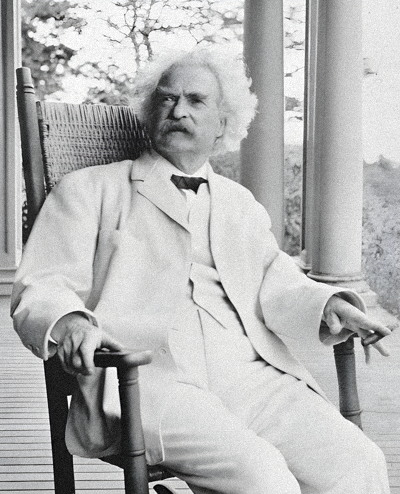
American author, satirist, and humorist, 1835—1910
“Whenever you find yourself on the side of the majority, it is time to pause and reflect.”
Samuel Langhorne Clemens (pen name Mark Twain) was born on November 30, 1835, in Florida, Missouri, and raised in the river town of Hannibal on the Mississippi. He would become the most famous humorist of nineteenth-century American literature and one of the sharpest satirists the United States ever produced. His best-known novels, The Adventures of Tom Sawyer (1876) and Adventures of Huckleberry Finn (1884), draw directly from the people, language, and moral contradictions of the river world that formed him.
Twain’s development began in a household where intellect mattered, even when money did not cooperate. His father, John Marshall Clemens, was a lawyer and judge who struggled financially and died when Sam was still a boy. The loss forced early adulthood on Clemens: he left school and learned the discipline of work the hard way. His mother, Jane Lampton Clemens, was known for warmth, storytelling, and steady practicality. The combination of her humor and his father’s stern realism echoes in Twain’s later voice—comic on the surface, unsparing underneath.
In Hannibal, young Sam absorbed a human comedy no classroom could provide: steamboat crews and drifters, preachers and swindlers, enslaved people and slaveholders, gamblers, merchants, and boys who treated danger as sport. The riverfront was a living theater, and Twain watched it closely. These years also made him fluent in a moral tension America preferred to deny: the same nation that celebrated liberty also normalized slavery. That contradiction would become one of the engines of his greatest work.
Like many writers of his era, Clemens had limited formal schooling, but he gained something more useful by apprenticing in print shops. Typesetting taught him how language looks on a page, how rhythm works, and how words can land like a punchline when placed with precision. He worked as a printer’s apprentice and later as a journeyman printer, moving through newspaper offices where he learned speed, argument, and the art of attracting attention without losing control of the sentence.
In 1853 Clemens left Hannibal with a restless desire to see the world. The river, however, remained the ambition that mattered most. He persuaded a steamboat pilot to teach him the trade, and by 1859 he had earned his license. River piloting was not romance; it was high-stakes mastery of current, depth, weather, and memory. Clemens learned to read the Mississippi as a shifting code. That training shaped his mind: he trusted observation over prestige and could describe a scene with the accuracy of someone used to betting his life on details.
The Civil War (1861) ended commercial river traffic and abruptly ended Clemens’s most treasured profession. He briefly joined a local militia unit, then chose a different path and went west with his older brother Orion Clemens, who had received a government appointment in the Nevada Territory. The move mattered. It placed Clemens in mining camps and boom towns where people reinvented themselves daily. He tried silver and gold mining, failed, and then returned to what he actually knew: writing for newspapers.
In Virginia City, Nevada, Clemens found a rough, competitive press culture that sharpened both his humor and his aggression. In 1863 he began publishing under the name “Mark Twain”—a river term meaning “two fathoms,” safe depth. It was a brilliant mask. It tied him to his river past, sounded like a workingman’s phrase, and fit his growing style: plainspoken, funny, and dangerous when provoked. Two years later he broke nationally with The Celebrated Jumping Frog of Calaveras County (1865), a story whose casual voice is carefully engineered to make the reader underestimate the narrator until it is too late.
Twain became a traveling correspondent and then a traveling celebrity. His letters from Europe and the Holy Land were gathered into The Innocents Abroad (1869), which made him famous by mocking pretension—including his own. Around this time he met Olivia Langdon, the educated and morally serious daughter of a prominent New York family. Their marriage in 1870 mattered as much as any publication. Olivia and her family introduced Twain to a higher social world, but they also anchored him. Her influence did not soften him into politeness; it pushed him toward purpose.
The couple settled in Hartford, Connecticut, during Twain’s most productive and publicly admired years. Hartford gave him stability, friendships, and a professional platform. He moved among writers, editors, and reformers and formed an especially important friendship with William Dean Howells, who became a trusted literary ally. Twain wrote, lectured, traveled, and built a household that tried to be normal even as fame kept breaking in. Between roughly 1873 and 1889 he produced major works including Tom Sawyer, Huckleberry Finn, The Prince and the Pauper (1881), and A Connecticut Yankee in King Arthur’s Court (1889).
Huckleberry Finn remains essential—and contested. Modern readers often recoil at its racial slurs, particularly language Twain recorded from the speech of his time and place. He did not use that language to celebrate racism; he used it to show what racism sounds like when it is normal. The novel’s moral core is Huck’s growing loyalty to Jim, an enslaved man whose humanity overwhelms the “respectable” logic of the society that shaped Huck. Twain’s point is blunt: a culture can be so corrupt that doing the right thing feels like sin.
Twain’s adulthood was not a straight line of success. He was capable of spectacular misjudgment in business and investing, and the later decades of his life were marked by crushing personal losses. Financial ventures collapsed, debts piled up, and he worked relentlessly to recover. Tragedy tightened its grip on the family, and grief changed the tone of his writing. The comic swagger of the early Twain gave way to a darker, more philosophical voice that increasingly doubted human motives and suspected the universe was indifferent.
Yet even in pessimism he kept the gift that made him dangerous: the ability to expose vanity. Twain attacked hypocrisy, moral laziness, and institutions that demanded respect without earning it. He never stopped being funny; he simply stopped believing humor alone could fix what he saw. That evolution—from riverboy to printer, from pilot to journalist, from comic lecturer to bitter moralist—is the arc of his life: a talent shaped by hardship, sharpened by travel, strengthened by friendship and marriage, and tempered by grief.
Mark Twain died on April 21, 1910. He remains a defining American voice—intiate with the nation’s charm, unsentimental about its cruelty, and unusually skilled at making readers laugh while forcing them to notice what they would rather ignore.
###
Profile originally written November 1995 | Profile edited January 2026
Resources
Some resources are linked through our affiliate program with Amazon.com. Purchasing these items is a simple way to support our work while expanding your own knowledge base.
Books
Mark Twain: A Life — Ron Powers
Large-scale biography that follows Clemens through reinvention, fame, family life, and the long slide into darker late-life writing.
Inventing Mark Twain: The Lives of Samuel Langhorne Clemens — Andrew Hoffman
A layered portrait that treats Twain as a man who repeatedly rebuilt his identity while wrestling with personal loss and public expectation.
Adventures of Huckleberry Finn — Mark Twain
Twain’s most influential novel: a river journey that becomes a moral confrontation with slavery, conscience, and social cruelty.
The Adventures of Tom Sawyer — Mark Twain
A classic portrait of boyhood on the Mississippi, built from Twain’s Hannibal memories and sharpened into enduring myth.
Autobiography of Mark Twain — Mark Twain (ed. Charles Neider)
A classic portrait of boyhood on the Mississippi, built from Twain’s Hannibal memories and sharpened into enduring myth.
Documentaries & Films
Biography: Mark Twain (A&E)
Documentary overview using photographs, interviews, and excerpts to trace the public legend and the private man.
Mark Twain and Me (Disney)
A family film that imagines Twain through the eyes of a young admirer and aspiring writer.
The Adventures of Mark Twain (1944)
Classic biographical film (Fredric March) dramatizing key moments and famous lines across Twain’s life.
Videos
Mark Twain (documentary / lecture-style video)
Mark Twain: The Man and His Times (talk / documentary segment)
Mark Twain Bio (biographical overview)
Mark Twain: Humor, Satire, and America (lecture / documentary segment)