
Mahatma Gandhi
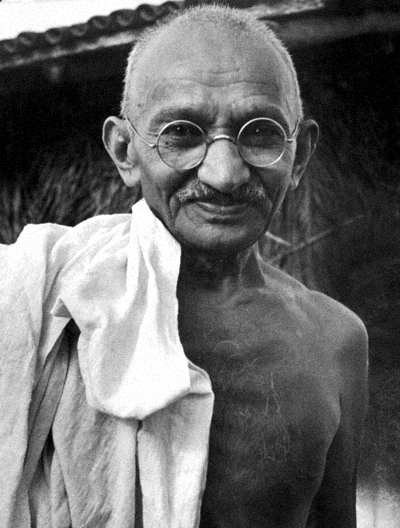
Spiritual-Political Leader and Humanitarian, 1869–1948
“I claim to be no more than an average man with less than average abilities. I have not the shadow of a doubt that any man or woman can achieve what I have, if he or she would make the same effort and cultivate the same hope and faith.”
Mohandas Karamchand Gandhi was born on October 2, 1869, in Porbandar, India. He became one of the most respected spiritual and political leaders of the twentieth century. Gandhi helped free the Indian people from British rule through disciplined nonviolent resistance and is honored by many as the father of the Indian nation. The Indian people called him Mahatma, meaning “Great Soul.”
At age 13, Gandhi married Kasturba, age 12, in a union arranged by their parents. The Gandhis had four sons: Harilal and Manilal (born in India), and Ramdas and Devdas (born in South Africa). Gandhi could be tender and compassionate in public yet severe and demanding at home—a tension worth understanding because it reveals the distance between a public philosophy and the private work of character. His family life, often idealized or ignored, was complex and sometimes painful, reflecting the difficulty of living moral ideals consistently across all domains of life.
Gandhi studied law in London and returned to India in 1891 to practice. In 1893 he accepted a one-year contract to do legal work in South Africa, then under British control. After being abused while attempting to claim his rights as a British subject, he came face to face with the systematic discrimination suffered by Indians. Gandhi remained in South Africa for 21 years, working to secure civil rights for the Indian community. There he developed his method of direct social action rooted in courage, nonviolence, and truth, which he called Satyagraha. He believed that how people behave matters as much as—often more than—what they achieve. Satyagraha promoted nonviolence and civil disobedience as morally legitimate means of pursuing political and social change.
In 1915 Gandhi returned to India. Within 15 years he emerged as the central leader of the Indian nationalist movement. Guided by Satyagraha, he led campaigns for independence from British rule and was arrested many times for his activities in both South Africa and India. He believed it could be honorable to accept imprisonment for a just cause. In total, he spent roughly seven years in prison for political activity. At critical moments, he used fasting as a moral appeal, pressing others to step back from violence when anger and revenge threatened to turn into cruelty.
India gained independence in 1947 and was partitioned into India and Pakistan. The division triggered widespread violence between Hindus and Muslims. Gandhi had argued relentlessly for a united India in which different religions could live together in peace. On January 13, 1948, at the age of 78, he began a fast to stop the bloodshed. After five days, leaders from opposing sides pledged to end the violence, and Gandhi broke his fast. Twelve days later, he was assassinated by a Hindu extremist who opposed Gandhi’s commitment to religious tolerance.
Among the many tributes to Gandhi after his death were these words from Albert Einstein:
“Generations to come will scarce believe that such a one as this walked the earth in flesh and blood.”
###
Profile originally written August 1995 | Revised October 11, 2025
Resources
Some resources are linked through our affiliate program with Amazon.com. Purchasing these items is a simple way to support our work while expanding your own knowledge base.
Books
An Autobiography: The Story of My Experiments With Truth — M.K. Gandhi
Gain greater insight into the life of one of the most influential leaders of the modern era. Great reading. Very moving.
Gandhi on Non-Violence — M.K. Gandhi
Covers the principles of nonviolence, its spiritual dimensions, its political scope, and the demanding standard of purity Gandhi set for nonviolent action.
The Essential Gandhi: His Life, Work, and Ideas — Edited by Louis Fischer
An anthology that makes Gandhi legible: the moral logic, the political method, and the relentless demand that ends never excuse corrupt means.
The Bhagavad Gita According to Gandhi — M.K. Gandhi; edited by John Strohmeier
Gandhi’s Gita text and commentary, presented to disciples at prayer meetings over a nine-month period in 1926.
Films & Documentaries
Gandhi (1982) — Directed by Richard Attenborough
Winner of 9 Academy Awards including Best Picture, Best Director, and Best Actor. Starring Ben Kingsley. A landmark film.
Documentary-style presentation intended to contextualize Gandhi’s spiritual and political legacy.
Videos
The Salt March Explained — Historical context and consequences
Satyagraha & Nonviolent Resistance — Principles and strategy
Websites
GandhiServe — Archive and educational resources
Gandhi Heritage Portal — Major repository of writings, images, and curated materials.
BBC History: India profile — Timeline