
Orville Wright
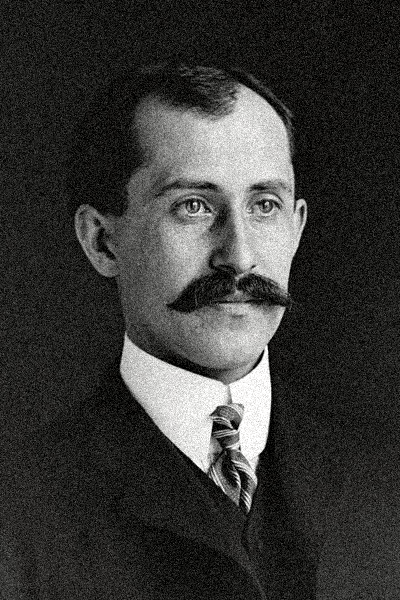
Co‑inventor of the first successful airplane, 1871-1948
“The course of the flight up and down was exceedingly erratic, partly due to the irregularity of the air, and partly to lack of experience in handling this machine.”
— Orville Wright, diary entry on the first flight of the Wright Flyer
Orville Wright was born on August 19, 1871, in Dayton, Ohio, the sixth of seven children of Bishop Milton Wright and Susan Catherine Koerner Wright. The household prized curiosity. Milton brought home books and mechanical toys (including a rubber‑band “helicopter” that fascinated the boys), while Susan—skilled with tools—encouraged tinkering. Orville and his older brother Wilbur grew up building kites, presses, and gadgets, cultivating habits of methodical trial and error that would define their partnership.
Entrepreneurial early on, Orville started a small print shop in his teens, designing and building a press to publish neighborhood papers. In 1892 the brothers opened the Wright Cycle Company in Dayton, selling, repairing, and ultimately manufacturing bicycles. The shop proved to be their laboratory—machining parts taught precision; balancing frames informed stability; and customer service demanded reliability. Profits from bicycles financed their experiments in flight, and the shop’s tools—lathes, drill presses, wind‑powered fixtures—became the hardware of invention.
Their turn to aeronautics intensified in 1899 after the death of glider pioneer Otto Lilienthal. The brothers studied everything available—from Chanute to Langley—before deciding that the chief problem of flight was control, not power. Between 1900 and 1902 at Kitty Hawk, North Carolina, they tested man‑carrying gliders and built a small wind tunnel in Dayton to generate their own airfoil data. From these trials came three linked breakthroughs: wing‑warping for roll control, a movable rudder coordinated with roll, and a forward elevator for pitch—an integrated three‑axis control system that made sustained, piloted flight possible.
By autumn 1903 the brothers had designed a lightweight 12‑horsepower engine and carved efficient propellers—airfoils in rotation—using shop mathematics and intuition. On December 17, 1903, near Kitty Hawk, Orville piloted the first controlled, sustained flight of a powered, heavier‑than‑air machine: 120 feet in 12 seconds. Three more flights followed that day; Wilbur’s fourth covered 852 feet in 59 seconds. What began as careful shop craft had become a new art—piloting.
After Kitty Hawk, the work accelerated. Back in Dayton (1904–05) they refined the Flyer into a practical aircraft capable of turns, circles, and figure‑eights—flights measured in miles rather than yards. Public acceptance lagged until dramatic demonstrations in 1908–09 in France and at Fort Myer, Virginia, convinced skeptics and secured military and international contracts. The brothers formed the Wright Company in 1909 to manufacture airplanes and train pilots. Tragedy and transition soon followed as in 1912 Wilbur died of typhoid fever, leaving Orville the steward of their legacy.
Orville sold his interest in the company in 1915 but continued as an independent inventor and national advisor. He won the Collier Trophy (1913) for an automatic stabilizer, served on the NACA (precursor to NASA), and advocated safety and scientific testing in aviation. He remained a respected elder of the field until his death on January 30, 1948.
The brothers’ bicycle‑shop methods—build, test, measure, iterate—shaped modern engineering culture. Their three‑axis control remains fundamental to every fixed‑wing airplane, and their story recast flight from spectacle to system. From a small Dayton shop to a windswept Carolina dune, Orville and Wilbur transformed human mobility—and the century that followed.
###
Profile originally written August 1995 | Revised: October 11, 2025
Resources
Some resources are linked through our affiliate program with Amazon.com. Buying these items is a simple way to support our work while expanding your own knowledge base.
Books
The Wright Brothers — David McCullough
Accessible, richly documented narrative of the brothers’ lives and methods.
Wilbur and Orville: A Biography of the Wright Brothers — Fred Howard
Classic biography emphasizing the engineering partnership.
The Bishop’s Boys — Tom D. Crouch
Deep dive into family, faith, and the persistence that powered invention.
Documentaries
Kitty Hawk and the Wright Brothers
Documentary accounts of the 1903 flights and subsequent demonstrations.
First Flight (PBS/Smithsonian)
Archival footage and reconstructions that place the Flyer in context.
Videos
How The Wright Brothers Pioneered Flight | Bright Now (National Geographic Education)
First Flight: The Race to Create the World’s First Flying Machine | PBS Documentary
Being the Wright Brothers | American Genius (National Geographic)
Websites
Other Inventors
Other Aviation Pioneers
Amelia Earhart — American aviatrix