
Pablo Picasso
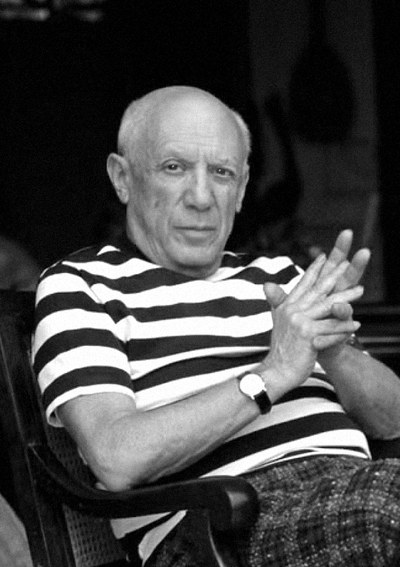
Painter, Sculptor, and Transformative Modernist, 1881–1973
“It takes a long time to become young.”
Pablo Ruiz Picasso was born on October 25, 1881, in Málaga, Spain, into a household where drawing was not a hobby but a way of life. His father, José Ruiz y Blasco, was an art teacher with his own studio. His mother, María Picasso y López, was certain of her son’s greatness. The family moved often—from Málaga to La Coruña and then to Barcelona—as his father pursued teaching posts. These relocations became Picasso’s first lesson in reinvention. Identity, he learned early, was not fixed.
By adolescence, Picasso’s technical skill was formidable. More important was his speed—how quickly he absorbed influence and transformed it. In Barcelona he found artists who valued boldness over polish. In Madrid he studied the old masters. The pull between tradition and rebellion became one of his lifelong engines. He did not simply want to paint well; he wanted to alter the terms of painting itself.
In 1900 he began traveling to Paris, then the center of modern art. Poverty and the suicide of a close friend shaped his Blue Period (1901–1904), when he painted the lonely and dispossessed in cold, mournful tones. In 1904, after settling in Paris and beginning a relationship with Fernande Olivier, the mood shifted. The Rose Period followed, warmer in color and spirit, filled with acrobats and performers whose fragility carried quiet dignity. Love did not make him gentle, but it softened his palette.
In 1907 Picasso broke with traditional representation and introduced a new visual language. Soon after, he and Georges Braque developed Cubism, dissecting form and rebuilding it from multiple viewpoints. Their collaboration was rigorous and relentless. Objects were reduced to planes, space was fractured, and reality was reassembled. By 1912 he began incorporating newspaper and found materials into his work, helping invent collage. The world itself could now enter the canvas.
At the same time, his rivalry with Henri Matisse sharpened his ambition. Matisse pursued harmony through color; Picasso broke form apart. They watched each other closely. The competition was not hostile, but it was catalytic. Together, they propelled modern art forward.
Yet Picasso’s deepest shifts often followed the women in his life. Olga Khokhlova, a Russian ballerina whom he married in 1918, brought a period of relative classicism and restraint. Later relationships—most notably with Marie-Thérèse Walter, Dora Maar, Françoise Gilot, and Jacqueline Roque—produced dramatic transformations in style. Marie-Thérèse inspired luminous, sensual curves. Dora Maar appears in the fractured anguish of the late 1930s. Françoise Gilot brought renewed vitality after the war. Picasso once said that every time he changed women, he changed style. The statement was provocative, even troubling, but not entirely false. For him, love was a creative force—intimate, consuming, and often destructive.
As Europe moved toward war, his art darkened. Guernica (1937), painted after the bombing of a Basque town during the Spanish Civil War, became one of the most powerful anti-war images of the twentieth century—a monumental cry of broken bodies and light. Dora Maar documented its creation, and her presence echoes in its anguish.
After World War II, Picasso continued to experiment. He worked in ceramics and sculpture and revisited earlier masters in bold reinterpretations. Even in old age, he remained restless. His final decades, shared largely with Jacqueline Roque, were prolific and reflective—less about revolution and more about conversation with history.
Picasso died on April 8, 1973, at his home Notre-Dame-de-Vie in Mougins, France. He was buried at his Château of Vauvenargues in southern France. His legacy is complicated. His relationships were often intense and uneven. Yet across painting, sculpture, ceramics, and printmaking, he redrew the boundaries of modern art. He did not merely reflect the twentieth century—he helped invent its visual language.
###
Profile originally written October 1995 | Revised February 2, 2026
Resources
Some resources are linked through our affiliate program with Amazon.com. Buying these items is a simple way to support our work while expanding your own knowledge base.
Books
Conversations With Picasso— Brassaï
A memorable record of Picasso in conversation over decades—sharp, paradoxical, and revealing.
Picasso: A Biography — Patrick O’Brian
Readable, richly written biography that connects the work to the life without drowning in theory.
Matisse and Picasso— Yve-Alain Bois
Serious art history that treats their rivalry as a creative engine that shaped modern painting.
Documentaries & Films
Picasso: The Man and His Work (2 volumes)
Video biography tracing Picasso’s development with extensive coverage of his work across eras.
A rare film that captures Picasso creating art on camera—process as performance.
Videos
Picasso’s Guernica (Smarthistory)
A Smarthistory overview of Guernica explains how Picasso used fractured forms, stark black-and-white imagery, and anguished figures to transform the bombing of the Spanish town into a powerful, universal condemnation of modern warfare.
Picasso’s Les Demoiselles d’Avignon
An analysis of Les Demoiselles d’Avignon exploring how Picasso shattered traditional perspective and idealized beauty, using fragmented forms and African-inspired masks to launch the radical visual language that became Cubism.
Explains how Picasso’s Blue Period used monochromatic blue tones and elongated, melancholic figures to express themes of poverty, isolation, and emotional depth.
Cubism Art Movement by Pablo Picasso explained
This video explains how Picasso and Braque developed Cubism by breaking objects into geometric planes and presenting multiple viewpoints at once, fundamentally reshaping modern art’s understanding of space and representation.
Websites
MoMA’s Pablo Picasso page surveys the artist’s prolific career across painting, sculpture, printmaking, and design, highlighting key works and movements that shaped the development of modern art.
Musée national Picasso-Paris (official site)
The official Musée national Picasso-Paris website presents the museum’s unparalleled collection of Picasso’s works, along with exhibitions, archival materials, and insights into the artist’s life and creative evolution.
Museu Picasso Barcelona (official site)
The official Museu Picasso Barcelona website showcases the museum’s extensive collection emphasizing Picasso’s formative years in Barcelona, along with exhibitions, research resources, and educational programming dedicated to his artistic development.