
Volodymyr Zelenskyy
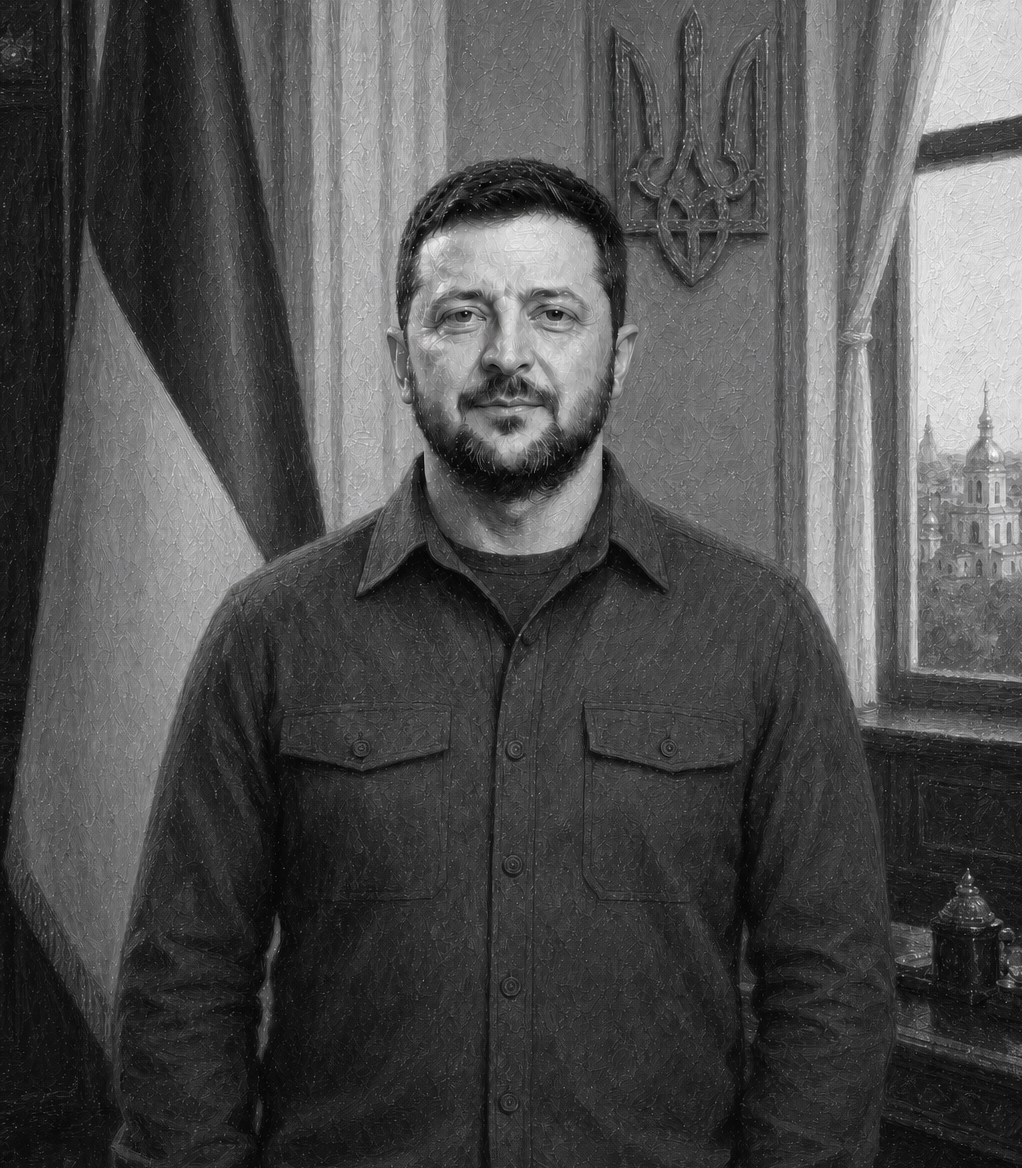
The Man Who Stayed, 1978-Present
“The fight is here; I need ammunition, not a ride.”
Volodymyr Oleksandrovych Zelenskyy was born in Kryvyi Rih (kruh-VEE REEH), Soviet Ukraine, on January 25, 1978. Iron mines cut into the earth around the long industrial city. Blast furnaces burned above neighborhoods coated with red dust, and Russian was heard more often than Ukrainian. After the Soviet Union collapsed, factories struggled, crime rose, and a generation discovered how quickly familiar institutions could lose their authority.
Zelenskyy would become a comedian, actor, writer, producer, businessman, and—against nearly every expectation—the sixth president of Ukraine. After Russia launched its full-scale invasion on February 24, 2022, he became the face of a nation fighting for its existence.
The transformation appeared astonishing. Yet war did not manufacture a new man. It tested qualities formed over decades: competitiveness, loyalty, stubbornness, emotional intelligence, an instinct for communication, and a resistance to being controlled.
The war was the catalyst. The man was already there.
Zelenskyy was the only child of Oleksandr and Rimma Zelenskyy, members of Kryvyi Rih’s educated, Russian-speaking Jewish middle class. The Second World War had devastated his father’s family. Zelenskyy’s paternal grandfather, Semyon, fought in the Red Army, while Semyon’s father and three brothers were murdered in the Holocaust.
Oleksandr became a mathematician and university professor; Rimma was an engineer. He was exacting and principled, while she was warm and protective. Their son grew up striving to meet his father’s demanding standards while developing the charisma to win over a room.
His father provided an example of independence, refusing to join the Communist Party even though membership could have advanced his career. Oleksandr spent years working on a mining project in Mongolia, where his family briefly joined him. Mother and son returned to Kryvyi Rih while he divided his time between Mongolia and Ukraine. Through his father’s example, Volodymyr learned that a person could live within a powerful system without surrendering to it.
As a boy, Volodymyr was bright, sociable, and intensely competitive. He studied piano and ballroom dancing, exercised, wrestled, and showed an aptitude for languages and the humanities. At sixteen he received an opportunity to study in Israel, but his father wouldn’t allow him to go. The decision kept him in Kryvyi Rih and on the path that would bind his future to Ukraine.
After independence in 1991, economic dislocation helped make Kryvyi Rih, by Zelenskyy’s own description, a “city of bandits.” Humor offered both escape and social protection. The physically small young man discovered that timing, nerve, and language could reverse the balance of power in a situation.
His parents wanted a serious profession for him. Zelenskyy studied law at the Kryvyi Rih Economic Institute, graduating in 2000, but never practiced. His real education was taking place onstage.
As a teenager, Zelenskyy entered KVN, the popular Soviet and post-Soviet comedy competition, writing jokes before becoming a performer. In 1997 he helped form Kvartal 95, named for the Kryvyi Rih neighborhood where his friends hung out. Comedy taught him to read audiences, work under pressure, and manage personalities. The troupe reached KVN’s Moscow-based major league, where Zelenskyy was offered an opportunity to continue without his friends. He refused, and in 2003 they left KVN together and founded the independent Studio Kvartal 95.
The decision revealed a pattern. Zelenskyy was ambitious, but his ambition was collective. His power came from trusted collaborators, many of them friends from youth. That loyalty would become both a political strength and a vulnerability while helping a group from an industrial city build one of Ukraine’s most successful studios.
Zelenskyy became its artistic leader, principal performer, writer, and public face. He hosted television programs, won the Ukrainian version of Dancing with the Stars, acted in romantic comedies, and voiced Paddington Bear in Ukrainian. Evening Kvartal satirized corruption, bureaucracy, oligarchs, and politicians across party lines.
Much of his work was performed in Russian and circulated throughout the former Soviet world. This later made him a powerful opponent of Putin. Zelenskyy understood Russian culture from within, yet rejected the claim that speaking Russian made someone politically Russian. His patriotism was civic rather than ethnic: Ukraine belonged equally to all its citizens.
In late 2013, President Viktor Yanukovych abandoned an agreement that would have brought Ukraine closer to the European Union. Protesters gathered in Kyiv’s (KEE-yiv) Independence Square—known as the Maidan (my-DAHN)—and Zelenskyy supported them. After Russia seized Crimea and began the war in the Donbas in 2014, Kvartal 95 ended its Russian business relationships, supported Ukrainian forces with money and equipment, and performed near the front. Support for Ukraine cost the company its largest foreign market.
In 2015, Zelenskyy assumed the television role that connected his two lives. In Servant of the People, he played Vasyl Holoborodko, an honest history teacher whose angry speech against corruption goes viral and propels him into the presidency. Millions associated Zelenskyy with an appealing possibility: the decent outsider who might break a corrupt system.
On New Year’s Eve in 2018, Zelenskyy announced he would run for president. He promised to fight corruption, modernize government, and seek peace in the Donbas without surrendering Ukrainian territory. In April 2019 he defeated incumbent Petro Poroshenko with more than 73 percent of the vote.
His first years in office were uneven. Zelenskyy pursued negotiations and prisoner exchanges, hoping diplomacy might end the war in eastern Ukraine. Some reforms made progress, but his administration also drew criticism. Appointments from his personal circle suggested that the political outsider had simply brought his own insiders. Before Russia’s full-scale invasion, he resisted public warnings from the United States, fearing panic would damage Ukraine’s economy. He had sought peace with a man who treated compromise as weakness.
Then, before dawn on February 24, 2022, missiles struck cities across Ukraine and Russian forces drove toward Kyiv.
Russia expected the government to fracture. Zelenskyy was offered help leaving the capital. Assassination teams reportedly hunted him. If the president were captured or killed, the state could lose its center when it most needed cohesion.
Zelenskyy stayed.
The following evening, he stood outside the presidential offices with his closest officials and recorded a short phone video. “We are all here,” he said. The fact was the message. The president had not fled. The government—and Ukraine—remained.
Everything he had learned converged in that moment. The child of Kryvyi Rih knew how to project toughness without distance. The comedian understood timing and the emotional force of words. The producer knew how to turn a smartphone into a TV studio. As the grandson of a Jewish soldier whose family the Nazis had murdered, Zelenskyy understood the danger of rhetoric that denies a people’s right to exist. As a Russian-speaking Ukrainian, he personified the falsehood of Putin’s claim that Russia had invaded to “denazify” Ukraine and protect people like him.
Performance was (and is) an instrument of Zelenskyy’s wartime leadership. He converted private fear into collective resolve through nightly addresses, visits to cities scarred by atrocities, and travel on the front lines to see the troops. His courage helped Ukrainians subordinate fear to duty.
Zelenskyy didn’t become courageous because the world began to watch. The world began watching because, when history stripped away every lesser role, he remained where he believed he belonged.
The comedian spent his life learning to stand before an audience. In Kyiv, the war asked whether he could stand before Putin and Russia.
He did. He is.
###
Profile written July, 2026.
Resources
Some resources are linked through our affiliate program with Amazon.com. Buying these items is a simple way to support our work while expanding your own knowledge base.
Books
The Showman: Inside the Invasion That Shook the World and Made a Leader of Volodymyr Zelenskyy — by Simon Shuster
The most substantial journalistic portrait of Zelenskyy’s transformation from entertainer and political novice into a wartime president. Shuster draws upon years of access to Zelenskyy, his family, advisers, and presidential headquarters.
A Message from Ukraine— by Volodymyr Zelenskyy
Zelenskyy’s authorized selection of wartime speeches, accompanied by a new introduction. Particularly useful for studying how he shapes his language, historical references, and emotional appeals for different audiences.
Zelensky: Ukraine’s President and His Country— by Steven Derix with Marina Shelkunova; translated by Brent Annable
A concise biography connecting Zelenskyy’s childhood, entertainment career, relationship with Ukraine’s television oligarchs, presidential campaign, and early political record to the country’s post-Soviet history.
Zelensky: A Biography— by Serhii Rudenko; translated by Michael Naydan and Alla Perminova
A Ukrainian journalist’s critical account of Zelenskyy’s rise through entertainment and politics. Best read as a counterweight to more admiring portraits; it emphasizes controversies, associates, and shortcomings in his prewar administration.
The Gates of Europe: A History of Ukraine — by Serhii Plokhy
The best single-volume introduction to Ukrainian history. Plokhy explains how geography, empire, language, religion, and competing historical claims shaped Ukraine’s struggle for political and cultural independence.
Documentaries
Superpower— Directed by Sean Penn and Aaron Kaufman
Begun as a profile of the entertainer who became president, the film changed when its directors found themselves in Kyiv as Russia invaded. Penn’s interviews with Zelenskyy capture the transition as it was happening.
The Zelensky Story — BBC/72 Films
A three-part biography built around extensive interviews with Volodymyr and Olena Zelenskyy, friends, colleagues, and political associates. It follows him from childhood and comedy through the presidency and Russia’s full-scale invasion.
Zelenskyy: The Man Who Took On Putin— Channel 4/PBS
A concise account of Zelenskyy’s childhood, entertainment career, presidential campaign, political record, and emergence as Ukraine’s wartime leader.
20 Days in Mariupol — FRONTLINE and The Associated Press
Ukrainian journalists trapped inside Mariupol document the Russian siege, civilian deaths, mass graves, and the destruction of the city. Academy Award winner for Best Documentary Feature. Contains graphic images.
Websites
Ukrainian Research Institute at Harvard University
Scholarly publications, lectures, archival projects, teaching materials, and research devoted to Ukrainian history, language, literature, politics, and culture.
FRONTLINE’s Ukraine Archive— PBS/GBH
A growing collection of full documentaries, interviews, investigations, and interactive reporting on Russia, Ukraine, war crimes, civilian life, and the course of the invasion.