
Warren Buffett
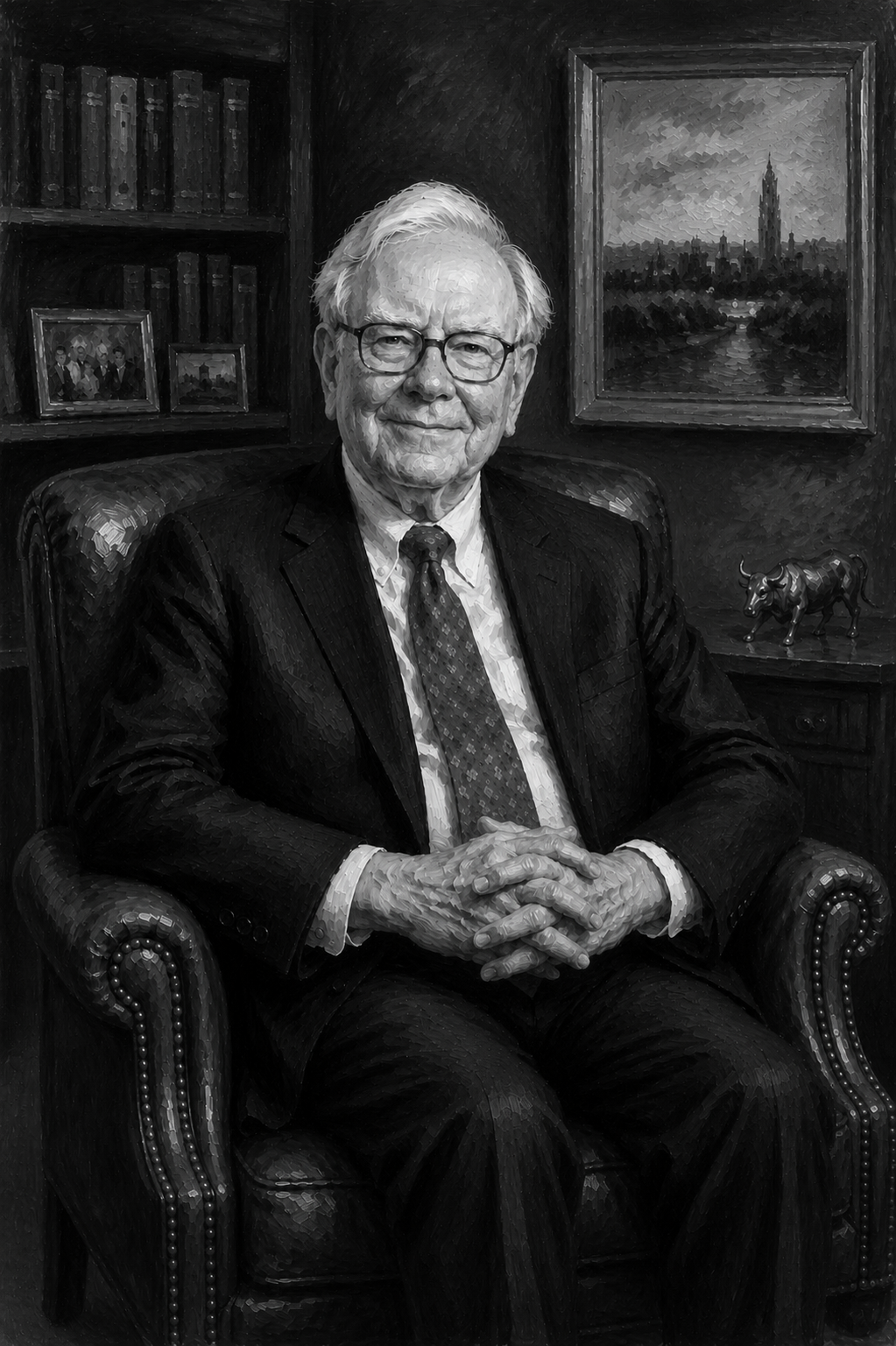
Capital, Character, and Trust, 1930-Present
“We can afford to lose money—even a lot of money. But we can’t afford to lose reputation—even a shred of reputation.”
Warren Edward Buffett was born in Omaha, Nebraska, on August 30, 1930, during the first years of the Great Depression. Banks were failing, businesses were closing, and families who had once considered themselves secure were discovering how quickly prosperity could disappear. Far from the trading floors of New York, money was not an abstraction. It represented security, independence, and the fragile distance between stability and hardship.
Buffett would eventually become one of history’s most successful investors, transforming a struggling New England textile company into Berkshire Hathaway, one of the world’s largest and most respected holding companies. Yet his remarkable career can’t be understood simply by following Berkshire’s growth. It began decades earlier in Depression-era Omaha, where family, circumstance, education, and an insatiable curiosity shaped a boy who viewed business not merely as a way to make money, but as a system to be understood.
Warren was the second of three children and the only son of Howard and Leila Buffett. His father, a stockbroker who later represented Nebraska in Congress, introduced him to financial markets while demonstrating that trust and reputation were among a businessperson’s greatest assets.
Home life offered a different kind of lesson. Warren’s mother could be demanding and emotionally unpredictable, and he often sought refuge in books, numbers, and carefully ordered systems. Mathematics offered a dependability that human behavior sometimes lacked. Although the roots of temperament are never simple, Buffett’s preference for disciplined analysis over emotional reaction would become one of the defining characteristics of his investment philosophy.
Buffett displayed an unusual fascination with numbers almost as soon as he could count. He memorized statistics, calculated probabilities, and searched constantly for patterns. He was equally drawn to commerce. As a boy, he sold chewing gum, Coca-Cola, golf balls, and magazines door to door. During his teenage years, he delivered newspapers, operated pinball machines, and invested his savings in farmland. Each venture reinforced the same lesson: money could be accumulated, invested, and put to work producing more money. He was discovering how capital functioned.
When Howard Buffett was elected to Congress in 1942, the family moved to Washington, D.C. Warren initially struggled to feel at home in the capital. In time, however, he began to recognize the opportunities available in his new surroundings. He built an expanding newspaper-delivery business, and by his teenage years his routes generated more income than many adults earned at full-time jobs. At thirteen he filed his first tax return. At fourteen he used his savings to purchase forty acres of Nebraska farmland. Long before adulthood, Buffett had discovered the difference between working for money and owning assets that could generate income on their own.
Buffett questioned the value of college, but his father insisted that he attend. He enrolled at the Wharton School of the University of Pennsylvania in 1947, later transferring to the University of Nebraska, where he completed his undergraduate degree.
While still a student, Buffett discovered Benjamin Graham’s The Intelligent Investor. Graham argued that a stock represented ownership in a real business, not a lottery ticket whose value changed with every rumor or headline. Investors should determine what a business was truly worth and buy only when the market offered it at a meaningful discount. Graham gave intellectual structure to instincts Buffett had been developing since childhood.
After Harvard Business School rejected his application, Buffett enrolled at Columbia University, where Graham taught. There, he studied the principles of value investing directly under Graham and fellow professor David Dodd. Graham taught Buffett how to evaluate businesses and, more importantly, how to think independently when markets were swept up by emotion. His influence would shape Buffett’s approach to investing for the rest of his life.
After earning his master’s degree, Buffett returned to Omaha, taught investment courses, and confronted his fear of public speaking through a Dale Carnegie program. In 1954, he joined Graham’s investment firm, Graham-Newman Corporation, in New York, where he worked until Graham retired in 1956. Those years convinced Buffett that education was a lifelong discipline. He read constantly, sought out exceptional teachers, and treated mistakes as opportunities to refine his judgment.
Returning to Omaha in 1956, Buffett established a series of investment partnerships built upon Graham’s principles. His early success attracted increasing amounts of capital, but one investment proved especially important—not because it succeeded immediately, but because it forced him to reconsider his entire philosophy.
That investment was Berkshire Hathaway.
Buffett began purchasing shares in Berkshire because the declining textile manufacturer appeared statistically inexpensive. He eventually took control of the company but later acknowledged that doing so had been a mistake. Cheap businesses, he discovered, often remained cheap for good reason. That realization became one of the most valuable lessons of his career.
Another Omaha native helped him complete that evolution. Charlie Munger challenged Buffett to look beyond merely undervalued companies and seek exceptional businesses with durable competitive advantages, capable management, and loyal customers. It was a subtle shift with enormous consequences. Berkshire’s purchase of See’s Candies demonstrated that an outstanding company purchased at a fair price could prove far more rewarding than a mediocre company bought cheaply. That insight reshaped Buffett’s investment philosophy and, ultimately, Berkshire Hathaway itself.
Redirecting Berkshire’s resources away from textiles, Buffett built one of the world’s most successful holding companies through disciplined acquisitions and long-term investments. Berkshire’s insurance operations supplied investment capital in the form of “float”—premiums collected before claims had to be paid. Buffett used that capital to acquire businesses such as GEICO, BNSF Railway, and See’s Candies, while building substantial holdings in companies including Coca-Cola and American Express.
Throughout Berkshire’s growth, Buffett asked remarkably consistent questions: Could he understand the business? Did it possess lasting advantages? Was its management trustworthy? Was the purchase price reasonable?
Behind those decisions stood a remarkably simple daily habit.
Buffett read.
Annual reports, biographies, newspapers, financial statements, history, psychology, and economics all became part of a continuing education that never ended. Buffett believed that knowledge compounded much like invested capital. Individual facts accumulated into judgment. Judgment produced better decisions. Better decisions, repeated over decades, produced extraordinary results.
That same philosophy shaped Buffett’s approach to leadership. His annual letters to Berkshire Hathaway shareholders became required reading for investors around the world because they explained complicated ideas with unusual clarity and candor. Buffett readily acknowledged mistakes, believing that credibility, once lost, was nearly impossible to recover. Over time, Berkshire’s reputation for integrity became one of its greatest competitive advantages.
Although Buffett accumulated immense wealth, he remained in the Omaha home he purchased in 1958 and pledged to give away more than 99 percent of his fortune. His philanthropy reflected a belief that extraordinary success carried extraordinary responsibility—and an awareness that many of the opportunities he received resulted from circumstances beyond his control.
At the end of 2025, Buffett stepped down as Berkshire Hathaway’s chief executive after more than six decades leading the company, while remaining chairman of its board. He left behind not simply an investment record but an enduring philosophy. His career demonstrated that remarkable success need not be built upon speculation, complexity, or constant activity. It could emerge from patience, disciplined thinking, continuous learning, and unwavering integrity.
Buffett’s life is ultimately a story of compounding. Money compounded into capital. Knowledge compounded into judgment. Judgment compounded into opportunity. Character compounded into trust.
And over the course of a lifetime, trust became Warren Buffett’s most valuable asset.
###
Profile written July, 2026.
Resources
Some resources are linked through our affiliate program with Amazon.com. Buying these items is a simple way to support our work while expanding your own knowledge base.
Books
The Snowball: Warren Buffett and the Business of Life— by Alice Schroeder
The most comprehensive biography of Buffett and the best source for his childhood, family relationships, personal development, and business career. Schroeder received extensive access to Buffett, his family, friends, and records, although the resulting portrait is independent rather than officially controlled.
Buffett: The Making of an American Capitalist — by Roger Lowenstein
A highly readable, concise biography. It is an excellent choice for readers who want a serious account without the length and personal detail of The Snowball.
The Warren Buffett Way, 30th Anniversary Edition — by Robert G. Hagstrom
A systematic explanation of the principles behind Buffett’s selection and evaluation of businesses. It is less a biography than a practical examination of his investment method and its evolution.
The Intelligent Investor— by Benjamin Graham
This is not a book about Buffett, but it supplied the intellectual foundation for his early investment philosophy. The revised edition includes commentary connecting Graham’s principles to modern markets.
Documentaries
Warren Buffett Archive— CNBC
The most substantial video resource devoted to Buffett. It contains complete Berkshire annual meetings dating back to 1994, synchronized transcripts, interviews, subject indexes, and hundreds of searchable clips.
Warren Buffett and Bill Gates at Columbia University, 2017
A wide-ranging conversation moderated by Charlie Rose about business, optimism, temperament, philanthropy, immigration, and American economic opportunity. Buffett is particularly reflective and accessible in this setting.
Websites
Berkshire Hathaway Annual Letters
Buffett’s shareholder letters are the clearest primary record of his business thinking, decisions, mistakes, and evolution as an investor and corporate leader.
Warren E. Buffett — 20th-Century American Leaders — Harvard Business School
A concise institutional overview of Buffett’s career and leadership significance. It is most useful as a supplementary biographical source.
Warren Buffett News and Reporting — Associated Press
A curated collection of historical materials and documents related to Adams and the Revolutionary era.
The Giving Pledge is a promise by the world's wealthiest philanthropists to give the majority of their wealth to charitable causes in their lifetime or wills. This site explains Wareen Buffett’s personal pledge to give more than 99 percent of his wealth to philanthropy and the experiences and principles behind that commitment.