
Wolfgang Amadeus Mozart
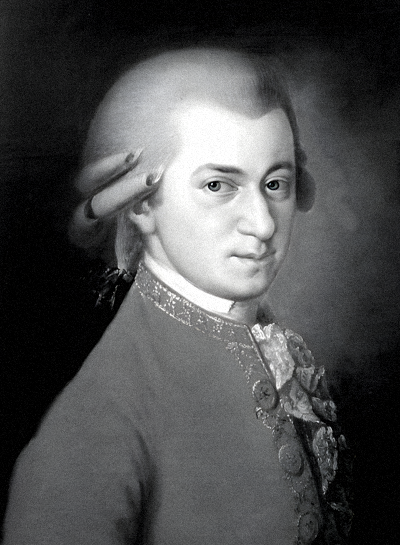
Austrian composer of the Classical era, 1756—1791
“Music is my life and my life is music.”
Wolfgang Amadeus Mozart was born on January 27, 1756, in Salzburg, then a prince-archbishopric within the Holy Roman Empire. Music in his home was not a pastime but a profession. His father, Leopold Mozart, was a respected musician and teacher who understood court life and how musical careers were built. His mother, Anna Maria, managed the household that allowed Leopold’s ambitions to function.
Mozart’s earliest and most important influence was the system of training Leopold created for him. Leopold taught technique, but he also taught standards—clarity, balance, and control. Mozart also grew up beside his older sister Maria Anna (“Nannerl”), an accomplished performer in her own right. Hearing excellence every day made high achievement feel normal rather than exceptional.
Fame came early and it mattered. As a child Mozart spent years traveling across Europe, performing in the salons and courts that shaped musical taste—Munich, Vienna, Paris, London, The Hague, and major Italian cities. These tours were not just performances; they were a working education. Mozart learned how different cultures listened and what each valued. He also learned the realities of patronage: admiration did not equal independence.
In London, Mozart encountered the music of Johann Christian Bach (youngest son of Johann Sebastian Bach), whose elegant, vocal style deeply influenced his melodic writing. In Italy, opera became a living language rather than an academic exercise. These experiences pushed Mozart beyond the category of prodigy. He developed a flexible musical vocabulary and the ability to write convincingly for church, stage, or private performance—without losing his own voice.
Back in Salzburg, the atmosphere narrowed. Mozart worked within the archbishop’s court system, which provided stability but little freedom. The discipline sharpened his craft, but the limits frustrated him. By his early twenties, he had mastered the system well enough to see its ceiling. If he was going to grow, he needed a larger and less restrictive stage.
In 1781 Mozart broke with the Salzburg court and moved to Vienna, the center of imperial musical life. It was a risky decision, but it matched his temperament. He supported himself by teaching, performing, publishing, and composing on commission. In 1782 he married Constanze Weber. Vienna gave him what he wanted: skilled musicians, serious orchestras, demanding audiences, and an opera culture that rewarded intelligence and drama.
Mozart’s mature work reflects the pressures and advantages of his youth: strict training, constant travel, and exposure to elite taste. His music often sounds effortless because the structure beneath it is exact. He wrote in nearly every major form—operas such as Le nozze di Figaro, Don Giovanni, and Die Zauberflöte; symphonies culminating in the trilogy of 1788; concertos that treat the soloist as both speaker and character; and chamber works of unusual intimacy.
Mozart died in Vienna on December 5, 1791, at the age of 35. More than 600 works survive. But his lasting achievement is not just quantity. His early life prepared him to unite discipline and expression—to write music that satisfies the intellect while speaking directly to human feeling: comedy, desire, pride, tenderness, and loss.
Mozart’s death did not prompt the kind of public response his posthumous reputation would inspire. Vienna recognized his talent, but he died during a busy season, without a court position or powerful patron to organize a grand response. His funeral followed the standard middle-class custom of the time: a simple service and burial in a communal grave. There were no mass crowds or state honors. Yet among musicians and informed listeners, the loss was quickly felt. Performances of his works increased, benefit concerts were organized for his widow, and within a few years his music was spoken of with a reverence that exceeded anything he experienced in life. His reputation grew faster than his finances ever had.
Later generations often associate Mozart with a dramatic rivalry against Antonio Salieri, popularized by the play and film Amadeus. In reality, the relationship was far less dramatic. Salieri was a respected court composer, and while professional competition existed, there is no evidence of personal enmity or sabotage. The story endures because it captures a deeper truth—not about Mozart’s life, but about how genius can unsettle those who recognize it but cannot match it.
###
Profile originally written January 1996 | Revised January 2026
Resources
Some resources are linked through our affiliate program with Amazon.com. Purchasing these items is a simple way to support our work while expanding your own knowledge base.
Books
Mozart: A Life — Maynard Solomon
Influential biography balancing narrative with psychological and cultural context.
The Compleat Mozart — Neal Zaslaw and William Cowdery
Practical guide to Mozart’s works with clear explanations and rich context.
Mozart's Women: His Family, His Friends, His Music — Jane Glover
Acclaimed conductor and Mozart expert, Jane Glover, brings the composer's remarkable ladies vividly to life.
Mozart’s Letters, Mozart’s Life: Selected Letters — trans. Robert Spaethling
Letters that show Mozart’s working mind, relationships, and daily pressures.
Documentaries & Films
Brilliant filmmaking and music, but heavily dramatized; use it as a story, not a biography.
Mozart documentaries (BBC, PBS, and major orchestras) (1997)
Search point for reputable long-form programs and concert films.
Videos
Mozart: What Shaped the Life of the Prodigy? | Classical Destinations
Queen of the Night Aria (Mozart, The Magic Flute) (performance excerpt)