
Yuval Noah Harari
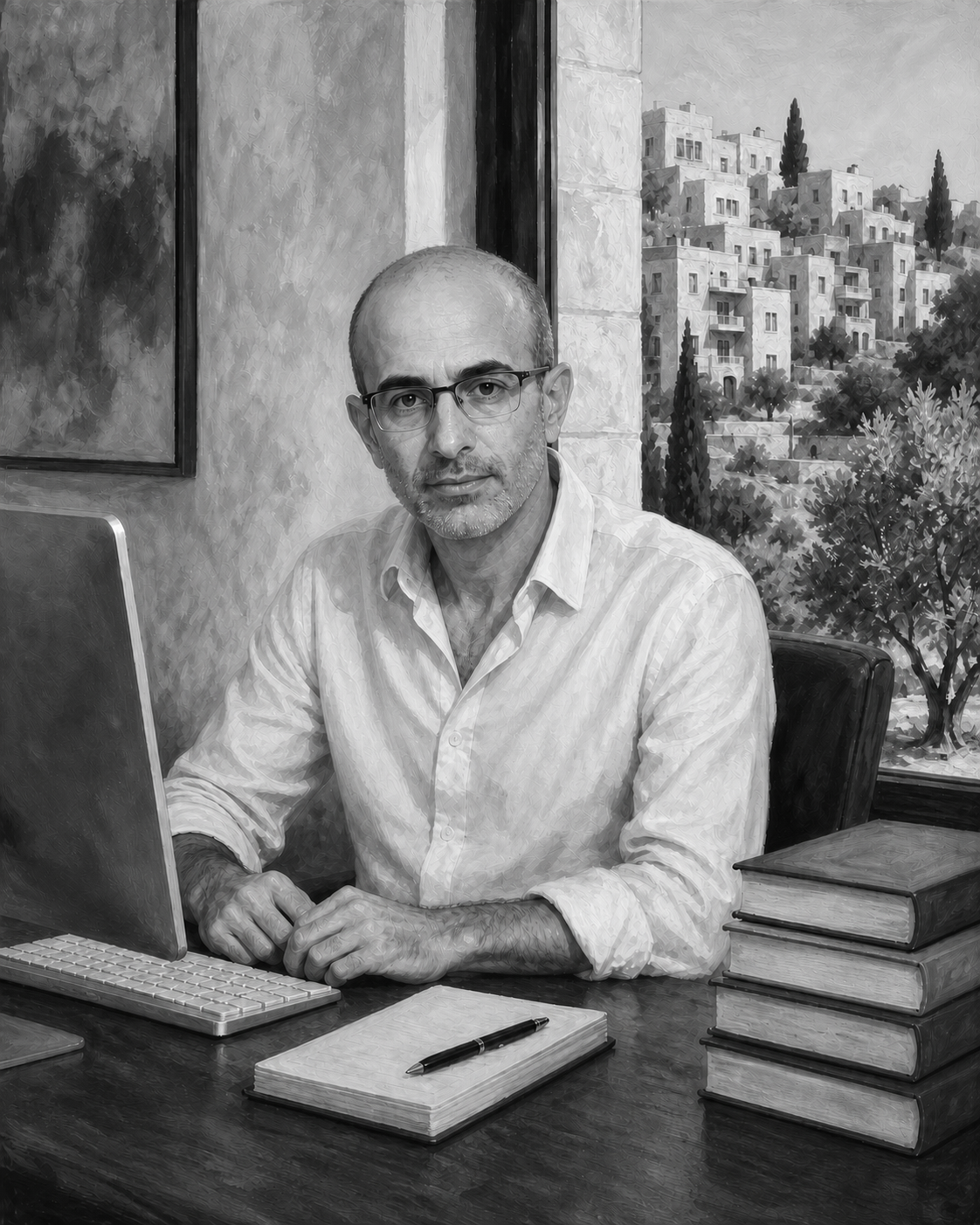
Historian, Author, Philosopher, and Interpreter of the Intelligence Age. Born: 1976
“The willingness to admit ignorance has made modern science more dynamic, supple and inquisitive than any previous tradition of knowledge.”
Yuval Noah Harari was born in Kiryat Ata, an industrial town near Haifa, Israel, on February 24, 1976. He would become a medieval historian, global bestselling author, and one of the most recognizable interpreters of humanity’s encounter with artificial intelligence.
Israel wasn’t yet thirty years old when Harari was born. Its society was shaped by the Holocaust, migration, repeated wars with neighboring states, and the continuing conflict with the Palestinians. He grew up in a secular Jewish family beside the industries of Haifa Bay, where factories represented both technological progress and its environmental costs.
Recognized early as unusually intelligent, he attended a program for gifted pupils. The program emphasized mathematics and science, but Harari was drawn to history. He wanted to understand why human beings created systems, believed in them, and sometimes died for them.
Harari has described himself as “a serious and unhappy child,” more comfortable observing the world than entering into it. He could understand difficult subjects without understanding himself. That outsider’s perspective encouraged a habit that later defined his work: stepping outside accepted explanations to see how the parts really fit together.
Harari grew up during the Lebanon War, the First Intifada, the collapse of the Soviet Union, and the rise and failure of the Oslo peace process. Nations, borders, and political orders could appear permanent, then change suddenly when the beliefs supporting them lost their authority.
He also grew up gay in a conservative environment. Harari didn’t come out until he was twenty-one. The experience taught him that society’s accepted categories could conflict with lived reality. Intelligence wasn’t merely absorbing the answers a culture supplied. It also meant recognizing when the answers were inadequate.
At seventeen, Harari began studying history at the Hebrew University of Jerusalem. He specialized in medieval and military history before continuing his education at Oxford University.
His doctoral research examined how Renaissance soldiers transformed the chaos of war—shaped by institutions, strategy, culture, and fear—into stories about honor, courage, and identity. They shaped how later generations understood war.
Academic training taught Harari to work carefully with evidence, but it also revealed the limits of specialization. Scholars were often rewarded for answering increasingly narrow questions. Harari wanted to ask questions no single discipline could contain.
Why had Homo sapiens become dominant? Had increasing knowledge made people happier? What happened when intelligence produced more power than wisdom could govern? Answering these questions required intellectual range and the humility to acknowledge ignorance.
At Oxford, a friend persuaded Harari to attend a ten-day Vipassana meditation retreat. Silently observing his breath, sensations, and thoughts taught him that intellectual understanding was not self-awareness. Meditation became central to his life, sharpening his concentration while grounding his thinking.
After returning to the Hebrew University, Harari continued publishing military history. His direction changed when he was asked to teach an introductory course in world history.
His challenge was to tell the human story across thousands of years, identify relationships crossing historical periods and academic disciplines. He came to see history as an evolving system of biology, imagination, cooperation, knowledge, and power.
The human capacity for language made shared stories possible. Shared stories enabled strangers to cooperate. Cooperation produced institutions, and institutions accumulated knowledge and power.
Humanity hadn’t conquered the planet through individual intelligence alone. Humans prevailed by connecting many minds through shared stories. Nations, religions, laws, corporations, and currencies existed through collective belief.
Harari’s lectures for this class became Sapiens: A Brief History of Humankind. Published in Hebrew in 2011 and later translated for an international audience, the book made him one of the world’s most widely read historians.
Sapiens was the result of everything that formed him: the outsider’s distance, the historian’s respect for evidence, the soldier’s construction of memory, the meditator’s suspicion of mental stories, and the teacher’s need to connect many fields within one intelligible account.
Its success carried Harari beyond academia to readers, political leaders, and technology executives around the world. His work also became a collective enterprise with his husband and manager, Itzik Yahav, with whom he founded the research and education organization Sapienship.
As Harari’s audience expanded, his central question changed. Having examined how humanity acquired power, he began asking what it would do with that power. Biotechnology and computing were giving humans abilities earlier societies could scarcely imagine, yet humanity’s capacity to alter the world had advanced more quickly than its understanding. Intelligence, he concluded, could make humanity powerful; but it would take wisdom to decide what that power was for.
Homo Deusmarked this turn. Humanity’s connected intelligence had produced extraordinary power, but not corresponding wisdom.
Harari distinguished intelligence—the ability to solve problems and attain goals—from consciousness, the capacity to feel. Machines might surpass humans at particular tasks without experiencing the consequences, showing that intelligence was neither inherently wise nor compassionate. Its value depended upon the goals, institutions, and people it served.
Harari observed that an algorithm might have recognized he was gay before he understood it himself. Such knowledge could help a confused young person, but in the hands of a company or government, it could become an instrument of manipulation and control.
His own development had depended upon discovering that society’s explanations didn’t fit his experience. An algorithmic system might identify that difference more quickly, but it could also use the knowledge before the individual understood or consented to it.
Harari brought these concerns into the present with 21 Lessons for the 21st Century. Automation, surveillance, nationalism, climate change, and misinformation appeared to be different problems, yet each crossed political and institutional boundaries. None could be understood or solved in isolation.
The danger of artificial intelligence did not require an all-knowing machine. A system needed only to understand people well enough to anticipate their choices and influence what they saw. Those choices would produce more data, improving the system’s ability to influence them again.
Control could develop through a feedback loop rather than arrive through force.
The COVID-19 pandemic demonstrated the power and limits of connected intelligence. Global cooperation produced vaccines, while mistrust and political division showed that information alone could not ensure wise action.
Harari’s sweeping conclusions have attracted criticism. Scholars have argued that he sometimes turns disputed evidence into confident generalizations and makes history appear smoother than it was.
Looking across disciplines can reveal relationships that specialization obscures. It can also tempt a thinker into mistaking a model for reality; or overlooking what doesn’t fit into the expected pattern. An explanation is useful when it clarifies reality while remaining open to evidence and revision. Intelligence grows by recognizing the boundaries of what it understands.
The emergence of generative artificial intelligence gave Harari’s lifelong questions new urgency. Machines could now produce language, images, code, and persuasive conversation. Intelligence was beginning to operate through systems capable of generating stories themselves.
With Nexus, Harari returned to the relationship between information and truth—a question present since his study of soldiers’ memoirs.
More information did not necessarily produce greater understanding. Networks often succeeded because they created order, not because they represented reality accurately. A highly intelligent system could solve the wrong problem, while a powerful network could spread falsehood more efficiently than truth.
The progression of Harari’s thought had come full circle.
As a young historian, he examined how individuals created stories from experience. As a global historian, he explored how shared stories connected people and built civilizations. As an interpreter of technology, he confronted machines that could create and distribute stories without consciousness.
This development allows Harari to speak with authority about the human meaning of artificial intelligence. His authority does not come from engineering computer systems. It comes from decades spent studying how information becomes narrative, how narratives organize cooperation, how cooperation builds institutions, and how institutions use intelligence to acquire power.
The same approach followed him back into Israeli public life. Political conflict challenged him to hold several realities at once: Israeli fear, Palestinian suffering, the danger of fanaticism, and the need for a future neither people could create alone.
History could expose the constructed nature of national stories, but it could not erase attachment, trauma, or responsibility. Intelligence required seeing the relationships without reducing the people within them to abstractions.
Harari’s intelligence began as the private ability of a quiet, observant child. History disciplined it. His experience as an outsider taught it to question accepted categories. Meditation turned it inward. World history expanded its scale. Technology forced it to confront intelligence separated from consciousness.
What emerged was Harari’s distinctive way of thinking: moving among disciplines and levels of experience, connecting stories to institutions and power, and remaining alert to what every explanation leaves out.
Intelligence, in this sense, isn’t simply knowing more or solving problems faster. It is recognizing relationships, questioning assumptions, anticipating consequences, and understanding the limits of one’s own knowledge.
Harari’s intelligence carries him outward—from Renaissance battlefields to the forces shaping civilization and the future of artificial minds. Meditation carried him inward, toward consciousness and the stories of the self.
His work stands where those movements meet: between the larger systems and the person living within them.
Humanity became powerful by connecting minds through stories, tools, and institutions. It is now creating systems capable of extending that intelligence beyond the human mind.
Whether those systems enlarge or diminish humanity will depend upon qualities intelligence doesn’t guarantee; the humility to recognize what we don’t know, the wisdom to choose meaningful goals, and the consciousness to care about the results.
###
Written August 29, 2026
Resources
Some resources are linked through our affiliate program with Amazon.com. Buying these items is a simple way to support our work while expanding your own knowledge base.
Books by Yuval Noah Harari
Sapiens: A Brief History of Humankind — by Yuval Noah Harari
Harari’s sweeping account of how imagination, cooperation, institutions, and technology enabled Homo sapiens to dominate the planet.
Homo Deus: A Brief History of Tomorrow— by Yuval Noah Harari
Extends the questions raised in Sapiens into a future shaped by artificial intelligence, biotechnology, and humanity’s pursuit of greater power.
21 Lessons for the 21st Century — by Yuval Noah Harari
Examines the political, technological, and existential challenges confronting humanity in the present.
Nexus: A Brief History of Information Networks from the Stone Age to AI — by Yuval Noah Harari
Traces how stories, documents, bureaucracies, mass media, and computer networks have organized societies—and how AI may transform those networks.
Sapiens: A Graphic History — by Yuval Noah Harari, David Vandermeulen, and Daniel Casanave
An imaginative visual adaptation that makes the central arguments of Sapiens accessible to a wider audience.
Documentaries & Profiles
The Book of My Life—with Yuval Noah Harari
A reflective documentary in which Harari discusses the books, experiences, and questions that shaped his intellectual life.
Humans, Gods and Technology — VPRO Documentary
Harari and technology writer Kevin Kelly consider humanity’s changing relationship with machines, intelligence, and power.
Yuval Noah Harari — The 2021 60 Minutes with Anderson Cooper — CBS News
A concise profile covering Harari’s life, meditation practice, global influence, and concerns about technology.
Why the World Isn’t Fair — GZERO World with Ian Bremmer — PBS
Harari discusses the historical origins of inequality and the stories societies use to explain and preserve it.
Lectures, Interviews, and Conversations
Why Humans Run the World — Yuval Noah Harari, TED
A succinct introduction to Harari’s argument that humans became dominant through flexible cooperation based on shared stories.
Homo Deus: A Brief History of Tomorrow — University of CA Television
A public lecture exploring the future of human ambition, artificial intelligence, and biological engineering.
AI and the Future of Humanity — Frontiers Forum
Harari explains why artificial intelligence is not merely another human tool but a potentially independent participant in culture and history.
What Does the AI Revolution Mean for Our Future?
Yuval Noah Harari and Mustafa Suleyman, moderated by Zanny Minton Beddoes. A substantial debate between Harari and the cofounder of DeepMind about AI’s agency, benefits, risks, and possible containment.
Guardrails Needed for Safe and Responsible AI
Yuval Noah Harari and Nicholas Thompson, AI for Good. A discussion of the social consequences of AI and the safeguards needed to keep its development accountable to human interests.
Interview with Yuval Harari — Pariyatti
Harari discusses his spiritual development and the role Vipassana meditation plays in his work as a historian and public intellectual.
Websites
Yuval Noah Harari—Official Website
Books, articles, interviews, videos, public appearances, and biographical information.
Yuval Noah Harari’s History of Everyone, Ever — Ian Parker, The New Yorker
An extensive profile of Harari’s development from military historian and university lecturer into an internationally influential author.
Uncovering Realities: An Interview with Yuval Noah Harari — Pariyatti
An accessible overview of his life and continuing work, including the international practice centers and programs carrying his teachings forward.
The Dangerous Quest for Identity — TIME
Harari reflects on the limitations of tribal identity and the deeper biological and cultural inheritance shared by humanity.