
Clara Barton
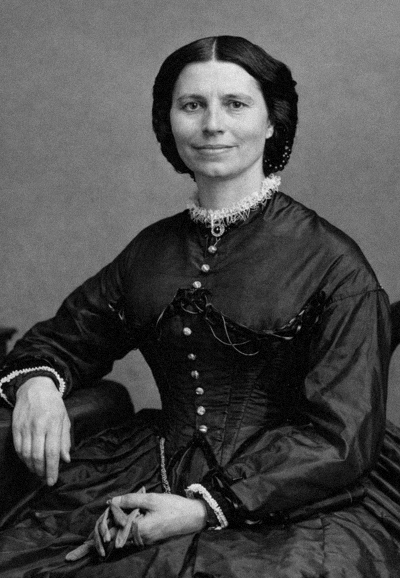
Humanitarian and Founder of the American Red Cross, 1821-1912
“It irritates me to be told how things always have been done … I defy the tyranny of precedent. I cannot afford the luxury of a closed mind. I go for anything new that might improve the past.”
Clarissa Harlowe Barton was born on December 25, 1821, in North Oxford, Massachusetts. She was the youngest of five children in a strongly patriotic and story-filled home. Her father, Stephen Barton, was a veteran of the French and Indian War. He often told stories about military service and civic duty. Those stories gave Clara an early belief that public service was both practical and honorable. Her mother, Sarah Barton, was known for her toughness and direct judgment. Clara’s older siblings were nearly grown when she was young. They protected her but expected her to mature quickly. This mix of care and high expectations shaped her character. She could be shy in daily life but calm and steady in moments of crisis.
As a child, Clara preferred animals and books to social gatherings. She struggled with deep shyness. Yet her sensitivity made her attentive to suffering. She cared for injured pets and showed early signs of discipline. At age eleven, her brother David was seriously injured in a fall. Clara helped nurse him through a long recovery. She measured medicine, kept watch, and followed careful routines. During this time, she learned that steady attention—not emotion—keeps people alive when things go wrong.
Clara became a teacher while still young. She wanted work that was useful and morally meaningful. Teaching forced her to overcome her timidity. In the classroom she learned to speak with authority, manage disorder, and defend overlooked children. In the 1850s she expanded her work into larger public education efforts. She developed a reputation for creating order from chaos. That skill would later define her wartime work. After moving to Washington, D.C., she took a position at the U.S. Patent Office. She became one of the first women employed there as a clerk. The job offered income and independence. It also exposed her to political favoritism, sexism, and institutional resistance. She learned that systems often reject competence when it appears in unfamiliar form.
When the American Civil War began, Barton started by gathering and delivering supplies to soldiers. She collected bandages, food, and clothing. Soon she insisted on going closer to the front lines. She had no formal nursing degree. Her strength was organization and persistence. She could coordinate people and supplies under pressure. She continued showing up when others stepped back. On battlefields and in field hospitals, she delivered medical materials and practical aid. She stayed with the wounded until they could be transported. Her composure under fire earned her the nickname “Angel of the Battlefield.”
After the war, Barton turned to another form of suffering: uncertainty. Families across the country searched for missing loved ones. In 1865 she created an information office in Washington to help locate lost soldiers. She answered letters and pressed the government to improve identification of the dead. The work required careful record keeping—names, regiments, burial sites. Grief cannot settle without facts. Her efforts led to the identification and marking of many unknown graves. She gave families what war had taken: confirmation.
In 1870 Barton traveled to Europe. There she encountered the growing international humanitarian movement. She volunteered with the International Red Cross during the Franco-Prussian War. She saw a new model of relief: prepare in advance, organize networks, establish rules before crisis strikes. Returning to the United States, she argued for an American Red Cross based on the Geneva Convention principles. In 1881 she helped found the American Red Cross and became its leading public voice. She promoted a clear standard: aid should not depend on politics.
Over the next twenty years, Barton led relief efforts not only in wartime but during floods, fires, hurricanes, and epidemics. She believed humanitarian work should extend beyond battlefields. Her leadership style was direct. She went to the site, evaluated needs, and mobilized resources. The public trusted her. However, as the organization grew, tensions increased. Larger institutions prefer procedures and committees. Barton operated through personal drive and decisive action. In 1904, at age eighty-two, she resigned amid internal conflicts. It was a familiar pattern: founders build with force of will; later leaders build systems.
Clara Barton spent her final years in Glen Echo, Maryland, near Washington, D.C. She died there on April 12, 1912, at age ninety. She was buried in Oxford, Massachusetts. Clara Barton remains important in American civic history not because she was flawless or universally praised, but because she proved a practical principle: when disaster strikes, sympathy is not enough. You organize. You act.
###
Profile originally written December 1995 | Revised February 25, 2026
Resources
Some resources are linked through our affiliate program with Amazon.com. Buying these items is a simple way to support our work while expanding your own knowledge base.
Books
A Woman of Valor: Clara Barton and the Civil War — Stephen B. Oates
Detailed narrative of Barton’s Civil War work and the logistical courage required to operate close to battle.
Clara Barton, Founder of the American Red Cross — Augusta Stevenson (Illustrations by Frank Giacoia)
A classic, accessible biography written for younger readers but still valuable as an introduction.
Videos
Clara Barton: The Beginnings of the American Red Cross
A concise historical overview produced by the American Red Cross tracing Clara Barton’s Civil War service and the founding vision that led to the creation of the American Red Cross.
The Clara Barton Story Part 1, School Teacher, 1839
Storyteller Tim Lowry brings Clara Barton’s early life to life, focusing on her formative years as a young schoolteacher and the character traits that shaped her future humanitarian work.
The Clara Barton Story Part 2, Angel of the Battlefield
Lowry recounts Barton’s Civil War service, highlighting her frontline relief efforts and the courage that earned her the title “Angel of the Battlefield.”
Websites
Library of Congress: Clara Barton Papers
The Library of Congress Clara Barton Papers collection provides digitized letters, diaries, and organizational records documenting Barton’s Civil War service and leadership of the American Red Cross.
American Red Cross: History of Clara Barton
The American Red Cross history page outlines Clara Barton’s Civil War relief work and her founding leadership in establishing the American Red Cross in 1881.
Clara Barton Birthplace Museum
The Clara Barton Birthplace Museum website highlights the restored North Oxford home where she was born and offers historical exhibits on her early life and humanitarian legacy.
Clara Barton National Historic Site (NPS)
The National Park Service site for the Clara Barton National Historic Site provides historical background, virtual resources, and visitor information for her former Glen Echo home and Red Cross headquarters.