
Ludwig van Beethoven
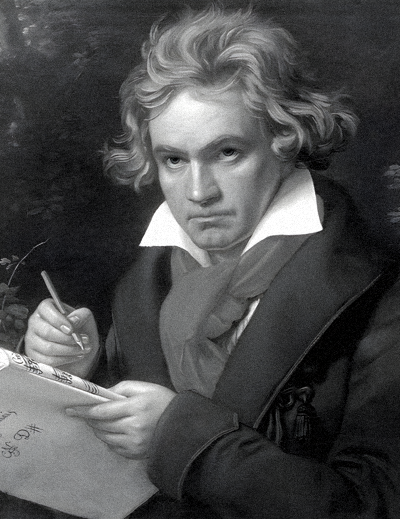
Composer, 1770–1827
“Music is a higher revelation than all wisdom and philosophy”
Ludwig van Beethoven was born on December 17, 1770, in Bonn, in the Rhineland of Germany. Music was a family trade: his grandfather, also named Ludwig, served as a respected court musician, and his father, Johann, sang in the electoral court chapel. That heritage mattered—but so did the household tension. Beethoven’s father pushed his son hard, hoping to produce a prodigy in the Mozart mold. In the middle of that pressure stood Beethoven’s mother, Maria Magdalena, remembered by him as his steady emotional anchor. The early mixture of discipline, instability, and longing for approval helped form the stubborn, self-reliant personality that later shaped both his life and his art.
Beethoven’s gifts became undeniable early, and he absorbed Bonn’s musical life with unusual intensity. A crucial influence was Christian Gottlob Neefe, court organist and composer, who took him seriously as a developing musician rather than merely a performing curiosity. Neefe helped Beethoven find a path as an organist, introduced him to the wider intellectual world, and supported his first publications. Equally important, Beethoven grew up in a city where Enlightenment ideas circulated alongside church and court traditions, and he learned to think of music not only as entertainment but as moral and human expression.
In the early 1790s Beethoven moved to Vienna (1792)—then Europe’s musical capital—to study, perform, and find patrons. He met and worked in the orbit of leading figures of the era, including Joseph Haydn, and quickly earned a reputation as a formidable improviser at the keyboard. Viennese aristocratic patronage mattered enormously: in salons and private concerts, Beethoven found both a platform and a testing ground. Friendships and alliances with supporters gave him space to compose on a scale that would have been impossible without backing. He also cultivated a fierce sense of artistic independence, resisting the role of servant-composer and insisting on being treated as a creative equal.
Beethoven’s dynamic musical style infused his compositions with confidence and struggle: dissonance resolves into clarity; turmoil breaks into triumph. But the drama was not only musical. In his late twenties he began to lose his hearing. The crisis was existential. In 1802, while staying in the village of Heiligenstadt, he wrote the famous Heiligenstadt Testament, a document that reveals despair, shame, and an equally fierce decision to live for his work. Deafness forced him to withdraw socially and intensified the sense of isolation that friends and admirers often mistook for mere rudeness. Yet the response was not surrender. Beethoven turned inward and outward at once: inward to his imagination, outward to a larger public idea of what music could do.
That transformation is audible in the so-called “heroic” period. Beethoven expanded the scale of the symphony, sharpened rhythmic force, and treated musical form as a field of conflict and resolution. He lived amid the political shocks of the age—revolution, empire, reaction—and wrestled with the moral question of heroism itself. (The story of admiration and disillusionment around Napoleon is a window into Beethoven’s temperament: he wanted greatness to mean integrity, not domination.) His music increasingly sounded like argument, defiance, and hard-won victory—not decorative beauty.
His personal life remained turbulent. Beethoven longed for intimacy, but his personality, class barriers, and complicated attachments made lasting relationships elusive. He could be generous and witty with friends, then cutting or suspicious when he felt misunderstood. In later years his bitter custody battle over his nephew Karl drained him emotionally and financially, and it fed the sense that Beethoven was both driven by love and damaged by it—capable of profound care, yet often unable to express it peacefully.
In the final decade Beethoven’s music became even freer, stranger, and more visionary. He pushed beyond the expectations of audiences and performers, writing late piano sonatas and string quartets that feel like private explorations rendered in public sound. Deaf and increasingly ill, he remained a composer to the end. By the 1820s he produced works that now stand as monuments, including the Ninth Symphony with its choral finale, a radical declaration that music could carry a universal human message.
On his deathbed Beethoven was reportedly still planning future work. Despite his notoriously brusque manner, he was revered by Viennese society as a singular celebrity. His funeral in Vienna drew an immense crowd, an extraordinary public acknowledgment for a man who had spent so much of his later life in isolation. Beethoven’s legacy is not merely that he composed great music, but that he redefined what a composer could be: a maker of art that confronts fate, insists on meaning, and demands that listeners grow strong enough to follow.
###
Profile originally written January 1996 | Revised February 16, 2026
Resources
Some resources are linked through our affiliate program with Amazon.com. Buying these items is a simple way to support our work while expanding your own knowledge base.
Books
Beethoven: The Music and the Life — Lewis Lockwood
A scholarly yet accessible biography that integrates Beethoven’s life with close study of his compositions, showing how personal crisis, political upheaval, and artistic ambition shaped the evolution of his music.
Beethoven — Maynard Solomon
A psychologically and historically rich biography that explores Beethoven’s inner life, personal relationships, and cultural context, combining musicology with social and intellectual history to present a deeply human portrait of the composer.
Beethoven — Barry Cooper
A concise and musically informed biography that connects key events in Beethoven’s life to the development of his compositions, offering clear analysis alongside an accessible narrative of his artistic growth.
The Beethoven Compendium: A Guide to Beethoven’s Life and Music — edited by Barry Cooper
A comprehensive reference volume bringing together leading scholars to examine Beethoven’s life, works, historical context, and reception, offering concise essays and detailed entries ideal for both study and research.
Documentaries & Films
Copying Beethoven (2006)
A historical drama set during the composition of Beethoven’s Ninth Symphony, portraying the aging, deaf composer’s fierce creative process through his relationship with a young copyist who assists him in preparing the score for its premiere.
Beethoven Lives Upstairs (1992)
A family-oriented television film that tells Beethoven’s story through letters written by a young boy who comes to understand the composer’s genius, temper, and struggle with deafness while living in the same boarding house.
Beethoven: The Sound and the Fury (A&E Biography)
An A&E documentary profile examining Beethoven’s turbulent personality, revolutionary musical style, and struggle with deafness, combining historical commentary and performance excerpts to trace the evolution of his art and enduring legacy.
Beethoven’s Music
Symphonies Nos. 1–9 — Box Sets
Piano Sonatas — Selections or Complete
Performance Videos
Related Websites
The official site of the Beethoven-Haus in Bonn, Germany, the cultural institution dedicated to Beethoven’s life, work, and influence, with museum exhibits, research collections, concerts, archives, and educational resources centered on the composer and his legacy.
An academic resource hub from the Ira F. Brilliant Center for Beethoven Studies at San José State University, offering research tools, bibliographies, and curated links for serious Beethoven scholarship.
An educational multimedia project exploring Beethoven’s music through performance, commentary, and historical context, designed to deepen listener understanding.
Hello Beethoven (Children’s Site)
An interactive, child-friendly introduction to Beethoven’s life and music from the Beethoven-Haus Bonn, featuring games, stories, and accessible explanations.
English National Opera – Beethoven
A profile page highlighting Beethoven’s life, influence, and connection to operatic and orchestral performance within the English National Opera repertoire.
A comprehensive public-domain archive of Beethoven’s scores and manuscripts, providing free access to sheet music for performers, scholars, and researchers.