
Rumi
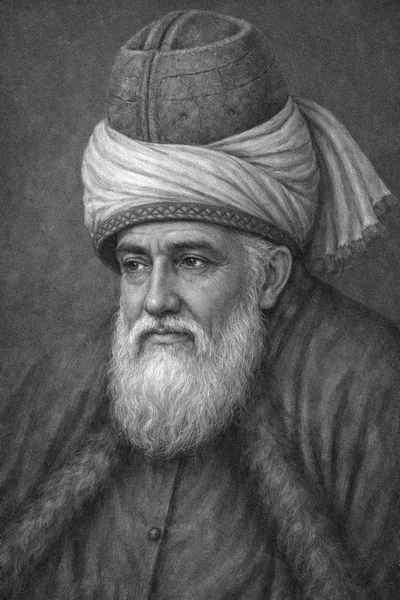
Persian Poet, Jurist, Theologian, and Sufi Teacher, 1207–1273
“Yesterday I was clever, so I wanted to change the world. Today I am wise, so I am changing myself.”
Jalāl al-Dīn Muḥammad Balkhī—later known simply as Rumi—was born on September 30, 1207, in Balkh, in what is now Afghanistan. He was the son of Baha al-Din Walad, a respected religious teacher, and Mu’mina Khatun. His early life was unsettled. Political conflict and the approaching Mongol invasions forced his family to leave their home when he was still a child. That move shaped him. Leaving Balkh meant leaving security and familiarity. As the family traveled west through Persia and into Anatolia, Rumi was exposed to scholars, mystics, traders, and rulers. Instability became part of his formation, planting early seeds of detachment from status and place.
The family eventually settled in Konya, in present-day Turkey. There Rumi’s education deepened. He studied the Qur’an, the sayings of the Prophet, Arabic grammar, and Islamic law. His father’s reputation helped him gain respect, but Rumi’s own discipline carried him forward. When his father died in 1231, Rumi stepped into his role as a teacher. By his thirties, he was a well-known legal scholar and preacher with students and authority. He was firmly rooted in Sunni Islamic tradition.
But scholarship alone did not define him. Under the direction of one of his father’s students, Burhan al-Din Muhaqqiq, Rumi intensified his spiritual practice. He fasted, traveled, and continued his studies in cities such as Aleppo and Damascus. These years blended formal learning with inner discipline. He was not pushing against Islam; he was living it seriously and completely.
The turning point came in 1244, when Rumi met Shams of Tabriz, a wandering mystic whose personality unsettled him. Shams did not question Rumi’s knowledge; he questioned his dependence on it. Their friendship was intense and controversial. Rumi withdrew from public teaching and spent long hours in conversation with Shams. Students were confused. Rumi was transformed. Intellectual certainty gave way to spiritual longing. Law turned into love.
When Shams suddenly disappeared—likely killed amid jealousy within Rumi’s circle—the loss shattered him. Yet his grief did not silence him. It flowed into poetry. He began composing verses that would later be collected as the Divan-e Shams-e Tabrizi. The careful jurist became a poet of longing, unity, and the dissolving of the ego (fana). His faith did not change direction; it moved inward. Religious law became the outer form of an inner awakening.
In the years that followed, Rumi dictated what became the Masnavi, a long poetic work filled with stories, humor, scriptural insight, and moral teaching. Often called the “Qur’an in Persian,” it did not replace tradition but deepened it. Rumi used storytelling the way a lawyer uses argument—to guide the listener toward understanding. But for him, understanding had to be lived. Knowledge without inner change, he believed, was incomplete.
Rumi’s community grew. Students gathered not just to learn, but to practice a spiritual way of life. After his death in 1273, his followers organized his teachings into what became known as the Mevlevi Order. The whirling ceremony—turning slowly in circles—expressed his spiritual vision in movement: the soul circling its center, surrendering pride through motion. For Rumi, movement itself could become prayer.
His personal life remained grounded. He married, had children, and led a household and community that relied on him. His life was not withdrawn from the world; it was woven into it. Exile, loss, and leadership pressures shaped him, but they did not break him. Each hardship refined his focus.
In his later years, Rumi’s influence spread across Anatolia and beyond. When he died on December 17, 1273, in Konya, people of different faiths attended his funeral—Muslims, Christians, and Jews alike. He was buried there, and his tomb remains a place of pilgrimage.
Rumi’s legacy is more than beautiful poetry. It is the movement from formal scholarship to lived spiritual experience. He began as a respected legal scholar. He became a poet of inner unity. Childhood displacement taught him impermanence. Education gave him structure. His encounter with Shams taught him surrender. From these forces emerged a body of work that presented Islam not only as doctrine, but as a path of inner transformation.
Rumi did not abandon tradition. He entered it so fully that only its living core remained.
###
Profile written February 23, 2026
Resources
Some resources are linked through our affiliate program with Amazon.com. Buying these items is a simple way to support our work while expanding your own knowledge base.
Books
The Masnavi — translated by Jawid Mojaddedi
A scholarly English translation of Rumi’s major spiritual epic.
The Essential Rumi — translated by Coleman Barks
A popular modern rendering that helped introduce Rumi to Western audiences.
Rumi: Past and Present, East and West — Franklin D. Lewis
A comprehensive academic biography of Rumi’s life and historical context.
Mystical Dimensions of Islam — Annemarie Schimmelel
A classic study of Sufism that situates Rumi within the broader Islamic mystical tradition.
Videos
BUDDHA and RUMI: The Muslim Poet Who Found NIRVANA
This video compares the spiritual journeys of Buddha and Rumi.
Rumi Documentary; Everything You Need to Know
A concise biographical overview of Rumi’s life, tracing his journey from respected Islamic scholar to transformative mystic poet and highlighting the pivotal role of Shams of Tabriz in shaping his spiritual legacy.
A Meditation on Rumi and the Power of Poetry | Leili Anvar | TED
In this TED talk, Leili Anvar reflects on Rumi’s poetry as a path to inner transformation, exploring how language, love, and longing open the human heart beyond ego and division.
Sema Ceremony – Mevlevi Whirling Dervishes
A filmed Sema ceremony showcasing the Mevlevi whirling dervishes’ ritual movement, music, and symbolism as a living embodiment of Rumi’s mystical vision of spiritual surrender and unity.
Websites
ReadingRumi.com is a scholarly resource dedicated to accurate translations, commentary, and contextual study of Rumi’s poetry, emphasizing historical fidelity over popularized reinterpretations.