
Claude Monet
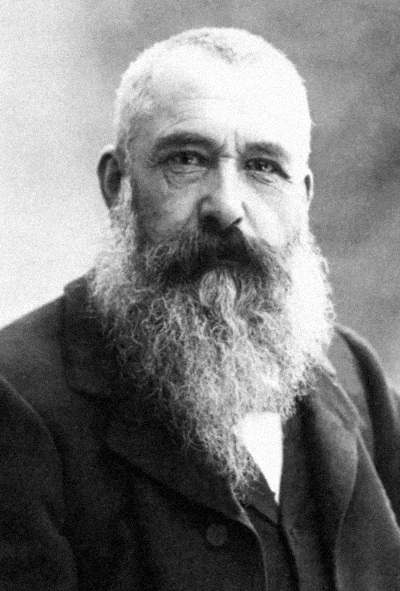
French painter and central figure of Impressionism, 1840–1926
“For me, a landscape does not exist in its own right, since its appearance changes at every moment; but the surrounding atmosphere brings it to life—the light and the air which vary continually.”
Oscar-Claude Monet was born on November 14, 1840, in Paris, France, the second son of Claude-Adolphe Monet and Louise-Justine Aubrée Monet. In 1845 the family moved to the Normandy coast near Le Havre. That landscape left a permanent mark. Tides, haze, wind, and shifting clouds taught Monet how atmosphere reorganizes color from moment to moment. He received a conventional education, but his real training happened outside the classroom. He sketched constantly and learned how quickly a face or scene changes when reduced to line and tone.
As a teenager Monet became locally known for caricatures, not paintings. He drew public figures with bold, simplified strokes and sold the drawings in shop windows. The practice mattered. Caricature forced quick decisions and rewarded commitment to what the eye sees. It also taught Monet to value immediacy over polish. Just as important, it showed him that art could earn money. His family offered uneven support, and early tension between commercial expectations and artistic instinct shaped his character. Monet learned to resist pressure. He would later choose poverty over compliance.
A decisive shift came in 1856–57, when Monet met Eugène Boudin. Boudin painted outdoors and treated the sky as an active source of color. He urged Monet to leave studio formulas behind and work directly from observation. Monet later described the encounter as a revelation. He realized that the world itself could be the subject, without idealization. Painting outdoors was not a novelty; it was a discipline. Boudin also modeled a working ethic that suited Monet’s temperament: return to the same place again and again, because nature never repeats itself.
In 1859 Monet moved to Paris to pursue art more seriously. The city offered museums, competitions, and contact with other driven young painters. He met artists who would shape his working life, including Camille Pissarro and Édouard Manet, who stood between tradition and revolt. Monet also formed close ties with Frédéric Bazille, Auguste Renoir, and Alfred Sisley. These relationships were practical as well as personal. They compared techniques, argued over choices, shared locations, and pushed each other to paint faster and closer to lived perception.
Like many young men of his time, Monet’s life was disrupted by military service, including time in North Africa. The experience strengthened his desire for independence and sharpened his resistance to authority. When he returned to France, the 1860s were unstable. Periods of intense work alternated with debt, rejection, and frequent moves. Hardship did not soften him. It clarified his priorities. Monet learned that painting what he believed in often meant risking poverty and relying, at times humiliatingly, on friends and patrons.
In 1870 Monet married Camille Doncieux, one of his favorite models and the mother of his first son. The marriage gave him emotional grounding while his career remained uncertain. Camille appears in his paintings as a real presence, not an allegory. After the Franco-Prussian War, the family settled in Argenteuil along the Seine. There Monet found ideal conditions: sun on water, reflections, mist, and rapid changes in weather over a working river. He even painted from a small boat fitted with an easel, turning the river into both studio and subject. Painting became a way to record brief alignments of light, air, and color.
In 1874 Monet and his peers organized an independent exhibition outside the official Salon. Monet showed Impression: Sunrise. A critic mocked the painting as nothing more than an “impression.” The label stuck. Monet was not just a participant in the new movement; he was one of its most committed voices. He accepted that a painting could appear unfinished and still be complete, as long as it was truthful to perception. The early Impressionists challenged more than style. They argued that modern life required modern ways of seeing.
Recognition came slowly. Monet depended on relationships that mixed art with survival. Fellow painters offered criticism and solidarity. Dealers and patrons provided financial oxygen. The most important was Paul Durand-Ruel, whose belief in the Impressionists kept many of them working when public opinion was hostile. Monet was competitive and proud, but he understood a hard fact: painting requires time, and time costs money. The journey from ridicule to acceptance was measured in rent, bills, and relentless production.
In 1883 Monet moved with his family to Giverny, where he would remain for the rest of his life. There he did something unusual. He began to build his subject. He shaped gardens, planted and replanted, and eventually created the pond and Japanese bridge that anchored his late work. This was not retreat but control. After decades of instability, Monet created an environment where he could study the same motifs under endless variation. His series paintings—haystacks, poplars, Rouen Cathedral, and the water lilies—were experiments, not repetitions. Each asked how painting might translate time into color.
Monet’s private life also shifted. Camille died in 1879, a loss that deepened his awareness of time and impermanence. Later he married Alice Hoschedé, joining two families into a complex household. Life at Giverny was busy and structured. It included children, stepchildren, visitors, gardeners, and the routines needed to support Monet’s work. Giverny was not simply peaceful. It was a working enterprise organized around one central obsession: seeing clearly and repeatedly.
In his final years Monet faced physical limits. Cataracts altered his vision and changed how he perceived color and contrast. Instead of stopping, he adapted. His late paintings grew broader, denser, and closer to abstraction. Those works would influence later modern art. Monet painted through grief, war, and illness because painting was not just his profession. It was how he lived. He died on December 5, 1926, at age 86 and was buried in Giverny. His legacy is not decorative beauty. It is a redefinition of painting as an act of perception itself.
###
Profile originally written August 1995 | Revised October 11, 2025
Resources
Some resources are linked through our affiliate program with Amazon.com. Buying these items is a simple way to support our work while expanding your own knowledge base.
Books
Claude Monet: Life and Art — by Paul Hayes Tucker
A strong, readable biography that treats Monet as both a visionary and a fiercely practical working artist. Excellent for understanding the long, difficult road from early rejection to late mastery.
Monet in Normandy — by Richard R. Brettell
A focused look at the coastline and river environments that trained Monet’s eye. Useful for seeing how place and weather shaped the technique we now call Impressionism.
Monet’s Years at Giverny — by Daniel Wildenstein (with contributions)
A deep dive into the decades at Giverny, where Monet turned repetition into innovation. Great for readers who want the late work treated as serious modern experimentation, not pastoral decoration.
Documentaries
The Impressionists: The Other French Revolution
A sweeping documentary series that places Monet inside the larger rupture that changed modern painting, with strong historical framing and visual analysis.
Videos
Monet’s “Impression, Sunrise”: Great Art Explained
A concise, visually rich analysis that explores how Impression, Sunrise sparked the Impressionist movement and reveals why Monet’s seemingly simple harbor scene revolutionized modern painting.
Monet and the Colors of The Rouen Cathedral
An insightful examination of Monet’s Rouen Cathedral series, showing how shifting light and atmospheric conditions transformed a single façade into a study of color, time, and perception.
Monet & Architecture | National Gallery
A museum-produced exploration of how Monet’s paintings captured the energy, movement, and changing social landscape of modern nineteenth-century life.
Websites
Claude Monet’s House and Gardens – Giverny
The official site of Monet’s home and gardens at Giverny, offering historical information, visitor details, and insight into the landscape that inspired his late masterpieces.
Fondation Claude Monet (Giverny): research notes & updates
A foundation website feature offering scholarly updates and research insights into Monet’s work, including focused studies on series paintings such as the Rouen Cathedrals.
A searchable collection page from The Metropolitan Museum of Art featuring Monet’s works in its holdings, along with detailed object descriptions acuratorial context.
Impressionism’s 150th birthday
Musée d’Orsay marks the 150th anniversary of Impressionism, highlighting key works, historical context, and the movement’s lasting cultural impact.
The Musée de l’Orangerie collection page showcasing Monet’s monumental Water Lilies panels and related works, with curatorial information about their installation and historical context.
A collection page from The Frick featuring Monet’s works in its holdings, with historical background and curatorial commentary on their place within his broader career.