
Henri Matisse
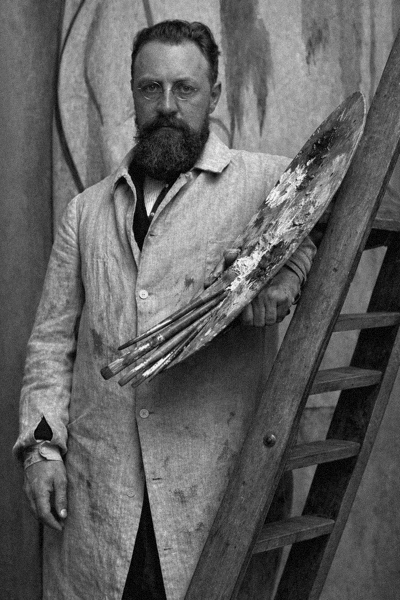
Painter, Draftsman, Sculptor, and Pioneer of Modern Color, 1869–1954
“There is nothing more difficult for a truly creative painter than to paint a rose, because before he can do so he has first to forget all the roses that were ever painted.”
Henri Matisse was born on December 31, 1869, in Le Cateau-Cambrésis in northern France and grew up in a practical, shopkeeping world that valued steadiness. His father ran a grain business in Bohain-en-Vermandois, a town known for its textile trade. His mother encouraged careful handwork and attentive observation. Before Matisse ever imagined himself an artist, he was surrounded by patterned fabrics, decorative surfaces, and the quiet discipline of craft. The visual culture of northern France formed a background he would later elevate into high art.
His family expected a respectable profession, and Matisse initially complied. He studied law and worked in an office. That early training left him with something he never lost: an orderly mind, a respect for structure, and the ability to work methodically. Even at his most radical, his paintings are built, not improvised.
The turning point came during a serious illness in his early twenties. Confined to bed, his mother brought him paints. He drew and painted to pass the time. What began as diversion quickly became necessity—an experience he later described as discovering “a kind of paradise.” The decision to pursue art was not romantic rebellion but a sober pivot. He was choosing instability over security. That choice required both courage and stubbornness.
He began training seriously in Paris. At the École des Beaux-Arts he studied under Gustave Moreau, who urged students to develop their own vision rather than merely repeat academic formulas. Independence, however, did not mean abandoning discipline. Matisse immersed himself in rigorous drawing and copied Old Masters in the Louvre to understand how paintings were constructed—how line, balance, and structure held an image together. Copying was not imitation for display but a means of learning. He absorbed tradition deeply before reshaping it in his own language.
In the late 1890s and early 1900s, the work of Cézanne, Van Gogh, and Gauguin confronted him with new possibilities. From Cézanne he learned that color could build form and that a painting could possess internal architecture. From Van Gogh he absorbed the emotional force of intensified color. From Gauguin he saw how flattened space and decorative surface could carry meaning. These were not personal relationships, but they were decisive influences. Matisse began to understand that color could do structural work, not merely descriptive work. That insight would become central.
In 1905, working alongside André Derain in Collioure, he pushed these ideas into open revolt. Their high-key colors and simplified forms shocked the Salon d’Automne and earned the label Fauves—“wild beasts.” The criticism was fierce. Sales were uncertain. Yet Matisse did not retreat. The discipline of his upbringing and the methodical habits formed in his legal training steadied him. Fauvism was not chaos for him; it was controlled intensity.
Soon after, another force entered his development: Pablo Picasso. Beginning around 1906, their rivalry became one of the defining dynamics of modern art. Picasso moved toward fragmentation and Cubism; Matisse responded by refining clarity, balance, and chromatic structure. They visited each other’s studios, exchanged works, and watched one another closely. Their competition was sustained and strategic, not explosive. Picasso forced Matisse to sharpen his principles. Matisse, in turn, demonstrated that harmony and decoration could be as radical as fracture.
Patronage also shaped his trajectory. Russian collectors such as Sergei Shchukin commissioned large decorative works, giving Matisse financial freedom and scale. These commissions allowed him to expand color and pattern into monumental compositions such as Dance and Music. The decorative language rooted in his regional background now operated on architectural scale.
His private life created both stability and strain. He married Amélie Parayre, and their household became the base from which he worked. Financial pressure sharpened his focus. He guarded long stretches of uninterrupted time because he understood that serious painting requires sustained attention. Unlike the tragic volatility that marked the lives of some earlier modernists, Matisse’s development was cumulative. He built, adjusted, and refined.
Later, in the light of southern France, he deepened his exploration of interiors, windows, textiles, and patterned surfaces—the visual language of his early environment now elevated and abstracted. When illness limited his mobility in the 1940s, he reinvented himself once more. His cut-paper works—what he called “drawing with scissors”—distilled decades of thinking about structure, color, and decorative surface into pure, decisive shape. The lessons of Cézanne’s architecture, Fauvist color, and lifelong discipline converged in those final works.
Matisse died on November 3, 1954. He left behind more than vivid canvases. He demonstrated that color could structure a painting the way geometry structures architecture, and that decoration—once dismissed as secondary—could organize emotion itself. The seeds were there early: craft, pattern, discipline, rivalry, and the steady courage to evolve without abandoning structure.
###
Profile originally written December 1995 | Revised March 1, 2026
Resources
Some resources are linked through our affiliate program with Amazon.com. Buying these items is a simple way to support our work while expanding your own knowledge base.
Books
The Unknown Matisse: A Life of Henri Matisse: The Early Years, 1869-1908— Hilary Spurling
Traces Matisse’s formative struggles from provincial beginnings to the breakthrough ofauvism, showing how discipline and experimentation shaped his early development.
Matisse at War: Art and Resistance in Nazi Occupied France — Christopher C. Gorham
Explores how Matisse navigated the moral and personal pressures of World War II, revealing the quiet resilience behind his art during one of France’s darkest periods.
Matisse: The Master— Hilary Spurling
A major biography focused on Matisse’s mature years, showing how ambition, rivalry, and relentless work shaped the late style.
Matisse: His Art and His Public — John Elderfield
A serious study of patrons, critics, exhibitions, and the long fight for legitimacy.
Henri Matisse: The Cut-Outs — Karl Buchberg (Editor), Nicholas Cullinan (Editor), Jodi Hauptman (Editor), Henri Matisse (Artist), Samantha Friedman (Contributor)
Accompanies MoMA’s landmark exhibition, examining how Matisse’s late paper cut-outs distilled decades of experimentation with color, form, and composition into bold, monumental works.
Chatting with Henri Matisse: The Lost 1941 Interview — by Henri Matisse (Author), Pierre Courthion Serge Guilbaut (Editor), Chris Miller (Translator)
Presents a rare, extended conversation in which Matisse reflects on his artistic philosophy, process, and lifelong pursuit of clarity and harmony in painting.
Video/Audio
MoMA Audio: Introduction to Henri Matisse: The Cut-Outs
An audio introduction from The Museum of Modern Art that explains how Matisse developed his late-career cut-out technique—“drawing with scissors”—and how these bold, simplified shapes distilled decades of experimentation with color, structure, and decorative form into a radically modern visual language.
Henri Matisse — The Snail at Tate Modern (short video)
A brief Tate Modern video highlighting The Snail, explaining how Matisse used bold cut-paper shapes and vibrant color blocks to create movement, balance, and abstract harmony in one of his most celebrated late works.
Websites
The Met Museum: Henri Matisse — Heilbrunn Timeline of Art History
An authoritative overview from The Metropolitan Museum of Art’s Heilbrunn Timeline that situates Matisse within the development of modern art, tracing his evolution from academic training to Fauvism and his lasting impact on color, abstraction, and decorative form.
MoMA: Henri Matisse — Artist page
MoMA’s official artist page on Henri Matisse, featuring a concise biography and a curated selection of works in the museum’s collection that highlight his evolution from Fauvism to the late cut-outs.
An accessible overview of Fauvism from The Art Story, explaining the movement’s origins, key artists, defining use of bold color and simplified form, and its role in the development of early modern art.