
Élisabeth Louise Vigée Le Brun
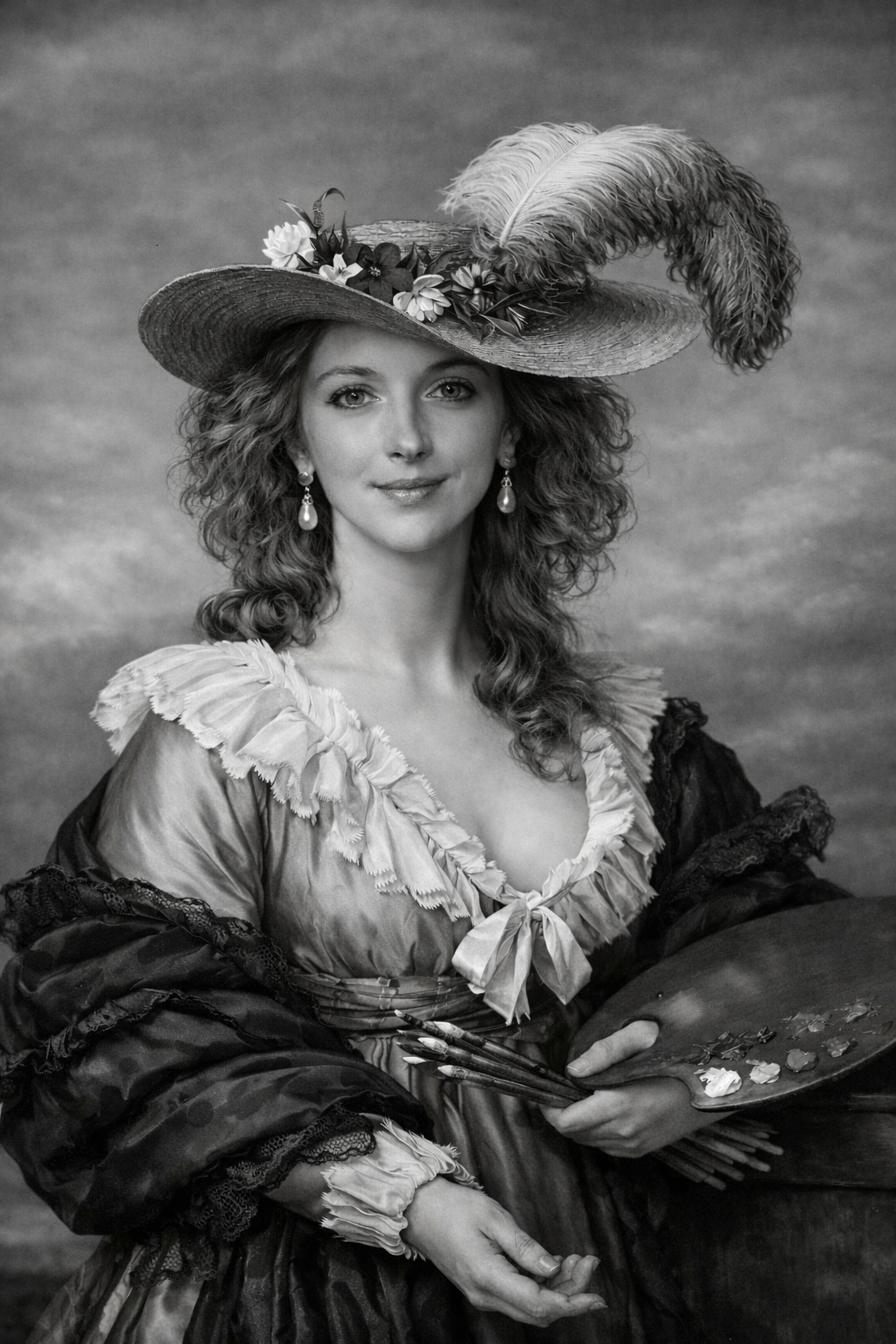
Portraitist of Marie Antoinette and the Royal Courts of Europe, 1755–1842
“The art of the portrait consists less in exact likeness than in the expression of character.”
Élisabeth Louise Vigée Le Brun emerged from the vibrant cultural life of eighteenth-century Paris to become one of Europe’s most celebrated portrait painters. In an era when artistic academies and professional workshops were dominated by men, she built a career that carried her from Enlightenment Paris to the courts of Italy, Austria, and Russia. Her paintings—especially those of Marie Antoinette—shaped how the French royal court was seen by contemporaries and how it is remembered today.
She was born in Paris on April 16, 1755, into a household where art was part of daily life. Her father, Louis Vigée, was a respected portrait painter who encouraged his daughter’s early interest in drawing. The young Élisabeth grew up watching canvases take shape in her father’s studio and absorbed the techniques of portraiture almost by instinct. Visitors later recalled the child sketching constantly, her hand already confident and observant.
The turning point of her early life came when her father died while she was still a girl. The loss was emotional, but it also forced early independence. Painting quickly became more than a passion; it became a practical means of supporting her family. By her mid-teens she was accepting commissions from members of Parisian society. Her portraits stood out for their vitality. At a time when aristocratic portraiture often relied on stiff ceremonial poses, Vigée’s subjects seemed alive—faces animated, gestures relaxed, expressions warm.
The Paris in which she emerged as an artist was the world of the Enlightenment: a society of salons, philosophers, and cultivated aristocrats. The elegance of the late Rococo style still shaped taste, but new ideas about simplicity and classical form were already spreading through the arts. Vigée Le Brun absorbed both influences. Her paintings combined Rococo grace with the clarity and restraint that would soon define Neoclassicism. Fabrics shimmered, light softened features, and her sitters appeared less like symbols of rank and more like individuals.
Her reputation spread quickly through aristocratic circles, and she was soon introduced to the young queen of France, Marie Antoinette. The meeting changed her life. The queen admired her work and asked her to paint royal portraits. Vigée Le Brun became one of the queen’s favored painters and eventually produced more than thirty portraits of Marie Antoinette and members of the royal family.
These paintings did more than decorate palace walls. They helped shape the queen’s public image at a time when criticism of the monarchy was growing louder. Vigée Le Brun portrayed Marie Antoinette with elegance but also with humanity—sometimes as a mother surrounded by her children, sometimes in more intimate poses that softened the formality of court life. Works such as Marie Antoinette with a Rose presented the queen not only as a symbol of royal authority but also as a woman of grace and refinement.
The artist’s success reached a milestone in 1783 when she was admitted to the Académie Royale de Peinture et de Sculpture. Membership in the academy was one of the highest honors an artist in France could receive, and only a handful of women had been admitted. Her acceptance required the direct support of the queen and reflected both her extraordinary talent and her growing influence at court.
Yet the glittering world of Versailles was already nearing its end. When the French Revolution erupted in 1789, association with the royal court became dangerous. Vigée Le Brun recognized the risk immediately. Soon after the first upheavals in Paris, she fled the country with her daughter, leaving behind her studio, her clients, and the life she had built.
What might have ended her career instead opened a remarkable second act. For the next twelve years she traveled across Europe and worked in many of its cultural capitals—Rome, Vienna, Naples, and St. Petersburg among them. Her reputation as the former portraitist of the French queen preceded her. Aristocratic families throughout Europe competed for the chance to sit for her.
During these years she painted hundreds of portraits and was elected to numerous art academies—an extraordinary achievement for any painter of the time. Her work from this period shows a mature artist whose technique had grown even more assured. Colors became richer, compositions more confident, and psychological insight deeper.
Among her most celebrated works is Self-Portrait with Her Daughter Julie, which captures a moment of maternal affection with unusual intimacy. In the painting, mother and child lean toward one another with spontaneous warmth. The scene offers a quiet contrast to the formal grandeur of the aristocratic portraits that had once defined her career.
Eventually the political climate in France softened enough to allow her return. By the early nineteenth century she again spent part of her time in Paris. The world she returned to, however, had changed profoundly. The court society that had launched her career had vanished, replaced by a new political and social order.
In her later years Vigée Le Brun turned to writing and produced memoirs titled Souvenirs. These recollections offer vivid glimpses of the society she had known: the elegance of pre-revolutionary salons, the personalities of European nobles, and the upheavals that reshaped the continent during her lifetime. Few artists left such a detailed personal record of their era.
She lived to the age of eighty-six and died in Paris on March 30, 1842. By then the world of Louis XVI and Marie Antoinette had passed into history. Through Vigée Le Brun’s portraits, however, that world remained visible—its elegance, its anxieties, and its human faces preserved on canvas.
Today her work stands among the most recognizable visual records of late eighteenth-century Europe. More than a court painter, she was an artist who navigated one of the most turbulent transitions in European history. She carried her talent across borders and political upheaval while leaving portraits that continue to define the image of an entire age.
###
Profile written March 2026
Resources
Some resources are linked through our affiliate program with Amazon.com. Buying these items is a simple way to support our work while expanding your own knowledge base.
Books
Souvenirs of Madame Vigée Le Brun
A two-volume memoir by Le Brun recounting her artistic rise in pre-revolutionary Paris, her work as portraitist to Marie Antoinette, and her years of exile painting the royal courts of Europe.
Daring: The Life and Art of Elisabeth Vigée Le Brun— by Jordana Pomeroy
Examines LeBrun’s remarkable career across the courts of Europe and the cultural environment that shaped her work. The book explores how she navigated the male-dominated art world of eighteenth-century France while producing some of the most recognizable portraits of the era.
Documentaries & Films
Élisabeth Vigée Le Brun: The Queen’s Painter - Full Documentary
Élisabeth Vigée Le Brun was more than just the court painter of Versailles she was one of the most successful and independent women of the 18th century.
Portraits of Marie Antoinette Part 01 | The Art and Legacy of Vigée Le Brun
Step into the world of 18th-century France through the eyes of Élisabeth Louise Vigée Le Brun, portraitist of Marie Antoinette.
Uffizi Gallery – Video and Historical Commentary
A museum video discussing the painter’s life, her friendship with Marie Antoinette, and her influence on portraiture at the end of the eighteenth century.
Websites
Élisabeth Louise Vigée Le Brun Collection — The Metropolitan Museum of Art
The Met’s Heilbrunn Timeline provides examples of her work held in the museum’s collection.
Artist Overview and Works — National Gallery, London
An overview of the artist’s life along with examples of paintings and contextual commentary on her career and artistic development.
National Gallery of Art — Washington D.C.
Selected works and bibliography related to the artist and her paintings held in major collections.
Le Brun’s Sumptuous Portraits — National Gallery of Canada
A feature article exploring the elegance, technique, and historical context of the sumptuous portrait paintings of Élisabeth Louise Vigée Le Brunand their role in shaping the visual culture of late eighteenth-century European courts.
Essay on Vigée Le Brun and Romantic Portraiture
An interpretive essay exploring the artist’s work within the broader cultural and artistic climate of late eighteenth-century Europe.