
Galileo Galilei
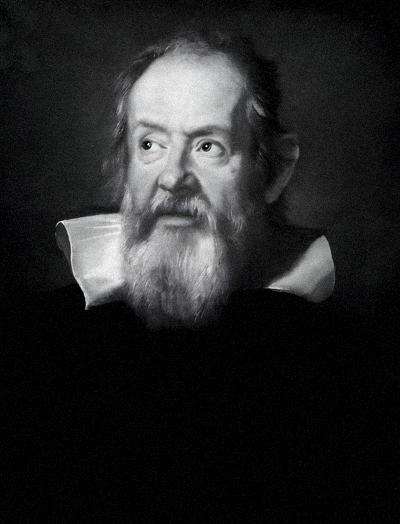
Astronomer and Physicist, 1564–1642
“I do not feel obliged to believe that the same god who has endowed us with sense, reason and intellect has intended us to forgo their use.”
Galileo Galilei was born on February 15, 1564, in Pisa, Italy. He was the eldest son of Vincenzo Galilei and Giulia Ammannati. Vincenzo was a serious music theorist who challenged accepted ideas. Galileo grew up in a home where people tested arguments instead of accepting tradition. That shaped his lifelong habit: don’t repeat authorities—test claims against evidence. Vincenzo’s attacks on bad musical theory weren’t science, but they trained the same mindset Galileo later used in physics and astronomy.
As a young man, Galileo entered the University of Pisa to study medicine. He shifted toward mathematics and natural philosophy. He did this partly because he was good at it, partly because money was tight, and partly because these fields offered cleaner answers than status games. He left the university without a degree. That matters because the “hero of science” started as a school dropout. He was smart and stubborn. Over time, that stubbornness was shaped by real-world pressures: patrons, salaries, and institutional politics. Those pressures influenced how he wrote and argued for the rest of his life.
In 1589, at 25 years of age, Galileo became the mathematics chair at Pisa. In 1592, he moved to the University of Padua and stayed until 1610. Padua gave him room to teach and experiment. It also put him around craftspeople, instrument makers, and practical engineering work. That environment fit him. During these years he did major work in mechanics. He built instruments, including an early thermoscope. He also designed tools like the geometric and military compass. This was not the life of a secluded scholar. It was hands-on work in a competitive world.
In 1609, Galileo heard about the telescope developed in the Netherlands. He quickly improved the design. With it, he made observations that challenged the old picture of the heavens. He saw mountains on the Moon. He observed moons orbiting Jupiter. He saw the phases of Venus. These were not abstract ideas. They were visible through the instrument and could be checked by others who had one. His results made him famous fast. That fame raised the stakes. Public influence brings attention, but it also brings enemies.
Galileo’s rise also depended on people and networks. In 1610, he became mathematician and philosopher to the Grand Duke of Tuscany, a move that drew him into court life. Courts rewarded persuasion and performance as much as truth, and Galileo adapted quickly. He wrote with force and flair, debated aggressively, and cultivated elite connections, most notably with the Accademia dei Lincei, one of Europe’s earliest scientific societies. Membership in the Lincei gave Galileo intellectual prestige, publishing support, and occasional protection. At the same time, it pulled him closer to Rome and its centers of power—exposing his work to greater scrutiny and increasing the political risks he faced.
Galileo committed himself to the sun-centered (heliocentric) theory associated with Nicolaus Copernicus. His telescopic observations refuted an Earth-centered model. He did not keep this conclusions to himself. Galileo pressed the case for heliocentrism publicly, pushing the debate beyond technical circles and into the wider culture—where it became a conflict not just about astronomy, but about authority.
That conflict eventually collided with the Roman Catholic Church. Resistance to Copernican ideas grew stronger. In 1616, Galileo was formally warned not to advocate or teach Copernican astronomy as true. He tried to work within the limits, but not always consistently. In 1633, the Inquisition convicted him of heresy connected to heliocentrism. He was sentenced to imprisonment, but the sentence was commuted to house arrest. He spent the rest of his life confined at Arcetri, near Florence.
The “Galileo vs. Church” story is often told like a simple battle. The real story is more tangled. Galileo was gifted, ambitious, and fearless in argument. He also depended on patrons and institutions. He pushed his case in a world where theology, philosophy, politics, and prestige were tightly connected. He helped shape the scientific future. But he paid for it in social standing and legal punishment.
His private life mattered, too. Galileo fathered children out of wedlock. His relationship with his daughter Sister Maria Celeste (Virginia Galilei), a nun, is one of the best windows into him as a person. That bond—preserved in their surviving correspondence and explored in Dava Sobel’s book, Galileo’s Daughter—reveals warmth, anxiety, and emotional dependence, not just intellect. It is especially revealing during the years when pressure and danger intensified around him.
As a scientist, Galileo’s originality was in his method. He reduced problems to clear terms based on experience. Then he expressed them in simple mathematics. That approach helped create modern mathematical physics. Later, Isaac Newton built on Galileo’s ideas about inertia and motion. Galileo’s work helped lay the foundation for classical mechanics.
Late in life, Galileo became blind. Many people wrongly blame his looking at the Sun. Modern accounts point instead to cataracts and glaucoma. He died in 1642, the same year Isaac Newton was born; like a symbolic handoff between two architects of modern science.
###
Profile originally written in February 1996 — Revised January 31, 2026
Resources
Some resources are linked through our affiliate program with Amazon.com. Purchasing these items is a simple way to support our work while expanding your own knowledge base.
Books
Discoveries and Opinions of Galileo — by Galileo Galilei; translated by Stillman Drake
A definitive collection of Galileo’s key writings that captures his scientific breakthroughs, argumentative style, and intellectual defiance, presented with clarity and rigor in Stillman Drake’s authoritative translation. Including the Starry Messenger (1610, Letter to the Grand Duchess Christina).
Dialogue Concerning the Two Chief World Systems: Ptolemaic and Copernicano — by Galileo Galilei; translated by Stillman Drake
Galileo’s masterwork, framed as a lively debate, that systematically dismantles the Ptolemaic system while making the Copernican universe intelligible—and dangerous—to a wider public.
Galileo’s Daughter: A Historical Memoir of Science, Faith, and Love — by Dava Sobel
A finely researched historical memoir that reveals Galileo’s private life through his correspondence with his daughter, illuminating the human intersection of science, faith, family, and intellectual courage.
Galileo: Astronomer and Physicist — Paul W. Hightower
A clear, accessible introduction that situates Galileo’s astronomical and physical discoveries within the scientific methods and controversies that reshaped early modern science.
Documentaries
NOVA — Galileo’s Battle for the Heavens — WGBH Boston
A compelling documentary that traces Galileo’s scientific discoveries and his confrontation with Church authority, showing how evidence, belief, and power collided at the birth of modern science.
Galileo: On the Shoulders of Giants — HBO The Inventors’ Specials
An engaging biographical profile that places Galileo within the continuum of scientific progress, highlighting how he built on earlier thinkers while transforming observation into a new engine of discovery.
NOVA — Genius: The Science of Einstein, Newton, Darwin, and Galileo — WGBH Boston
A sweeping exploration of four scientific revolutionaries, showing how their radically different insights reshaped humanity’s understanding of nature, life, and the universe.
Related Videos
Galileo, Mathematics, and the Arts — Yale University
Mark A. Peterson, Professor of Physics and Mathematics gives this Franke Program lecture.
Galileo Mini-Bio — Biography
A short biography video of Galileo, "The father of modern physics."
Websites
Stanford Encyclopedia of Philosophy — “Galileo Galilei” — A rigorous, scholarly entry examining Galileo’s scientific work, methodological innovations, and philosophical significance, with detailed analysis of his contributions to astronomy, physics, and the early development of modern scientific reasoning, as well as the historical context of his conflict with Church authority.
Museo Galileo (Florence) — Biography: Galileo Galilei — The online biography section of one of the world’s leading history-of-science institutions, presenting key facts about Galileo’s life and work alongside the museum’s preservation of his original scientific instruments and related artifacts.
The Galileo Project — A comprehensive scholarly resource maintained by Rice University that presents Galileo’s life, writings, scientific work, and historical context through primary texts, translations, timelines, and interpretive essays aimed at understanding Galileo within the intellectual world of early modern Europe.