
Nicolaus Copernicus
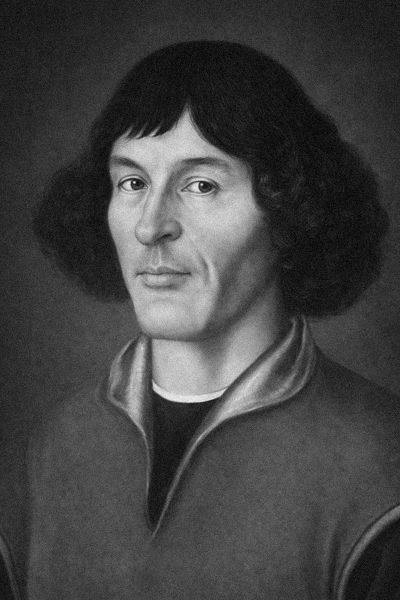
Cleric, Astronomer, and Architect of the Heliocentric Cosmos, 1473 — 1543
“Finally we shall place the Sun himself at the center of the Universe. All this is suggested by the systematic procession of events and the harmony of the whole Universe, if only we face the facts—with both eyes open.”
Nicolaus Copernicus (Mikołaj Kopernik) was born on February 19, 1473, in Toruń (Thorn), a trading city in Royal Prussia under the Polish Crown. He grew up in a world where commerce, church authority, and civic politics were tightly linked. That mattered, because Copernicus did not become an ivory-tower scholar. He became the kind of thinker who could do careful, patient work while also managing obligations.
His early life was shaped by family disruption and a powerful substitute father figure. Copernicus’s father, a merchant, died when Nicolaus was still young. The person who stepped in was his maternal uncle, Lucas Watzenrode, an ambitious churchman who later became Prince-Bishop of Warmia. Watzenrode sponsored Nicolaus’s education and positioned him for a secure career in the Church. That relationship gave Copernicus stability and access—but it also taught him caution. He learned early that advancement depended on patronage, and that ideas were safest when they were defended with discipline, not bravado.
Copernicus first studied at the University of Kraków, where he encountered the mathematical astronomy of the day: the Ptolemaic system, the tools of calculation, and the long tradition of trying to “save the appearances” of planetary motion. Kraków didn’t give him a finished alternative, but it gave him a habit of mind: measure first, argue later. He then went to Italy—Bologna, Padua, and Ferrara—where he absorbed a broader Renaissance education. He studied canon law, medicine, Greek, and mathematics, and he lived inside a culture that prized classical learning and technical skill. Italy also expanded his circle: he was no longer a provincial student but a participant in a European intellectual network.
By 1503 he had earned a degree in canon law at Ferrara and returned north to take up duties in Warmia as a cathedral canon. This is the key point many people miss: Copernicus was not a professional astronomer in the modern sense. He was a church administrator, advisor, and physician who did astronomy in the margins of a demanding life. He handled finances, helped manage church lands, served as a medical practitioner, and even wrote on monetary reform. That mixture—practical responsibility paired with private scientific obsession—helps explain both his productivity and his restraint. He could think radically while living conservatively.
Somewhere in the early 1500s, Copernicus began to suspect that the machinery of the Ptolemaic system was too complicated for what it delivered. The old model could predict, but it did so with a growing pile of epicycles and adjustments that felt more like patchwork than understanding. His alternative was bold but also strangely simple: put the Sun near the center, let Earth become a moving planet, and many of the awkward motions—especially retrograde loops—begin to look like natural results of relative motion rather than cosmic quirks.
Around 1514 he privately circulated a short outline of his new approach (often called the Commentariolus). He did not publish it widely. That secrecy was not just fear; it was temperament and strategy. Copernicus wanted the mathematics to be strong enough that he could not be brushed aside as a clever amateur. He also lived inside a church world where theological and philosophical assumptions about the cosmos were woven into education and authority. He had no desire to start a public fight he couldn’t finish.
His eventual publication depended heavily on relationships. Two friends in particular—Bishop Tiedemann Giese and Cardinal Nikolaus von Schönberg—encouraged him to stop hiding the work. And then came the most catalytic relationship of all: the younger mathematician Georg Joachim Rheticus. Rheticus visited Copernicus, grasped the significance of the model, and effectively forced the issue by publishing an early account (the Narratio Prima) and pushing the larger work toward print.
That larger work, On the Revolutions of the Heavenly Spheres (De revolutionibus orbium coelestium), finally appeared in 1543, near the end of Copernicus’s life. The book is not written like a manifesto. It is written like a careful construction—dense, geometric, and aimed at readers with the patience to follow proofs. Even the publication story shows the tension between caution and disruption: a Lutheran editor, Andreas Osiander, added an unsigned foreword suggesting the system should be taken as a computational device rather than literal truth. That framing softened the shock for some readers, but it also muddied Copernicus’s intent.
Copernicus died on May 24, 1543, in Frombork (Frauenburg). His theory did not “win” overnight. Most educated people continued to doubt that Earth moved. The Copernican model needed better observations, better physics, and better arguments. But it changed the direction of inquiry. It gave later thinkers—especially Johannes Kepler and Galileo Galilei—a new structure to refine and defend, and it set the stage for Isaac Newton’s synthesis of celestial motion under universal gravitation. In that sense Copernicus did something rare: he did not just solve a problem; he changed what counted as a satisfying explanation.
Centuries later, his symbolic status only grew. In 2005, archaeologists identified remains believed to be Copernicus in Frombork Cathedral, and in 2010 he was reburied there with ceremony. It was a modern epilogue to a very Renaissance life: a careful canon who worked quietly, published late, and still managed to move the Earth.
###
Profile originally written in December 1995 — Revised January 31, 2026
Resources
Some resources are linked through our affiliate program with Amazon.com. Purchasing these items is a simple way to support our work while expanding your own knowledge base.
Books
On the Revolutions of Heavenly Spheres — Nicolaus Copernicus (tr. Charles G. Wallis)
Copernicus’s groundbreaking 1543 work that proposed the heliocentric model of the universe, placing the Sun rather than the Earth at the center of planetary motion.
The Book Nobody Read: Chasing the Revolutions of Nicolaus Copernicus — Owen Gingerich
A historian of astronomy traces surviving copies of Copernicus’s De Revolutionibus, revealing how scholars actually read, annotated, and debated the revolutionary heliocentric text.
Dialogue Concerning the Two Chief World Systems: Ptolemaic and Copernican — Galileo Galilei (tr. Stillman Drake)
Galileo’s famous defense of Copernican astronomy presented as a lively debate comparing the traditional Earth-centered universe with the emerging Sun-centered model.
The Eye of Heaven: Ptolemy, Copernicus, Kepler — Owen Gingerich
A concise historical study explaining how three great astronomers transformed humanity’s understanding of the structure and motion of the cosmos.
The Copernican Revolution: Planetary Astronomy in the Development of Western Thought — Thomas S. Kuhn
A classic intellectual history examining how Copernicus’s heliocentric theory reshaped astronomy, philosophy, and the broader development of scientific thought.
eTexts
De Revolutionibus (excerpts and contextual material)
Selections from Copernicus’s De Revolutionibus Orbium Coelestium with historical commentary explaining the development of the heliocentric theory.
Videos
The life and revolutionary contributions of Nicolaus Copernicus
A concise educational video explaining how Nicolaus Copernicus challenged the Earth-centered model of the universe and introduced the heliocentric system that helped launch the Scientific Revolution.
A 2-hour plus documentary of Nicolaus Copernicus’s life and work, explaining how his heliocentric model of the solar system overturned centuries of Earth-centered cosmology and helped ignite the Scientific Revolution.
Websites
Stanford Encyclopedia of Philosophy — Copernicus
A detailed academic article exploring Copernicus’s cosmology, philosophical implications, and place in the history of scientific thought.
MacTutor History of Mathematics — Copernicus
A well-researched biography focusing on Copernicus’s mathematical work and his role in the transformation of Renaissance astronomy.
Nicolaus Copernicus University (Toruń)
The official website of the major Polish university named in honor of Copernicus, located near his birthplace.
Nicolaus Copernicus Astronomical Center (Polish Academy of Sciences)
A leading research institute devoted to modern astrophysics and astronomy, named for the pioneer of the heliocentric model.