
Niels Bohr
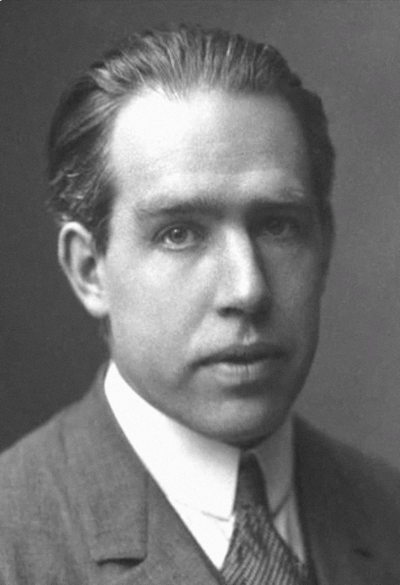
Danish physicist and Nobel laureate, 1885–1962
“The opposite of a correct statement is a false statement. But the opposite of a profound truth may well be another profound truth.”
Niels Henrik David Bohr was born on October 7, 1885, in Copenhagen, Denmark, into a household where ideas mattered. His father, Christian Bohr, was a respected physiologist at the University of Copenhagen, and dinner-table conversations frequently turned to science, philosophy, and medicine. His mother, Ellen Adler Bohr, came from a prominent Jewish banking family and fostered a cosmopolitan, intellectually tolerant home. This fusion of rigorous science and humane values would define Bohr’s character.
Bohr excelled early in physics and mathematics, completing his doctorate at the University of Copenhagen in 1911 at 26 years of age. Rather than remain insular, he sought intellectual confrontation. That search brought him to Manchester, England, where he studied under Ernest Rutherford, whose nuclear model of the atom had shattered classical assumptions. The partnership was catalytic: Rutherford supplied experimental clarity; Bohr supplied theoretical audacity.
In 1913, Bohr published his revolutionary model of the atom, proposing that electrons occupy discrete orbits and emit radiation only when transitioning between them. The idea violated classical physics but matched experimental results with unprecedented accuracy. Though later superseded, the Bohr model introduced quantum structure into atomic theory and marked the beginning of modern quantum physics.
Bohr’s deepest contribution was not a single equation but a way of thinking. Returning to Copenhagen, he founded what became the Niels Bohr Institute, deliberately cultivating an environment of open debate and intellectual humility. Young physicists—Werner Heisenberg, Wolfgang Pauli, Paul Dirac, among others—passed through its halls. Bohr encouraged contradiction, insisting that progress emerged from tension rather than certainty. This ethos crystallized into the Copenhagen interpretation of quantum mechanics.
His long philosophical duel with Albert Einstein—particularly over determinism and probability—became legendary. Einstein resisted quantum indeterminacy; Bohr embraced it, arguing that nature itself set limits on what could be known. Their debates, conducted with mutual respect, shaped twentieth-century physics as much as any experiment.
World War II forced Bohr into moral action. With Denmark occupied, he escaped in 1943 via Sweden and eventually reached the United States, advising the Manhattan Project at Los Alamos. Unlike many colleagues, Bohr remained deeply uneasy about nuclear weapons. After the war, he became a global advocate for international cooperation, transparency, and the peaceful use of atomic energy.
Bohr spent his final years promoting scientific openness and ethical responsibility, convinced that humanity’s survival depended as much on wisdom as on knowledge. He died in Copenhagen on November 18, 1962. His legacy endures not only in physics textbooks, but in the culture of science itself—where doubt, dialogue, and disciplined imagination remain essential.
###
Profile originally written October 1995 | Revised February 2, 2026
Resources
Some resources are linked through our affiliate program with Amazon.com. Buying these items is a simple way to support our work while expanding your own knowledge base.
Books
Niels Bohr’s Times — Abraham Pais
The definitive intellectual biography of Bohr’s scientific and philosophical world.
Niels Bohr: the man, his science, & the world they changed — Ruth Moore
Celebrates the centennial of the birth of Neils Bohr. It is an engrossing account of an exciting period in history and science as well as a good introduction to nuclear physics.
Suspended in Language — Jim Ottaviani
An inventive graphic biography exploring Bohr’s ideas and influence. Suspended in Language tells the complete story of Niels Bohr's amazing life, discoveries, and his pervasive influence on science, philosophy, and politics.
Videos
Niels Bohr and the Quantum World - BMResearch
Through medieval-style art and immersive physics documentaries, we explore Bohr's physics breakthroughs, shedding light on how the nuclear age and scientific discoveries continue to shape the modern world.
The Great Bohr-Einstein Debate | PBS Space Time
Albert Einstein strongly disagreed with Niels Bohr when it came to Bohr’s interpretation of quantum mechanics. Quantum entanglement settled the argument once and for all.
Drinking tea with Niels Bohr — Daily Dose
A short biography covering the life and works of Niels Bohr.
About Niels Bohr | PBS Space Time
Scott’s son-in-law offers the classic, intimate life in full.
Niels Bohr: the Quantum Pioneer | PBS Space Time
Another short biography covering Bohr’s life and work.
Websites
Niels Bohr Institute (University of Copenhagen)
The institute was inaugurated March 3, 1921, by Professor Niels Bohr. We are approx. 430 researchers, 100 administrative and technical staff, 140 Ph.D. students and 750 Physics students.
Nobel Prize: Niels Bohr Biography
Recognition of Bohr's work on the structure of atoms came with the award of the Nobel Prize for 1922.
MacTutor History of Mathematics: Niels Bohr
Biographical profile brought to you by the School of Mathematics and Statistics, University of St. Andrews, Scotland.