
Marie Curie
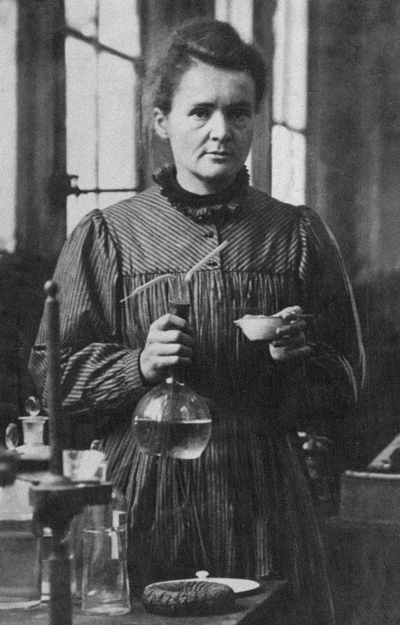
Physicist and chemist; pioneer of radioactivity research and two-time Nobel laureate, 1867–1934
“Nothing in life is to be feared, it is only to be understood. Now is the time to understand more, so that we may fear less.”
Marie Skłodowska Curie was born Maria Salomea Skłodowska on November 7, 1867, in Warsaw, then under Russian rule. Her early life was not a prelude but a test. Both parents were educators, and the household emphasized learning, discipline, and self-control. At the same time, Polish culture was suppressed and opportunity tightly controlled by imperial authority. From this environment, Curie learned early that persistence mattered more than permission.
Loss shaped her childhood. She lost her mother to tuberculosis and an older sister while still young. These experiences hardened her seriousness and tied her sense of purpose to work. Curie excelled in school, but formal paths into science were closed to Polish women. One decisive influence was her participation in informal education networks—often called “floating” instruction—that preserved advanced learning when official institutions excluded people for reasons of politics, class, or gender. There she learned to think independently and to treat education as something to defend, not simply receive.
Before Paris came years of delay and obligation. Curie worked as a governess to support herself and to help finance her sister Bronisława’s medical education. Their bond became a practical alliance: each committed to helping the other reach higher study. Curie studied at night, often exhausted. From these years she developed the habit that defined her career—steady effort without immediate reward. The period lacked glamour, but it built endurance and emotional resilience.
In 1891 Curie moved to Paris and enrolled at the Sorbonne. She lived simply and studied intensely, focusing on mathematics, physics, and chemistry. She adopted the French form of her name, “Marie,” and entered an academic world rich in ideas but narrow in opportunity. What set her apart was not brilliance alone, but discipline. She treated learning as training rather than inspiration.
In 1894 she met Pierre Curie, a reserved physicist whose focus matched her own. Their partnership was both personal and scientific. They married in 1895 and worked as a unified research team, sharing goals and methods with little interest in status. Curie began studying the unusual emissions from uranium compounds, building on earlier findings by Henri Becquerel.
The key insight came from an insistence on evidence. Pitchblende, a uranium ore, proved more radioactive than uranium alone could explain. Curie trusted the measurements and pursued the implication. The Curies undertook exhausting chemical separations, processing massive quantities of ore under harsh conditions. From this work emerged two new elements: polonium, named for Poland, and radium. Curie also helped establish radioactivity as an atomic phenomenon, not a chemical anomaly.
In 1903 Marie and Pierre Curie shared the Nobel Prize in Physics with Becquerel for their work on radioactivity. Curie became the first woman to receive a Nobel Prize, though recognition did little to remove institutional barriers. In 1906 Pierre was killed in a street accident. Curie’s life shifted abruptly. She continued the research, assumed his academic post, and became the first woman to teach at the University of Paris. She was not preserving the past but reconstructing her life around the work.
In 1911 Curie received a second Nobel Prize, this time in Chemistry, for isolating radium and advancing the study of radioactive substances. That same period brought a public scandal surrounding her relationship with physicist Paul Langevin. The episode revealed the unequal scrutiny faced by women in science, as her private life became a national fixation. Despite the pressure, her scientific output did not slow.
During World War I, Curie turned science toward immediate service. She organized mobile radiography units—later called the “Little Curies”—to bring X-ray imaging to the front lines. These units helped surgeons locate bullets and shrapnel quickly and accurately. Curie trained operators, many of them women, and treated logistics, standardization, and instruction as scientific responsibilities. Discovery, for her, was incomplete without use.
After the war, Curie helped establish and lead the Radium Institute in Paris, later associated with Institut Curie. She also worked to secure international support for research, including a 1921 trip to the United States to obtain radium for scientific use. In her later years, her focus shifted from personal achievement to building durable institutions and training new researchers. Among them was her daughter, Irène Joliot-Curie, who would later win a Nobel Prize herself.
Curie died on July 4, 1934, from aplastic anemia, widely believed to be caused by prolonged radiation exposure. Her notebooks and laboratory materials remained radioactive for decades. They stand as physical evidence of a generation working before the risks were understood. Her legacy is not limited to specific elements or techniques. It lies in opening an entirely new field—one that reshaped physics, chemistry, medicine, and modern understanding of matter.Walter Scott was born on August 15, 1771, in Edinburgh, Scotland, the son of a Writer to the Signet (solicitor) and a mother steeped in books and family lore. A childhood illness left him partially lame; to strengthen his health he was sent to relatives in the Scottish Borders, where he absorbed Border ballads, clan histories, and oral storytelling. That early immersion in landscape and legend became the bedrock of his art: a feeling for place, a chorus of voices, and sympathy for competing loyalties.
###
Profile originally written November 1995 | Revised February 16, 2026
Resources
Some resources are linked through our affiliate program with Amazon.com. Buying these items is a simple way to support our work while expanding your own knowledge base.
Books
Obsessive Genius: The Inner World of Marie Curie — Barbara Goldsmith
A deeply human biography that follows Curie’s ambition, discipline, grief, and public pressure, showing the private cost behind the public legend.
Marie Curie: A Biography — Ève Curie (with Vincent Sheean)
Written by Curie’s daughter, this biography adds family atmosphere and an intimate sense of how Curie lived, worked, and endured.
Marie Curie: A Life — Susan Quinn
A modern, detailed biography drawing on letters and personal documents, including the difficult years after Pierre’s death and the Langevin scandal.
Something Out of Nothing: Marie Curie and Radium — Carla Killough McClafferty
A vivid account of Curie’s scientific grind and the strange cultural moment when radium became both miracle and menace.
Radioactive: Marie & Pierre Curie, A Tale of Love and Fallout — Lauren Redniss
An innovative, visually rich biography that blends story, documents, and art to capture the Curies’ partnership and the aftermath of their discoveries.
Videos
The Genius of Marie Curie — TEDEd
Canadian physicist, author, and science communicator Shohini Ghose expounds on some of Marie Curie’s most revolutionary discoveries.
A short educational video exploring Curie’s groundbreaking research into radioactivity—then mysterious emissions she initially called “rays.”
Short biography
Marie Curie receives ACR Gold Medal
Watch Curie receive the ACR Gold Medal in 1931 with this newly digitized film.
Related Websites
Authoritative Nobel biography and award context
1911 Nobel Prize in Chemistry Summary
The second Nobel award and official summary
Curie’s Institutional legacy and modern continuation.
Science History Institute: Marie Curie webpages
Strong science-history framing and biographical clarity