
Sir Isaac Newton
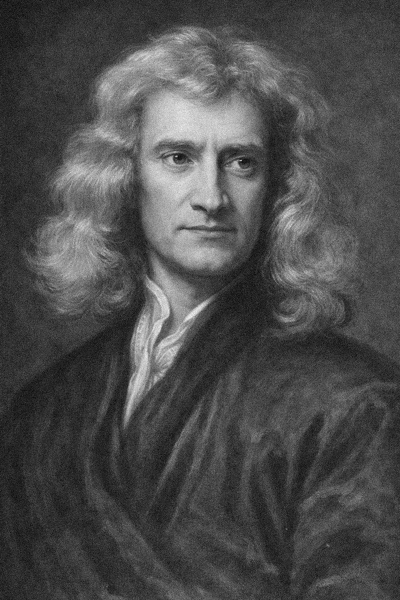
Scientist and Mathematician, 1642 -1727
“If I have been able to see further, it was only because I stood on the shoulders of giants.”
Isaac Newton was born on December 25, 1642 in Woolsthorpe, near Grantham in Lincolnshire, England—the same year Galileo Galilei died. This coincidence is often noted as a symbolic passing of the torch in scientific thought between two extraordinary human beings.
Newton himself arrived under fragile circumstances. He was born prematurely and so small that, as family lore later recalled, he could have fit inside a quart mug—an unpromising beginning for a figure who would later dominate European science. His father, also named Isaac Newton, died three months before his birth, leaving Isaac to be raised in a household shaped by absence and instability. When Newton was three, his mother remarried and left him behind with his maternal grandparents, a separation that deeply affected him and likely contributed to his lifelong emotional reserve and fierce independence.
Newton grew up in a rural agricultural community, far from the intellectual centers of England, but he showed early signs of mechanical ingenuity and intense inward focus. As a boy he built sundials, water clocks, and model windmills, and kept notebooks filled with diagrams, lists, and private reflections. His early schooling at Grantham Grammar School revealed a mind capable of sustained concentration and solitary work, traits that would later define his scientific style. Though initially expected to manage the family farm, Newton proved unsuited to practical agriculture but ideally suited to abstract problem-solving.
His intellectual path widened dramatically when he entered Trinity College, Cambridge in 1661 at 19 years of age. Cambridge exposed him to classical learning, natural philosophy, and mathematics, but Newton largely taught himself by reading aggressively beyond the standard curriculum. During the plague years of 1665–1667, when the university closed and Newton returned to Woolsthorpe, he entered what later became known as his annus mirabilis. Working in isolation, he developed the foundations of calculus, began formulating the laws of motion, and conceived the basic principles of universal gravitation—remarkable achievements produced not through collaboration, but through intense private reasoning.
That solitary mode of work shaped Newton’s relationships as his reputation grew. He was notoriously guarded, slow to publish, and deeply sensitive to criticism. His disputes with Gottfried Wilhelm Leibniz over the invention of calculus and with Robert Hooke over optics and priority reveal both his brilliance and his insecurity. Newton could be generous to allies and ruthless toward rivals, defending his ideas with a tenacity that sometimes bordered on obsession. Yet these conflicts also forced him to sharpen his arguments and formalize his results, culminating in the publication of Philosophiæ Naturalis Principia Mathematica (Principia), urged into print in part through Edmond Halley’s encouragement and diplomacy.
As Newton rose to prominence, his relationships shifted from academic peers to institutional power. His election as President of the Royal Society and later appointment as Master of the Royal Mint placed him at the center of England’s scientific and political establishment. In London, Newton became less the solitary thinker and more the arbiter of scientific legitimacy, shaping what counted as proper method, evidence, and explanation. Though personally reserved and often difficult, he commanded immense respect, and by the end of his life his authority in science was unmatched.
Newton died in London on March 20, 1727 and was buried in Westminster Abbey, the first scientist accorded this honor. A quick scan of the history of science still reveals how often his name appears—not as a footnote, but as a structural beam. Alexander Pope’s famous couplet captured the public awe Newton inspired in his own era:
“Nature and Nature’s laws lay hid in night;
God said, Let Newton be! and all was light.”
###
Profile originally written in December 1995 — Revised January 31, 2026
Resources
Some resources are linked through our affiliate program with Amazon.com. Purchasing these items is a simple way to support our work while expanding your own knowledge base.
Books
The Principia — Sir Isaac Newton
Newton’s foundational work that formulates the laws of motion and universal gravitation, unifying terrestrial and celestial mechanics into a single mathematical framework that became the cornerstone of classical physics.
Isaac Newton: Philosophical Writings — Sir Isaac Newton (ed. Andrew Janiak)
Excerpts from the Principia and Opticks, plus key correspondence (including material often ignored in favor of later debates).
Newton’s Philosophy of Nature: Selections from His Writings — Sir Isaac Newton (ed. H. S. Thayer)
Selections organized by methods, principles, and theological considerations, with notes and cross-references.
The Life of Isaac Newton — Richard Westfall
The definitive scholarly biography of Newton, combining rigorous historical research with psychological insight to trace his scientific achievements, personal struggles, and lasting influence on the modern world.
Newton’s Gift: How Sir Isaac Newton Unlocked the System of the World — David Berlinski
A highly readable narrative biography spanning Newton’s childhood through his later role in England’s financial system.
eTexts
Excerpts from Principia Mathematica — Fordham University
Excerpts from Optics— Fordham University
Documentaries
Biography — Sir Isaac Newton: Gravity of Genius — A&E Home Video
An authoritative documentary portrait that traces Newton’s life from his troubled childhood to his scientific dominance, combining historical reenactment and expert commentary to explain both his genius and his complex, often difficult personality.
Biography — Sir Isaac Newton: Gravity of Genius — A&E Home Video
An authoritative documentary portrait that traces Newton’s life from his troubled childhood to his scientific dominance, combining historical reenactment and expert commentary to explain both his genius and his complex, often difficult personality.
NOVA: Newton’s Dark Secrets — WGBH Boston
A probing documentary that explores the lesser-known sides of Newton’s life, including his religious beliefs, alchemical studies, and personal conflicts, revealing how these hidden pursuits shaped both his science and his worldview.
NOVA — Genius: The Science of Einstein, Newton, Darwin, and Galileo — WGBH Boston
A sweeping exploration of four scientific revolutionaries, showing how their radically different insights reshaped humanity’s understanding of nature, life, and the universe.
Related Videos
Neil deGrasse Tyson: My Man, Sir Isaac Newton
Tyson explains Newton’s achievements and their lasting impact on our understanding of the universe.
Neil deGrasse Tyson:Who is the greatest scientific mind?
Isaac Newton remains the most influential scientist in history. Tyson explains the unmatched scope of Newton’s achievements and their lasting impact.
Websites
This site is awesome. Newton Project is a digital archive based at the University of Oxford. The site provides authoritative transcriptions and interpretations of Isaac Newton’s manuscripts, correspondence, and unpublished writings, revealing the full breadth of Newton’s scientific, mathematical, theological, and alchemical work.
Sir Isaac Newton At Trinity College
Mostly text but good material. Includes a concise historical bio drawn from W. W. Rouse Ball’s classic history of Newton’s life, major scientific achievements, and intellectual legacy. It is presented in a clear, reference-style format suited for students and general readers.
From NASA Glenn Research Center, a clear, beginner-friendly explanation of Newton’s three laws of motion, using plain language and practical examples from aeronautics and spaceflight to show how the laws govern movement, force, and inertia in the real world.
Newton’s Monument at Westminster Abbey
This is the official commemorative page describing Newton’s monument in Westminster Abbey, outlining its symbolism, inscriptions, and historical significance as a testament to Newton’s stature as Britain’s most celebrated scientist.
Neil deGrasse Tyson:Who is the greatest scientific mind?
Isaac Newton remains the most influential scientist in history. Tyson explains the unmatched scope of Newton’s achievements and their lasting impact.