
Meriwether Lewis
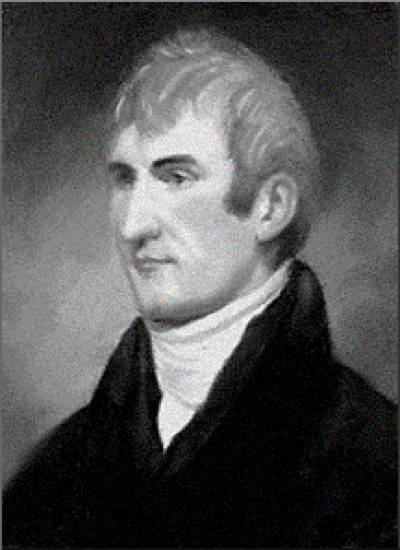
Explorer, 1774 – 1809
“This immense river waters one of the fairest portions of the globe. Nor do I believe that there is in the universe a similar extent of country. As we passed on, it seemed as if those scenes of visionary enchantment would never have an end.”
— Meriwether Lewis, Voyage of Discovery Journal
Meriwether Lewis was born in Albemarle County, Virginia, on August 18, 1774, the second of three children of Lucy Meriwether and John Lewis. His father died when he was five, leaving his mother to manage the family farm. She later remarried, but after his stepfather’s death Lewis assumed responsibility for running the plantation as a young man. Life on the Virginia frontier fostered in him toughness, self-reliance, and an early fascination with the natural world.
In 1794 Lewis joined the Virginia militia during the Whiskey Rebellion and soon after entered the U.S. Army. Serving on the western frontier, he gained valuable experience in wilderness survival, discipline, and leadership. Rising to the rank of captain by 1800, he became known for his steadiness and intellect—qualities that brought him to the attention of President Thomas Jefferson.
In 1801 Jefferson appointed Lewis his personal secretary. Recognizing Lewis’s talents, Jefferson chose him to lead an expedition to explore the Louisiana Purchase, secure relations with Native nations, and search for a practical route to the Pacific. Lewis invited his former comrade William Clark to share command, and the two agreed to act as equal leaders.
Lewis prepared meticulously. In Philadelphia he studied celestial navigation, medicine, botany, and zoology; he acquired advanced scientific instruments and oversaw the design of a custom 55-foot keelboat. Together with Clark, he recruited the Corps of Discovery—about 45 enlisted soldiers and frontier hands, chosen for their skills, endurance, and loyalty.
In May 1804 the Corps set out from Camp Dubois near St. Louis, ascending the Missouri River. They wintered among the Mandan and Hidatsa in North Dakota before pressing west in 1805. With the aid of the Shoshone—including the young woman Sacagawea and her husband Toussaint Charbonneau—the Corps secured horses to cross the Bitterroot Mountains. Later, the Nez Perce provided critical food and shelter, and the Chinook traded with them along the Columbia River. These alliances often meant the difference between survival and failure.
By November 1805 the Corps reached the Pacific and wintered at Fort Clatsop, near present-day Astoria, Oregon. They returned to St. Louis in September 1806, having traveled some 8,000 miles. Lewis served as commander and naturalist, carefully documenting geography, flora, fauna, and Native cultures with scientific precision, while Clark excelled at mapping and field leadership. Together they provided the young republic with its first systematic knowledge of the West.
After the expedition, Jefferson rewarded Lewis by appointing him governor of the Louisiana Territory in 1807. But administrative work and political disputes wore heavily on him. Burdened by debt and bouts of depression, he set out for Washington in 1809 to resolve his affairs. On October 11, at Grinder’s Stand along the Natchez Trace in Tennessee, Lewis died violently under circumstances still debated—many believed suicide, others suspected murder. Though his life ended tragically at 35, his journals, specimens, and records—paired with Clark’s maps—transformed America’s understanding of its western lands.
###
Profile originally written August 1995 | Last revised: August 24, 2025
Resources
Some resources are linked through our affiliate program with Amazon.com—a simple way to support our work while expanding your own library.
Books
The Journals of Lewis and Clark — Meriwether Lewis, William Clark, Frank Bergon (Editor)
A richly detailed record of the journey from St. Louis to the Pacific.
Undaunted Courage: Meriwether Lewis, Thomas Jefferson and the Opening of the American West — Stephen Ambrose
A biography grounded in the leaders’ journals, paired with the author’s retracing of their route.
Lewis and Clark: Across the Divide — Carolyn Gilman, Robert A. Robertson, James P. Ronda
Official companion to the Lewis and Clark National Bicentennial Exhibition.
DVDs
National Geographic – Lewis & Clark: Great Journey West (2002)
National Geographic’s dramatization of the expedition.
Lewis & Clark – The Journey of the Corps of Discovery (1997)
Ken Burns documentary weaving historical accounts with visuals.
Videos
Lewis & Clark: Explorers of the New Frontier | Full Documentary
The Mysterious Death of Meriwether Lewis | Historical Investigation
Websites
The Lewis and Clark National Historic Trail winds nearly 4,900 miles through the homelands of more than 60 Tribal nations. It follows the historic outbound and inbound routes of the Lewis and Clark Expedition of 1803-1806 from Pittsburgh, Pennsylvania to the Pacific Ocean. Follow the trail to find the people, places, and stories that make up the complex legacy of the expedition.
Lewis & Clark Trail Alliance — The Lewis and Clark National Historic Trail was established by the United States Congress in 1978 as part of the national trails system. The trail “winds nearly 4,900 miles through the homelands of more than 60 Tribal nations. It follows the historic outbound and inbound routes of the Lewis and Clark Expedition of 1803-1806 from Pittsburgh, Pennsylvania to the Pacific Ocean.”
PBS – Settling the West — A nine-part series chronicling the turbulent history of one of the most extraordinary landscapes on earth. Beginning when the land belonged only to Native Americans and ending in the 20th century, the film introduces unforgettable characters, including William Clark, whose competing dreams transformed the land. It was a tragic, inspiring intersection where the best of us met the worst of us — and nothing was left unchanged.