
Thomas Jefferson
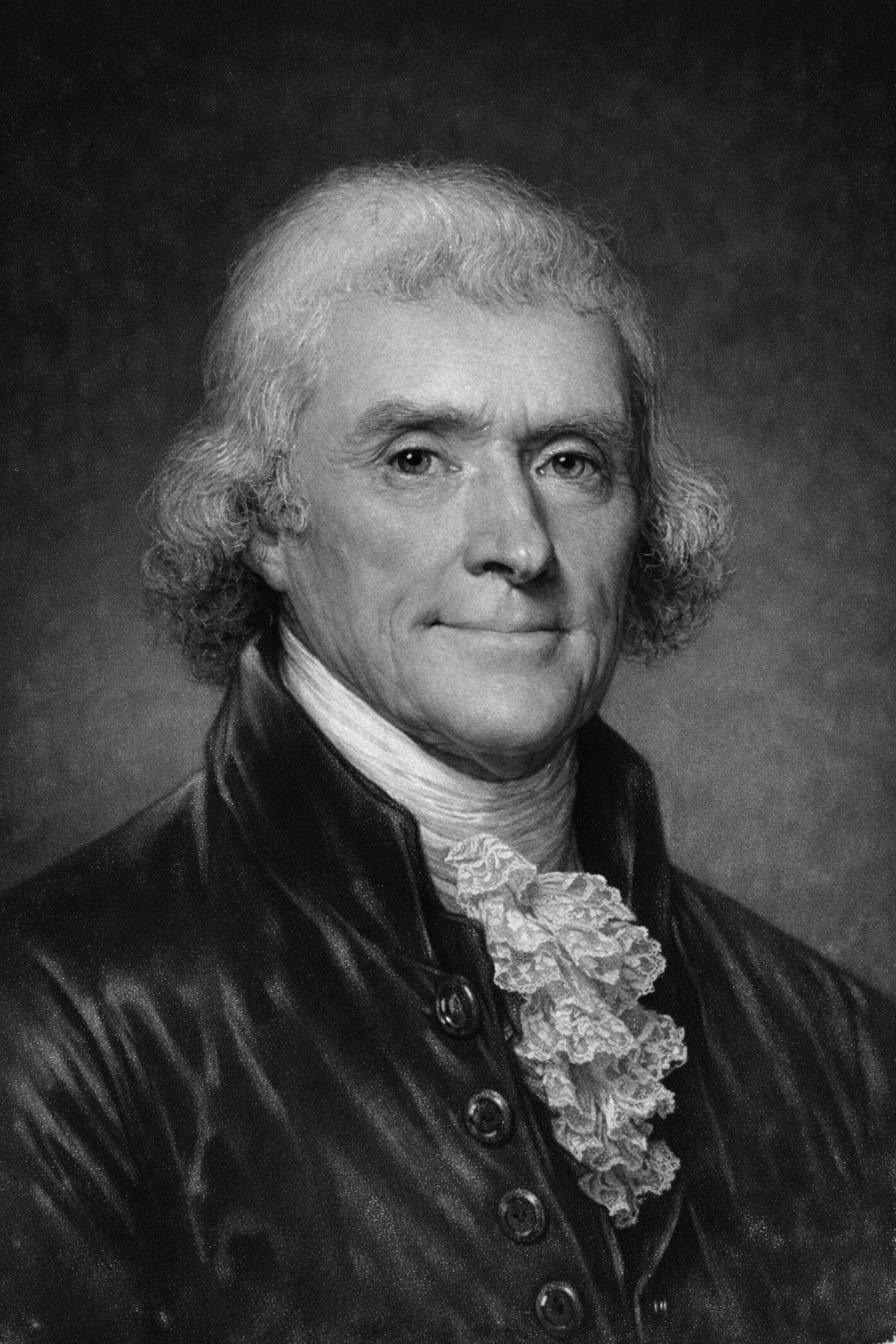
Founding Father • Author of the Declaration of Independence • Enlightenment Statesman, 1743–1826
“[The people] are in truth the only legitimate proprietors of the soil and government.”
Thomas Jefferson stands at the center of the American experiment—its most eloquent advocate and one of its most complicated architects. Born into the Virginia planter class and shaped by Enlightenment thought, he believed that human beings possessed natural rights no government could justly deny. His life’s work was an attempt—imperfect and often contradictory—to translate those ideas into a functioning republic.
Jefferson was born on April 13, 1743, at Shadwell in Albemarle County, Virginia, then a frontier region of the British American colonies. The area was still being carved from forests and wilderness. Jefferson grew up in a household that combined frontier practicality with intellectual ambition. His father, Peter Jefferson, was a successful planter, surveyor, and mapmaker whose work helped define the geography of colonial Virginia. His mother, Jane Randolph Jefferson, came from one of the colony’s most prominent families, linking Jefferson to Virginia’s social and political elite. From this blend of frontier pragmatism and aristocratic tradition, Jefferson developed a lifelong belief that education, reason, and self-government formed the foundations of a free society.
Jefferson inherited a substantial estate from his father at age fourteen, along with the responsibilities of landownership and social leadership in colonial Virginia. He was educated first by local tutors and later attended the College of William & Mary in Williamsburg. There he encountered some of the most influential mentors of his life. Among them was the Scottish professor William Small, who introduced Jefferson to Enlightenment thinkers such as John Locke, Isaac Newton, and Francis Bacon. Jefferson later described this period as the turning point of his intellectual life. Through Small’s guidance—and through conversations with Virginia’s royal governor Francis Fauquier and the eminent lawyer George Wythe—Jefferson entered a circle that valued reason, science, architecture, and political philosophy.
After studying law under George Wythe, Jefferson established himself as a respected attorney and planter. In 1772 he married Martha Wayles Skelton, a young widow whose inheritance significantly expanded his estate, and whose companionship he valued deeply. The marriage strengthened his standing among Virginia’s planter elite and tied his fortunes more firmly to the plantation system that shaped the colony’s economy and social order.
This system also embodied one of the central contradictions of early American history. Although Jefferson wrote the words “all men are created equal,” he remained a lifelong slaveholder. Like many members of Virginia’s planter elite, he inherited both land and enslaved people as part of the structure that defined wealth, status, and responsibility in colonial Virginia. Over the course of his life he expressed moral unease about slavery and occasionally proposed gradual emancipation, yet he freed only a small number of the people he enslaved. Modern scholarship has also documented his long and complex relationship with the Hemings family, including strong evidence that he fathered children with Sally Hemings, an enslaved woman at Monticello. These realities place Jefferson within the profound ethical tensions of his time, illustrating the gap that could exist between Enlightenment ideals and the social and economic realities of eighteenth-century Virginia.
Jefferson entered politics as tensions between the American colonies and Great Britain rapidly escalated. At twenty-five he was elected to the Virginia House of Burgesses, where he aligned himself with leaders advocating colonial rights. His skill as a writer and political thinker soon became clear. When the Continental Congress convened in Philadelphia in 1776 to consider independence, Jefferson—still in his early thirties—was appointed to the Committee of Five with John Adams, Benjamin Franklin, Roger Sherman, and Robert Livingston to draft a declaration explaining the colonies’ decision to separate from Britain.
Jefferson wrote the first draft of what became the Declaration of Independence. Drawing on Enlightenment philosophy, colonial grievances, and his own political convictions, he argued that legitimate governments derive their authority from the consent of the governed. Adams and Franklin suggested revisions, and Congress made additional edits, but Jefferson’s language and structure defined the final document. The Declaration established principles that would resonate far beyond the American Revolution, presenting liberty, equality, and natural rights as universal ideals.
After the Revolution, Jefferson served the new nation in several diplomatic roles. In 1784 he traveled to Europe as a commissioner negotiating commercial treaties and later succeeded Benjamin Franklin as American minister to France. During his years in Paris he observed the early stages of the French Revolution and formed close friendships with leading reformers, including the Marquis de Lafayette. Jefferson supported many of the Revolution’s early constitutional aims and even advised Lafayette on elements of the Declaration of the Rights of Man. At first he sympathized with the movement, but he later grew troubled by the violence that followed. His time in Europe reinforced his admiration for Enlightenment thought while strengthening his belief that republican government required balance and restraint.
Jefferson remained abroad during the Constitutional Convention of 1787 and therefore played no direct role in drafting the United States Constitution. Even so, his influence was felt through correspondence with allies such as James Madison. Jefferson strongly supported the addition of a Bill of Rights, arguing that the new government must explicitly protect freedoms such as speech, religion, and due process.
Jefferson returned to the United States to serve as the first Secretary of State under President George Washington. His tenure brought sharp disagreements with Treasury Secretary Alexander Hamilton over the direction of the young republic. Hamilton favored a strong central government and close ties with financial interests. Jefferson envisioned a more decentralized republic grounded in agriculture and individual liberty. Their rivalry helped give rise to the first American political parties.
In 1800 Jefferson was elected the third President of the United States after a bitter election. His victory marked the first peaceful transfer of power between rival political factions, an event he later called the “Revolution of 1800.” The defining achievement of his presidency came in 1803 with the Louisiana Purchase. For fifteen million dollars, the United States acquired a vast territory from France that doubled the nation’s size and opened the interior of North America to exploration. Jefferson soon commissioned Meriwether Lewis and William Clark to explore the new lands and seek a route to the Pacific.
Jefferson’s second term proved more difficult. International tensions between Britain and France disrupted American trade and threatened to pull the United States into European conflicts. At home, he faced political controversies including the Burr Conspiracy, in which former Vice President Aaron Burr was tried for treason after allegedly plotting to create an independent nation in the western territories.
Jefferson left the presidency in 1809 and retired to Monticello. During the final seventeen years of his life he devoted himself to intellectual pursuits, architecture, agriculture, and an extensive correspondence with many leading figures of the age. His letters with John Adams—once a rival and later a close friend—form one of the most remarkable exchanges in American intellectual history.
Jefferson’s last major public achievement was founding the University of Virginia in 1819. Designed according to his own architectural plans, the university reflected his conviction that education was essential to preserving republican government. Unlike many institutions of the era, it emphasized science, modern languages, and secular inquiry.
Thomas Jefferson died at Monticello on July 4, 1826, exactly fifty years after the adoption of the Declaration of Independence. On that same day, hundreds of miles away, his old friend and rival John Adams also died. Jefferson left a complex legacy: philosopher of liberty, architect of democratic ideals, statesman, inventor, architect, and lifelong student of human knowledge.
###
Profile originally written August 1995 | Revised June 5, 2026
Resources
Some resources are linked through our affiliate program with Amazon.com. Buying these items is a simple way to support our work while expanding your own knowledge base.
Click here to see The Declaration of Independence
Books
Thomas Jefferson: A Life— Willard Sterne Randall
A sweeping biography that traces Jefferson’s life from his youth in colonial Virginia through his presidency and retirement at Monticello, portraying him as one of the most intellectually curious leaders of the early republic.
The Inner Jefferson: Portrait of a Grieving Optimist — Andrew Burstein
A psychological portrait that explores the emotional life of Jefferson and the private motivations that shaped his public accomplishments.
American Sphinx: The Character of Thomas Jefferson— Joseph J. Ellis
A Pulitzer Prize–winning biography that examines the contradictions and complexities of Jefferson’s personality and political philosophy.
The Long Affair: Thomas Jefferson and the French Revolution, 1785–1800— Conor Cruise O’Brien
A provocative interpretation of Jefferson’s relationship to the French Revolution and its influence on his political thinking.
Sworn on the Altar of God: A Religious Biography of Thomas Jefferson— Edwin S. Gaustad
An exploration of Jefferson’s religious views and his influential role in shaping the American principle of separation between church and state.
Jefferson and Monticello: The Biography of a Builder— Jack McLaughlin
A biography that examines Jefferson’s life through his architectural vision and lifelong dedication to designing and rebuilding Monticello.
The Life and Selected Writings of Thomas Jefferson — Adrienne Koch and William Peden (Editors)
A comprehensive collection of Jefferson’s letters, speeches, and essays providing insight into the intellectual foundations of the American republic.
The Republic of Letters: The Correspondence Between Thomas Jefferson and James Madison 1776–1826— James Morton Smith
A rich collection of letters between Jefferson and Madison that reveals how two founding statesmen shaped the philosophy and policy of the early United States.
Documentaries
Thomas Jefferson – Philosopher of Freedom- A&E Biography
A documentary overview of Jefferson’s life and ideas, examining his role in shaping the philosophical foundations of the United States.
Thomas Jefferson- Ken Burns Documentary
This Ken Burns’ documentary follows Jefferson from colonial Virginia through the presidency and explores his lasting influence on American democracy.
Thomas Jefferson - The White House
A concise overview of Jefferson’s role as principal author of the Declaration of Independence, a key architect of early American republican ideals, and the nation’s third president, while situating his life within the broader history of the early United States.
eTexts
Thomas Jefferson Papers— Library of Congress
The largest collection of Jefferson’s original writings, letters, and documents, preserved by the Library of Congress.
Official Documents and Personal Letters by Thomas Jefferson
A selection of Jefferson’s writings illustrating his views on religion, government, and individual liberty.
Jefferson’s edited compilation of the moral teachings of Jesus, reflecting his rationalist approach to religion.
Websites
Lucidcafe’s take on the architects of the Declaration of Independence.
Life of Jefferson - 1834 Biography by B. L. Rayner
A nineteenth-century biography that emphasizes Jefferson’s role in shaping republican political principles. Includes selections from the most valuable portions of his voluminous private correspondence.
Monticello — The Home of Thomas Jefferson
The official website of Jefferson’s historic home and plantation, offering extensive historical resources and research.
White House Profile of Thomas Jefferson
The official presidential biography summarizing Jefferson’s role as the third President of the United States.
Lucidcafe’s overview to the men tasked with writing the United States Declaration of Independence.