
Samuel Adams
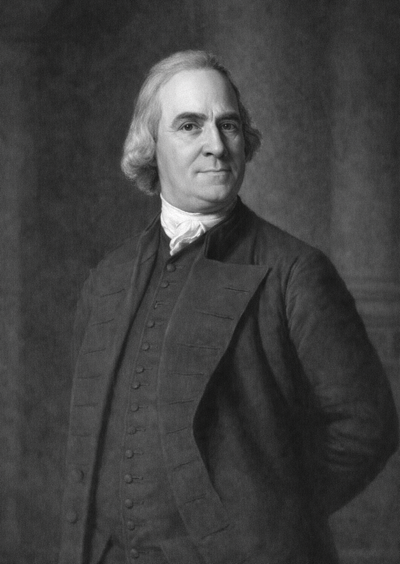
American Patriot & Political Agitator, 1722–1803
“If ye love wealth greater than liberty, the tranquility of servitude greater than the animating contest for freedom, go home from us in peace. We seek not your counsel, nor your arms. Crouch down and lick the hand that feeds you; May your chains set lightly upon you, and may posterity forget that ye were our countrymen.”
In the decades leading up to the American Revolution, colonial resistance didn’t emerge fully formed—it was organized, sharpened, and sustained by people willing to push public opinion toward confrontation. Among them, Samuel Adams stands out not as a military leader or constitutional architect, but as a political catalyst. Where Benjamin Franklin built alliances, Thomas Jefferson articulated ideals, and James Madison designed systems of government, Adams mobilized resistance, shaping public sentiment, and turning grievance into organized opposition. He helped create the conditions in which revolution became possible.
Samuel Adams was born in Boston, Massachusetts, on September 27, 1722, into a world where religion, commerce, and politics were tightly interwoven. His father, a successful brewer and deacon, was deeply involved in local affairs and colonial resistance to British economic controls. When British authorities later dismantled one of his father’s financial ventures, the episode left a lasting impression on the younger Adams, reinforcing a suspicion of distant authority and arbitrary power. This early experience helped shape his lifelong hostility toward imperial overreach.
Adams attended Harvard College, graduating in 1743 with a Master of Arts degree—a broad classical education. His studies placed him within the intellectual currents of the Enlightenment, but his temperament leaned less toward abstract philosophy and more toward moral argument and political action. He briefly considered the ministry. He never entered it, but the influence remained. His political language carried the tone of a sermon—moral, urgent, and uncompromising.
After college, Adams drifted through a series of business efforts, none particularly successful. Yet failure in commerce pushed him toward his real strength: politics. Boston’s town meetings became his arena. There he developed a reputation as a tireless organizer and persuasive speaker, skilled at framing political disputes in terms ordinary citizens could understand. Where others debated policy, Adams framed questions of liberty and rights.
By the 1760s, tensions between Britain and the colonies were intensifying. Adams emerged as a vocal critics of Parliamentary taxation, particularly measures such as the Stamp Act and later the Tea Act. His opposition wasn’t merely reactive—it was strategic. He helped establish committees of correspondence, networks that allowed the colonies to coordinate resistance and share information. These systems became an early form of political infrastructure for revolution.
In 1772 Adams drafted a statement of colonial rights that argued Parliament had no authority to tax the colonies without representation. The document circulated widely and helped unify colonial opposition. His role in organizing resistance reached a peak in 1773 with the Boston Tea Party, when colonists dumped British tea into Boston Harbor in protest of monopoly and taxation. Though Adams did not personally lead the action, his influence helped create the conditions that made it possible.
Britain’s response—the Intolerable Acts—only hardened colonial resistance. Adams pushed for broader coordination among the colonies, helping drive the movement toward continental cooperation. In 1774 he was sent as a delegate to the First Continental Congress, and he returned for the Second Continental Congress, where the shift from protest to independence became explicit.
Adams was a strong advocate for breaking from Britain and signed the Declaration of Independence in 1776. While Jefferson gave the revolution its philosophical language, Adams ensured the will to act existed. His strength wasn’t theoretical clarity but political pressure—he made inaction difficult.
Unlike figures such as Franklin or Madison, Adams played a smaller role in shaping the national government that followed independence. He remained wary of centralized power and initially opposed the Constitution, fearing it might replicate the kinds of authority the revolution had resisted. Eventually, he supported ratification, but only with the understanding that individual liberties would be protected—a concern that contributed to the adoption of the Bill of Rights.
Adams served as governor of Massachusetts from 1793 to 1797, closing a long public career that had begun in local agitation and ended in state leadership. His trajectory reflects a broader arc within the revolutionary generation: from resistance to governance, from protest to institution-building.
Samuel Adams died in Boston on October 2, 1803 at 81. He is remembered less for a single document or office than for a sustained effort to shape the public will. If the American Revolution required thinkers, diplomats, and generals, it also required someone willing to keep the pressure constant—to turn discontent into action. Adams filled that role. He was not the architect of the American system, but he was one of the men who made its creation unavoidable.
###
Original profile written September, 1995. Updated March 28, 2026
Resources
Some resources are linked through our affiliate program with Amazon.com. Buying these items is a simple way to support our work while expanding your own knowledge base.
Books
Samuel Adams: A Life — by Ira Stoll
A modern, well-researched biography that restores Adams to his central role as a driving force behind colonial resistance and independence.
Samuel Adams: Father of the American Revolution — by Mark Puls
A concise and accessible account emphasizing Adams’s role as an organizer, strategist, and catalyst for revolutionary action.
Samuel Adams: Radical Puritan — by Lillian & William Fowler
A classic study exploring the religious and moral framework that shaped Adams’s political philosophy and rhetoric.
The Glorious Cause— by Robert Middlekauff
A broader history of the American Revolution that places Adams within the larger political and military struggle.
Documentaries
The American Revolution— PBS/WEDU Series
A multi-part documentary series that examines the political, social, and military forces that shaped the American Revolution, including the role of figures like Samuel Adams in organizing colonial resistance.
History Classics: The Revolution— History Channel
A documentary overview of the American Revolution that traces its key events and figures, highlighting the political tensions and leadership that drove the colonies toward independence.
Samuel Adams eTexts
Massachusetts Circular Letter (1768)
A coordinated protest against British taxation sent to other colonies, helping unify opposition and laying the groundwork for intercolonial resistance.
The Rights of the Colonists (1772)
A clear and forceful statement of colonial rights, arguing that Parliament had no authority to tax the colonies without representation and grounding that claim in natural law.
The Collected Works of Samuel Adams — Project Gutenberg
A comprehensive multi-volume collection of Adams’s letters, essays, and political documents, revealing his role in shaping revolutionary strategy and public sentiment.
Websites
Samuel Adams – Biography— National Park Service
Overview of Adams’s life and role in the revolutionary movement, with reliable historical context.
Samuel Adams – American Battlefield Trust
An overview of Adams’s role in organizing resistance and key events leading to the Revolution.
Samuel Adams – Library of Congress
A curated collection of historical materials and documents related to Adams and the Revolutionary era.