
James Madison
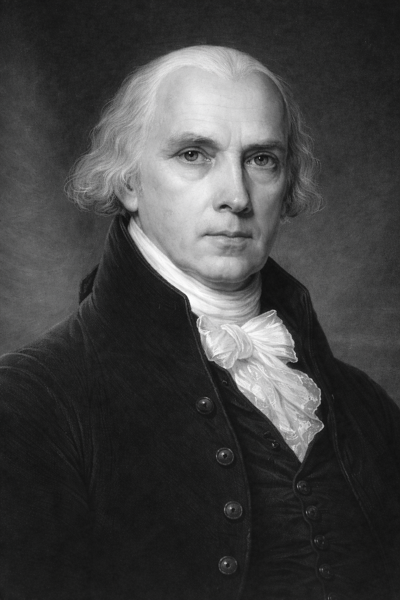
Principal Architect of the U.S. Constitution & Fourth President, 1751–1836
“If men were angels, no government would be necessary.”
James Madison was born at a moment when the political foundations of the modern world were shifting. Across Europe and the American colonies, Enlightenment thinkers debated the nature of liberty, authority, and the structure of government. Philosophers such as John Locke and Montesquieu argued that political power should be limited by law and balanced through institutions. In the American colonies, leaders such as Benjamin Franklin, George Washington, and Thomas Jefferson were beginning to translate these ideas into political action. From this intellectual climate Madison would emerge as the most systematic political thinker among the American founders and the principal architect of the United States Constitution.
Madison was born on March 16, 1751, at his grandparents’ home in Port Conway, Virginia, while his mother was visiting family. Soon after his birth she returned with the infant Madison to the family plantation at Montpelier in Orange County. Madison grew up as the eldest son of a prosperous Virginia planter family whose position placed them among the leadership class of colonial society. Yet Madison himself was physically slight and often in poor health. Periods of illness forced him to spend long hours reading and studying. These habits helped shape his intellectual character. Books, rather than physical adventure, became the landscape of his early life.
In 1769 Madison entered the College of New Jersey—today Princeton University—where he quickly distinguished himself as a brilliant student. At the time the college was strongly influenced by Enlightenment thought, particularly the ideas of the Scottish moral philosophers circulating throughout the Atlantic world. Madison completed four years of coursework in only two years, studying history, political philosophy, and classical literature. For a time he considered entering the ministry and remained at Princeton for an additional year studying theology and Hebrew. The college’s demanding intellectual environment sharpened his interest in political authority, religious liberty, and the principles of republican government.
A central influence on Madison was the College of New Jersey’s president, John Witherspoon, a Scottish minister who had brought the ideas of the Scottish Enlightenment directly into the curriculum. Through Witherspoon’s lectures on moral philosophy, political theory, and natural rights, Madison encountered thinkers such as Francis Hutcheson, David Hume, and Adam Smith. This training encouraged students to examine the moral foundations of government and the limits of political power—questions that would later stand at the center of Madison’s thinking about constitutional design, religious liberty, and the structure of the American republic.
Returning to Virginia in the early 1770s, Madison entered public life just as tensions between Britain and the colonies approached revolution. In 1775 he served on the Orange County Committee of Safety, an organization that coordinated local resistance to British authority. The following year he was elected to the Virginia Convention of 1776, where he supported a declaration of rights that included protections for religious freedom. During this period he met Thomas Jefferson, a fellow Virginian whose intellect and political vision strongly influenced him. The two men would form one of the most enduring intellectual partnerships of the founding generation.
Madison was elected to the Continental Congress in 1779 and served through the closing years of the Revolutionary War. Poor health prevented him from military service, but he contributed through political organization and legislative work. During the 1780s Madison grew increasingly concerned about the weakness of the national government under the Articles of Confederation. The young republic, he believed, could not survive if the states remained loosely connected and politically divided.
In 1787 Madison traveled to Philadelphia as a delegate to the Constitutional Convention. Before the convention began he arrived early and studied historical examples of confederations and republics, searching for lessons that could guide the design of a stable national government. Working with the Virginia delegation, Madison helped draft what became known as the Virginia Plan. The proposal replaced the weak confederation with a stronger federal system based on representation and divided powers.
During the convention Madison spoke more than 150 times and became one of the central figures shaping the debates. His detailed notes, recorded day by day, later became the most important record of the proceedings. Because of his intellectual leadership at the convention and his later defense of the Constitution, Madison would eventually earn the title “Father of the Constitution.” Yet Madison himself rejected the idea that any single person deserved that credit, insisting that the Constitution was “the work of many heads and many hands.”
After the convention Madison turned to persuading the states to ratify the new Constitution. Together with Alexander Hamilton and John Jay, he wrote a series of essays explaining and defending the proposed system of government. Published in newspapers and later collected as The Federalist Papers, these essays became one of the most influential works of political theory ever written.
Madison then served in the newly established United States House of Representatives. Although he had initially believed that the Constitution itself adequately protected liberty, he soon supported a series of amendments designed to safeguard individual rights. Ten of these amendments were ratified by the states and became the Bill of Rights, one of the most enduring features of the American constitutional system.
In 1794 Madison married Dolley Payne Todd, a Philadelphia widow whose intelligence, warmth, and political skill would make her one of the most admired figures in early American society. Dolley Madison became famous for her role as a political hostess, helping build alliances and maintain social networks within the new republic.
Madison returned to national leadership in 1801 when Thomas Jefferson appointed him Secretary of State. As Jefferson’s closest political ally, Madison helped guide the foreign policy of the young nation during a period of growing tension with European powers. In 1808 Madison was elected the fourth President of the United States.
His presidency was dominated by conflict with Britain, culminating in the War of 1812. The war proved difficult for the young nation, and in 1814 British troops even captured and burned Washington, D.C. Yet the conflict ultimately strengthened American national identity and confirmed the country’s independence from European power politics.
After leaving the presidency in 1817, Madison retired to Montpelier. During his long retirement he remained active in public affairs, advising political leaders and supporting educational initiatives. He worked closely with Thomas Jefferson in developing the University of Virginia and later served as the institution’s second rector after Jefferson’s death.
Madison also spent many years editing his detailed notes of the Constitutional Convention to ensure that future generations would understand how the Constitution had been created. These notes were published several years after his death and remain one of the most valuable historical records of the founding era.
James Madison died at Montpelier on June 28, 1836, at the age of eighty-five. Today he is remembered as the most systematic political thinker among the American founders—a statesman who translated Enlightenment philosophy into the practical architecture of republican government.
###
Profile written March 17, 2026
Resources
Some resources are linked through our affiliate program with Amazon.com. Buying these items is a simple way to support our work while expanding your own knowledge base.
Books
Notes of Debates in the Federal Convention of 1787 — by James Madison
Madison’s detailed record of the Constitutional Convention remains the single most important primary source for understanding how the United States Constitution was created.
James Madison: Writings 1772–1836 — by James Madison
A comprehensive collection of Madison’s essays, speeches, and political papers covering the American Revolution through his post-presidential years.
The Federalist— by Alexander Hamilton, James Madison, and John Jay
A classic series of essays defending the United States Constitution and explaining the principles of federal republican government.
James Madison— by Garry Wills
A concise biography examining Madison’s role as a constitutional thinker and evaluating his presidency within the broader history of the early republic.
James Madison: A Biography— by Ralph Ketcham
A detailed scholarly biography exploring Madison’s political philosophy, constitutional leadership, and lifelong commitment to republican government.
Father of the Constitution— by Barbara Mitchell
An accessible introduction to Madison’s life and constitutional contributions written for younger readers.
Documentaries
A More Perfect Union: America Becomes a Nation
A historical dramatization of the Constitutional Convention that captures the debates and personalities involved in creating the United States Constitution.
A documentary based on Joseph Ellis’s Pulitzer Prize–winning book examining the relationships and rivalries among the leaders of the early American republic.
James Madison eTexts
Memorial and Remonstrance Against Religious Assessments
Madison’s influential defense of religious liberty arguing against government support of religious institutions.
The complete collection of essays defending the ratification of the Constitution.
Madison’s opening statement outlining his vision for the presidency.
Madison’s reflections on the nation following the War of 1812.
Websites
James Madison Papers — University of Virginia
A major scholarly archive preserving Madison’s correspondence and political writings.
Montpelier — The Home of James Madison
The historic Virginia estate where Madison lived, worked, and wrote much of his political thought.
James Madison Center for Free Speech
A legal organization devoted to protecting First Amendment rights.
Library of Congress Exhibition: Madison’s Treasures
A digital exhibition featuring original documents and artifacts from Madison’s life.