
Adam Smith
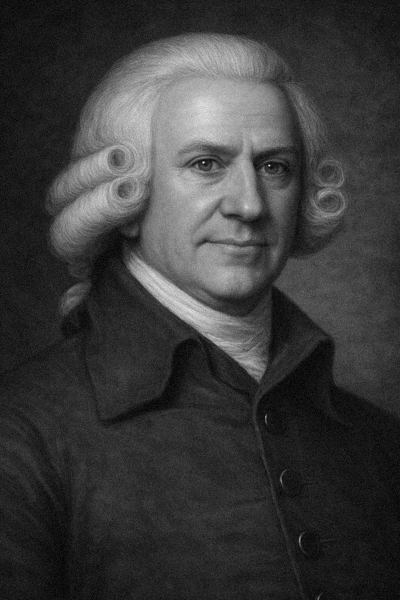
Philosopher and Founder of Modern Economics — 1723–1790
“Virtue is more to be feared than vice, because its excesses are not subject to the regulation of conscience.”
Adam Smith was born at a moment when Europe was beginning to rethink the foundations of society. The old order of hereditary privilege and mercantilist control still dominated politics and trade, but new ideas about liberty, commerce, and human behavior were spreading across the continent. In Scotland, the Scottish Enlightenment turned cities such as Edinburgh and Glasgow into centers of inquiry. Philosophers, historians, and scientists asked whether society itself could be studied through reason. Figures such as David Hume, Francis Hutcheson, and later James Watt explored questions about morality, political authority, and economic life. Smith emerged from this intellectual climate as the thinker who explained how a commercial society works.
He was born in Kirkcaldy, Fife, Scotland, and baptized on June 5, 1723. Kirkcaldy was a small coastal town across the Firth of Forth from Edinburgh, yet it stood within the orbit of one of Europe’s most active intellectual communities. His father, also named Adam Smith, served as a customs official and died shortly before his son was born. Smith was raised by his mother, Margaret Douglas, whose guidance shaped his early life and education. Scotland itself was changing rapidly. The 1707 union with England tied the country to the expanding British Empire, and debates about trade, industry, and national identity filled the public conversation. Growing up between a provincial town and a widening commercial world sharpened Smith’s interest in how economic systems shape society.
As a child Smith was known for deep concentration and an absent-minded temperament. One well-known story recalls that he was briefly kidnapped by traveling entertainers before being quickly recovered by family members. The episode became part of Smith’s early legend. From a young age he showed a strong curiosity about books and ideas.
Smith studied at the University of Glasgow, where he came under the influence of the philosopher Francis Hutcheson. Hutcheson’s lectures on moral philosophy emphasized sympathy, virtue, and the moral foundations of society. These ideas left a lasting mark on Smith’s thinking. Smith later attended Balliol College at Oxford, but he found the intellectual climate there stagnant compared with the energetic debates of Scotland. During these years he read widely in classical philosophy, history, and literature, building the intellectual base for his later work.
In 1751 Smith became Professor of Logic at the University of Glasgow, and the following year he assumed the chair of Moral Philosophy, a position he held for more than a decade. His lectures covered ethics, rhetoric, jurisprudence, and political economy. Students described them as wide-ranging and intellectually ambitious. Smith linked philosophical ideas with practical questions about commerce and social order.
In 1759 he published The Theory of Moral Sentiments, a book that grew out of those lectures. It examined the moral forces that hold societies together and emphasized the role of sympathy—our ability to imagine ourselves in the position of others. Smith argued that human beings are not guided solely by self-interest. They also possess moral instincts that support fairness, cooperation, and social stability.
Smith’s reputation soon spread across Europe. He formed a close friendship with David Hume, whose intellectual rigor strongly influenced him. In 1764 Smith left Glasgow to serve as tutor to the young Duke of Buccleuch. The position allowed him to travel through France and Switzerland, where he met leading European thinkers including Voltaire, François Quesnay, and Anne-Robert-Jacques Turgot. These economists, associated with the Physiocrats, believed that economic life followed natural laws. Their ideas broadened Smith’s thinking about markets, agriculture, and political economy.
After returning to Britain, Smith spent nearly ten years refining the work that would define his career. In 1776 he published An Inquiry into the Nature and Causes of the Wealth of Nations, commonly referred to as The Wealth of Nations, one of the most influential books in the history of economics. The book examined how societies generate prosperity. Smith explained the importance of the division of labor, the operation of markets, the role of trade, and the incentives created by individual self-interest.
Within this work Smith introduced the famous metaphor of the “invisible hand.” Individuals pursuing their own interests, he argued, often contribute unintentionally to the broader prosperity of society. Through exchange and competition, markets coordinate economic activity without central direction. With this work Smith helped establish economics as a distinct field of study and laid the intellectual foundation for modern ideas about free markets and commercial society.
Smith’s ideas quickly spread beyond Britain. American founders such as Thomas Jefferson, James Madison, and Alexander Hamilton studied his arguments about commerce and liberty while designing the economic foundations of the new United States. His work influenced debates about trade, taxation, and economic policy and helped shape the intellectual background of the modern market economy.
In 1778 Smith accepted a post as Commissioner of Customs in Edinburgh. He returned to Scotland and lived quietly there for the rest of his life. Although he is remembered as a defender of markets, his final position involved supervising trade regulation and customs administration. The role reflected his practical view that government still had necessary functions within a commercial system.
Adam Smith died in Edinburgh on July 17, 1790. After his death it became known that he had quietly given much of his wealth to charitable causes. Today he is remembered as one of the central figures of the Enlightenment and the founding thinker of modern economics—one of the first to explain how the everyday exchange of goods, labor, and ideas could shape the wealth of nations.
###
Profile originally written June 1996 | Revised March 16, 2026
Resources
Some resources are linked through our affiliate program with Amazon.com. Buying these items is a simple way to support our work while expanding your own knowledge base.
Books
The Wealth of Nations: An Inquiry into the Nature and Causes — Adam Smith
Smith’s landmark 1776 work explaining how markets, specialization, and trade create national prosperity.
Essential Adam Smith — Adam Smith, edited by Robert L. Heilbroner
A carefully selected collection of Smith’s most important writings drawn primarily from The Wealth of Nations and The Theory of Moral Sentiments.
Adam Smith and the Origins of American Enterprise — Roy C. Smith
Examines how Smith’s economic ideas influenced early American leaders such as Alexander Hamilton, James Madison, and Benjamin Franklin.
On Adam Smith — Jack Russell Weinstein
A concise introduction to Smith’s philosophical and economic ideas designed for students and readers new to his work.
Documentaries
A collection of presentations by Nobel Prize–winning economists discussing the future of capitalism at the Milken Institute Global Conference.
Commanding Heights: The Battle for the World Economy
A documentary series based on the book by Daniel Yergin and Joseph Stanislaw exploring globalization and the competing economic systems shaping the modern world.
Adam Smith eTexts
The Wealth of Nations— Online
A full online text of Smith’s influential work examining markets, trade, and economic growth.
The Theory of Moral Sentiments— PDF
Smith’s earlier philosophical work exploring sympathy, morality, and the ethical foundations of society.
Websites
A policy research organization dedicated to promoting free markets and classical liberal economic ideas.
Account of the Life and Writings of Adam Smith— Dugald Stewart (1793)
An early biography written by Smith’s student and colleague describing his life and philosophical contributions.
A comprehensive digital hub dedicated to exploring the life, writings, and enduring influence of Adam Smith, featuring essays, primary texts, commentary, and educational resources on economics, philosophy, and classical liberal thought.
International Adam Smith Society
An international network of students, scholars, and professionals dedicated to exploring the ideas of Adam Smith and their relevance to questions of markets, morality, and the role of business in society.