
Benjamin Franklin
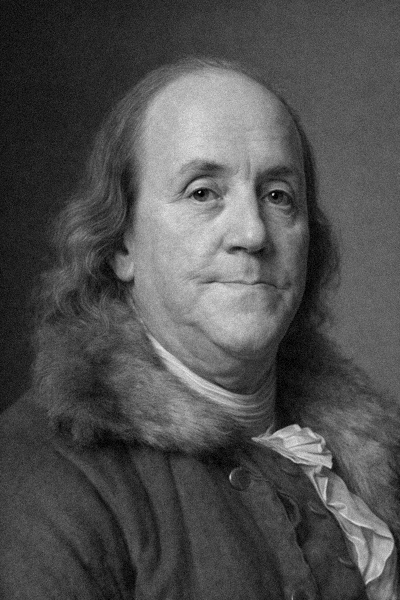
Printer, Scientist, Diplomat, and Founding Father, 1706-1790
“Those who would give up essential Liberty, to purchase a little temporary Safety, deserve neither Liberty nor Safety.”
Before the American republic, there were few public figures who embodied the Enlightenment as fully as Benjamin Franklin. Printer, writer, scientist, entrepreneur, diplomat, and statesman, Franklin moved easily between the world of ideas and practical affairs. His life bridged the colonial and revolutionary generations, and by the time the United States emerged as a nation he was already one of the most widely recognized Americans in the world. Franklin’s influence rested not on inherited authority but on credibility earned through experiment, enterprise, and public service.
Franklin was born on January 17, 1706, in Boston, Massachusetts, the fifteenth of seventeen children in a crowded household shaped by thrift, craft, and religious seriousness. His father, Josiah Franklin, made soap and candles—steady, practical work that demanded discipline and long hours. His mother, Abiah Folger Franklin, managed the large family with order and moral firmness. Franklin later described her as “a discreet and virtuous woman,” and the stability of the household owed much to her steady governance.
Resources were limited, and children were expected to contribute early. Conversation at the table mixed Scripture, moral instruction, and practical concerns about trade and survival. That environment left its mark. Franklin learned young that comfort is built from ordinary labor and that independence requires skill. Formal schooling ended after only a few years, largely for financial reasons, but the education did not stop. He absorbed lessons at home, in church, and in the streets of Boston. The city itself became a classroom. Sermons, pamphlets, and shop talk treated ideas as tools. Words carried economic value and political consequence. In a household where reputation mattered and opportunity was scarce, Franklin grew up watching how character and credibility could be made—or lost—in public.
His apprenticeship in his brother James’s print shop became a rough education in ambition and independence. He learned typesetting, the discipline of deadlines, and the mechanics of persuasion. He also saw the hazards of authority. When his brother’s newspaper clashed with local power, the young apprentice learned how quickly “acceptable” opinion could become “punishable” opinion.
Franklin’s habit of self-improvement was not a hobby; it was a strategy for mobility. He read aggressively, copied strong writers to refine his style, argued against books he disliked, and trained himself to write with clarity and force. These habits hardened under pressure in a household where there was little room for failure.
At seventeen, Franklin left Boston and remade himself in Philadelphia. He arrived with little money and a strong instinct for reinvention. Philadelphia’s commercial openness suited him. It was a city where merit could sometimes outrun pedigree and where a printer could become a civic force. Franklin’s rise was not magic but method. He built a printing business, published newspapers, and turned public curiosity into durable enterprises. He formed the Junto, a small discussion club devoted to practical improvement. From that seed grew a subscription library, a fire company, civic reforms, and educational initiatives that helped lead to what became the University of Pennsylvania. His ideal of usefulness served the public while strengthening the man who practiced it.
During his stays in London (1724–1726; 1757–1762; 1764–1775), Franklin moved within the city’s vibrant coffeehouse culture, a center of intellectual and political exchange. Coffeehouses served as meeting places for printers, scientists, merchants, and colonial agents, and Franklin refers to them frequently in his correspondence. Working near St. Paul’s Churchyard, he participated in informal networks that overlapped with institutions such as the Royal Society. In London, coffeehouses functioned as public offices of ideas—and Franklin operated comfortably within them.
From that culture of discussion and exchange, Franklin’s scientific work took clearer shape. He was not a cloistered academic but a craftsman of experiment. He relied on observation, repetition, and clear writing to turn curiosity into shared knowledge. His studies of electricity made him internationally famous. His inventions—the Franklin stove, bifocals, the lightning rod, and other practical improvements—reflected a consistent ethic: knowledge should reduce suffering and increase capability. He often declined patents, preferring broad adoption over personal profit. This choice amplified his influence and reinforced his image as a public benefactor rather than a monopolist.
That blend of credibility and accessibility made Franklin effective in politics. In 1776 he served with John Adams, Thomas Jefferson and Roger Sherman on the Committee of Five that drafted the Declaration of Independence and he signed it.
Franklin’s international reputation as a scientist soon became a diplomatic asset. Later in 1776 he was sent to France as a commissioner for the new nation. There his fame opened doors that formal credentials alone could not. He navigated court politics, cultivated relationships with French ministers, and helped secure the military and financial support that proved decisive in the Revolutionary War. The Treaty of Alliance in 1778 formalized French backing, and he later helped negotiate the Treaty of Paris in 1783, which recognized American independence. In France he combined calculation and charm, presenting himself as the embodiment of republican simplicity while working within the complexities of European power politics.
After returning from France, Franklin served as a delegate to the Constitutional Convention. His influence also rested on his relationships with other founding figures. He worked alongside Jefferson on the Declaration, offering edits that shifted some of its language toward reasoned argument rather than purely theological framing. In France his diplomatic tact complemented—and sometimes counterbalanced—Adams’s bluntness. At the Constitutional Convention, the elderly Franklin served less as architect than as conciliator, urging compromise when debate threatened fracture. His authority derived not from dominance but from accumulated credibility. In rooms filled with ambition, Franklin often provided steadiness.
Among the younger delegates present in Philadelphia was James Madison, who meticulously recorded the debates of the Convention. Madison arrived with the intellectual architecture of a new government already forming in his mind, while Franklin represented an earlier generation of revolutionary leadership whose authority had been earned through decades of public service. The contrast in the hall was clear: Madison contributed much of the constitutional design, while Franklin’s presence helped steady the process when disagreement threatened to unravel it. In that sense Franklin’s role carried a generational symbolism—the elder statesman lending credibility and calm while a younger cohort of leaders, including Madison and Jefferson, carried forward the work of building the new republic.
His political strength was not moral thunder but persuasion and coalition-building. He possessed a pragmatic sense of what could actually be accomplished in the world as it was.
Franklin’s legacy extends beyond helping to found a nation. He modeled a modern civic adult: self-educated, experimentally minded, commercially competent, and publicly committed. The boy who learned the power of print in Boston became the man who used print, science, and diplomacy to shape history. He died in Philadelphia on April 17, 1790, leaving behind a template for how ambition can be disciplined into service—and how service can enlarge ambition.
##
Profile originally written January 1996 | Revised February 28, 2026
Resources
Some resources are linked through our affiliate program with Amazon.com. Buying these items is a simple way to support our work while expanding your own knowledge base.
Books
The Autobiography and Other Writings — Benjamin Franklin
Franklin’s self-portrait alongside key selections that show his range as moralist, humorist, and public thinker.
Benjamin Franklin: An American Life — Walter Isaacson
A readable, panoramic biography that emphasizes Franklin’s pragmatism, social intelligence, and appetite for improvement.
The First American: The Life and Times of Benjamin Franklin — H. W. Brands
Engaging narrative biography that frames Franklin as a builder of institutions and a master of practical influence.
Benjamin Franklin and His Enemies — Robert Middlekauff
Franklin as a fully human political actor, including rivals, conflicts, and the costs of public life.
Documentaries
Benjamin Franklin (PBS / Ken Burns)
Documentary treatment, Ken Burns style, of Franklin’s life across science, printing, politics, and diplomacy.
Videos
Why was Benjamin Franklin such an important founder?
Khan Academy and National Constitution Center Constitution Center bring you this profile of Ben Franklin.
Benjamin Franklin: Author of the Declaration of Independence | Full Documentary | Biography
Revealing portrait of the Revolutionary War leader and self-educated Renaissance man.
Benjamin Franklin (2002)- PBS Documentary
A Benjamin Franklin documentary released by PBS in 2002.
Websites
Library of Congress: Benjamin Franklin Papers
The Library of Congress’s Benjamin Franklin Papers collection provides an overview of the digitized manuscripts, correspondence, and documents spanning Franklin’s public and private life, offering direct access to primary sources that trace his work as printer, scientist, diplomat, and founder.
National Archives (NHPRC): The Papers of Benjamin Franklin
The National Archives (NHPRC) page on The Papers of Benjamin Franklin outlines the long-running documentary editing project that collects, annotates, and publishes Franklin’s correspondence and writings, providing authoritative access to primary sources essential for scholarly research.
National Constitution Center: Benjamin Franklin (Signer profile)
The National Constitution Center’s Benjamin Franklin profile offers a concise overview of his role as a signer of the Declaration of Independence and the Constitution, highlighting his political influence and contributions to the founding of the United States.
The Franklin Institute: Benjamin Franklin Memorial
The Franklin Institute’s Benjamin Franklin Memorial page describes the museum’s permanent exhibit honoring Franklin’s scientific achievements and civic legacy, centered around the monumental marble statue housed within its classical rotunda in Philadelphia.