
Roger Sherman
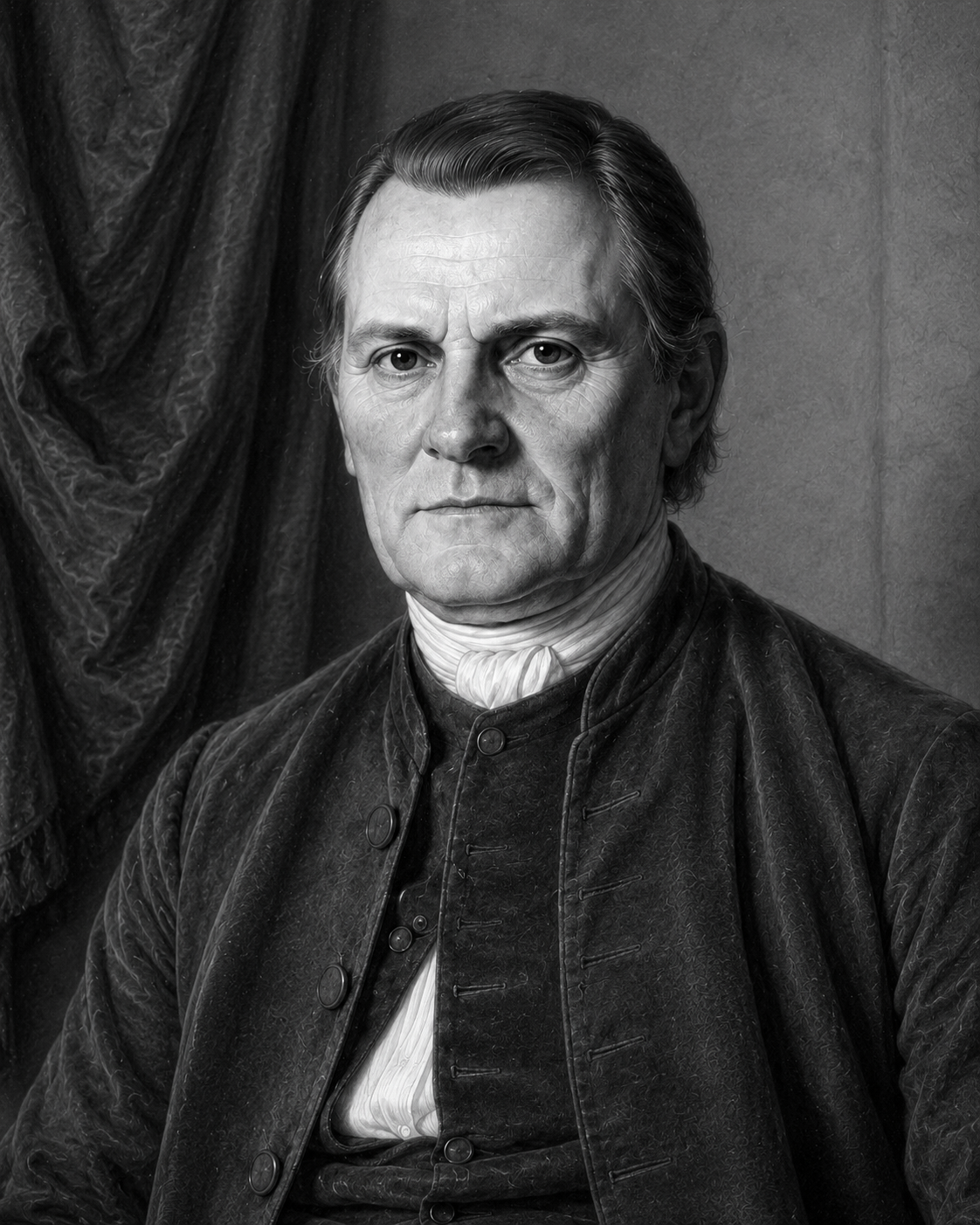
Architect of Compromise and Quiet Founder of the American Republic, 1721–1793
“The rights of conscience are, in their nature, of peculiar delicacy, and will little bear the gentlest touch of governmental hand.”
Few of the American founders played a more important role in the creation of the United States than Roger Sherman, yet few are less remembered today. He wasn’t a soaring orator like Patrick Henry or a philosophical writer like Thomas Jefferson. Sherman’s gifts were quieter, steadier, and more practical. He was a builder of consensus, a man whose calm judgment repeatedly helped prevent the American experiment from collapsing under regional distrust and political disagreement.
Born on April 19, 1721, in Newton, Massachusetts, Sherman came from modest circumstances. His father, William Sherman, was a farmer and shoemaker, and the family lived a disciplined New England life shaped by hard work, religion, and personal responsibility. Unlike many elite founders, Sherman was not born into wealth or privilege. He grew up helping support the household while educating himself through whatever books he could obtain.
Sherman’s formal schooling was limited. He never attended college, making him unusual among the leading founders of the Revolutionary generation. Yet he possessed a sharp, disciplined mind and an extraordinary capacity for self-education. He studied mathematics, surveying, law, theology, and political philosophy largely on his own. Through determination and relentless study, he developed the habits of careful reasoning that would define his later political career. In many ways, Sherman embodied the colonial ideal of the self-made man long before the phrase became common in American culture.
After his father’s death, Sherman moved with his family to New Milford, Connecticut, where he helped support the household through trade and surveying work. He eventually opened a store with his brother and became active in local civic affairs. His reputation for honesty, precision, and reliability steadily grew. In colonial New England, trust mattered enormously, and Sherman earned it through years of practical service rather than charisma or social status.
His rise into public life came gradually. Sherman first served as a surveyor, then as a town official, justice of the peace, and member of the Connecticut legislature. He studied law independently and was admitted to the bar without formal legal education. Over time, he became known as one of Connecticut’s most dependable public servants—methodical, practical, and deeply grounded in the realities of governance. Unlike founders driven by abstract theories or sweeping visions, Sherman focused on what would actually work.
By the early 1770s, tensions between Britain and the colonies were intensifying. Sherman opposed British overreach but remained cautious in temperament. He believed deeply in colonial rights and constitutional self-government, yet he was not naturally radical. What moved him toward independence was the growing conviction that Britain no longer respected the rights of Englishmen in America. Connecticut selected Sherman for the First Continental Congress because he was viewed as stable, trustworthy, and capable of navigating difficult political terrain without theatricality or extremism.
Sherman became one of the most respected members of the Continental Congress. Though less flamboyant than figures like John Adams or Benjamin Franklin, he possessed immense influence behind the scenes. Delegates trusted him because he approached problems with calm practicality and personal integrity. That trust helps explain why Sherman was chosen as one of the five men appointed to draft the United States Declaration of Independence.
The Committee of Five consisted of Jefferson, Adams, Franklin, Sherman, and Robert R. Livingston. Jefferson became the principal author, Adams the chief advocate for independence, and Franklin the elder statesman whose prestige helped unify support. Sherman’s role was different but essential. He represented practicality and political balance. Congress trusted him to help shape language and ideas into a form broad enough to secure agreement among deeply divided colonies. The Declaration was not merely a philosophical document; it was a political act requiring consensus among states with differing interests, economies, religions, and regional identities.
Sherman was one of the few men to sign all four great state papers of the American founding: the Continental Association, the Declaration of Independence, the Articles of Confederation, and the Constitution. That achievement alone places him among the central architects of the American republic.
During the Constitutional Convention, Sherman made perhaps his greatest contribution to the nation’s future. The convention became deadlocked between large and small states over representation in the new federal government. Large states favored representation based on population, while smaller states feared domination by their more populous neighbors.
Working closely with fellow Connecticut delegate Oliver Ellsworth, Sherman helped craft what became known as the Connecticut Compromise, or Great Compromise. The proposal created a bicameral legislature with proportional representation in the House of Representatives and equal representation for each state in the Senate. It was an elegant political solution to what seemed an impossible problem. Large states gained influence through population in one chamber, while small states retained equality and protection in the other.
Sherman’s legacy is a reminder that a republic does not run on ideas alone. It runs on the ability of citizens—and leaders—to negotiate, compromise, and accept progress over perfection. The Constitution was not written by men who agreed. It was written by men who disagreed deeply—and chose to keep working anyway.
In many ways, Sherman represented the practical backbone of the founding generation. He was less concerned with ideological purity than with preserving a workable framework for self-government. That instinct helped transform a loose collection of suspicious states into a durable constitutional republic.
After the Revolution, Sherman continued serving the new nation. He was elected to the House of Representatives and later served in the Senate under the new Constitution. He also remained deeply involved in Connecticut politics, helping shape state law and governance. Though advancing in age, he retained the same reputation he had built over decades: steady, disciplined, trustworthy, and practical.
Sherman died in 1793 in New Haven, Connecticut. By the time of his death, his career had stretched almost continuously from colonial government through revolution and into the constitutional republic itself. Yet unlike Washington, Jefferson, or Adams, he never became the center of national mythology. Perhaps that is fitting. Sherman was never interested in personal glory. His contribution was quieter and more structural. He helped make agreement possible when agreement seemed impossible.
Modern Americans often celebrate the founders as towering individuals of certainty and vision. Sherman reminds us that the republic also depended on something less dramatic but equally essential: patient negotiation, practical wisdom, and the willingness to accept imperfect solutions in service of a greater common purpose.
###
Profile written May 6, 2026
Resources
Some resources are linked through our affiliate program with Amazon.com. Buying these items is a simple way to support our work while expanding your own knowledge base.
Books
Collected Works of Roger Sherman — by Roger Sherman (Author), Mark David Hall (Editor)
A comprehensive collection of Sherman’s writings, speeches, and political papers that reveal the practical constitutional thinking and quiet influence of one of America’s most important—but often overlooked—founding fathers.
Miracle At Philadelphia: The Story of the Constitutional Convention May - September 1787 —Catherine Drinker Bowen
A highly readable narrative of the Constitutional Convention that captures the debates and compromises that produced the Constitution, including Sherman’s decisive role in the Connecticut Compromise.
Founding Brothers: The Revolutionary Generation— by Joseph J. Ellis
This Pulitzer Prize–winning study explores the personal alliances, rivalries, and political compromises that shaped the founding generation, including Roger Sherman’s often-overlooked role as one of the quiet but indispensable consensus builders within the brotherhood of founders.
Documentaries
The American Revolution: A Film by Ken Burns, Sarah Botstein & David Schmidt
A sweeping documentary that brings the Revolutionary era to life through vivid storytelling and historical insight, placing Washington and his contemporaries at the center of America’s founding struggle.
Websites
Lucidcafe’s take on the architects of the Declaration of Independence.
U.S. House of Representatives History Office – Roger Sherman
Resource on Sherman’s congressional service and role in early federal government.
Connecticut History – Roger Sherman
Focuses specifically on Sherman’s Connecticut roots and his often-overlooked role in shaping the American republic.
Lucidcafe’s overview to the men tasked with writing the United States Declaration of Independence.