
John Adams
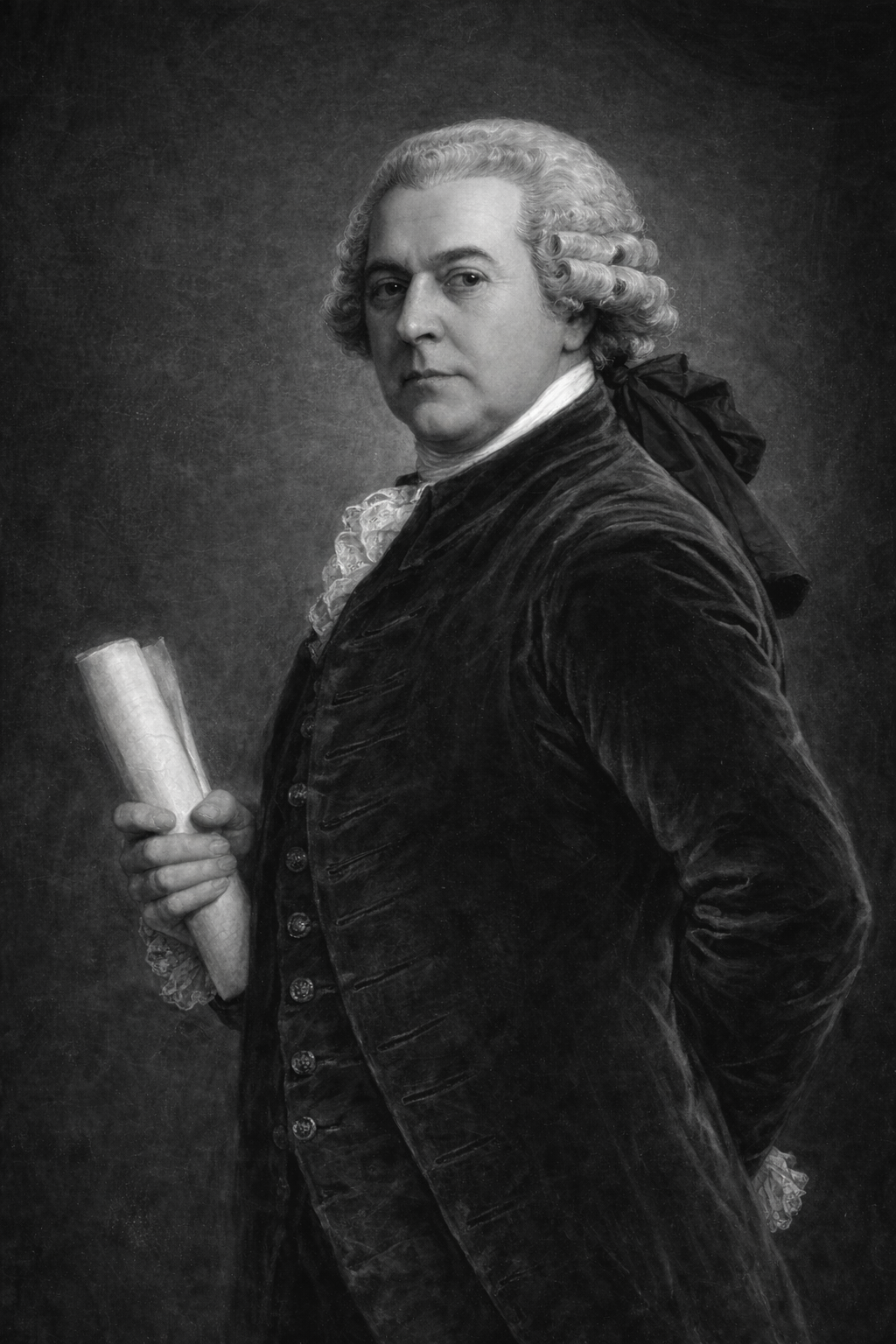
American Founding Father, Statesman, and Second President of the United States, 1735–1826
“Facts are stubborn things; and whatever may be our wishes, our inclinations, or the dictates of our passion, they cannot alter the state of facts and evidence.”
John Adams stands among the central architects of America’s founding—not as its most eloquent writer or its most celebrated general, but as one of its most indispensable forces of will. Where others articulated ideals or commanded armies, Adams supplied the steady insistence that independence be pursued, defended, and structured into durable government. His contributions span the movement for independence, the diplomacy that secured it, and the constitutional framework that sustained it. If the American experiment required vision, it also required discipline—and Adams brought that discipline to every stage of its creation.
Born on October 30, 1735, in Braintree, Massachusetts (now Quincy), Adams grew up in a household shaped by duty, modest means, and moral seriousness. His father, a farmer and deacon, instilled in him a respect for order, responsibility, and community obligation. This was not a household of idle speculation—it was one where effort and accountability were expected. His mother, Susanna Boylston Adams, came from a family of physicians and brought a sharper intellectual edge to the home. Together, they created an environment that valued both moral clarity and practical discipline. Adams would later reflect that the habits of mind formed in youth—particularly restraint and persistence—were among his greatest assets in public life.
Adams attended Harvard College, graduating in 1755 with a Master of Arts degree—a broad classical education rooted in Latin, rhetoric, and moral philosophy. While at Harvard, he encountered the intellectual currents of the Enlightenment, particularly the works of Cicero, Locke, and classical historians. Yet Adams was never merely a theorist. His reading reinforced his belief that ideas must be tested in action and governed by law. He briefly considered the ministry, but ultimately chose law as his vocation—a field that allowed him to apply moral reasoning within a structured system. Legal training sharpened his commitment to process, evidence, and disciplined argument, traits that would define his public career.
By the early 1770s, Adams had emerged as a leading voice in colonial resistance. Unlike more radical figures, he grounded his arguments in legal principle. His defense of British soldiers after the Boston Massacre—despite intense public pressure—demonstrated his belief that justice must be applied consistently, even when politically inconvenient. For Adams, liberty without law was not liberty at all. This tension between principle and popular sentiment would remain a defining feature of his career.
John Adams and Samuel Adams were second cousins who moved in the same Massachusetts political circles during the buildup to the Revolution. Samuel was already organizing resistance in Boston as John emerged as a lawyer and public voice. Their paths converged in the early 1770s and later in the Continental Congress, where both supported independence. They shared purpose but played different roles—Samuel shaping public sentiment through organization and agitation, John providing legal argument and institutional direction. They appear to have respected one another, but they were not close collaborators; their relationship is best understood as complementary, with Samuel helping create the conditions for revolution and John helping carry it forward into government.
Adams played a decisive role in the movement toward independence. As a member of the Continental Congress and a driving force behind the Committee of Five—alongside Thomas Jefferson, Benjamin Franklin, Roger Sherman, and Robert Livingston—he helped bring the Declaration of Independence to adoption. While Jefferson drafted the document, Adams served as its chief advocate on the floor of Congress, guiding it through debate and securing its passage. His influence lay in disciplined argument and political resolve. He later contributed to constitutional development through his work on the Massachusetts Constitution of 1780, which influenced the structure of the United States Constitution.
John Adams’ relationships with the other founders were often productive but rarely easy. He formed a close bond with Thomas Jefferson during the Revolution. Political differences later drove them apart before their reconciliation in retirement. With Benjamin Franklin, Adams found a valuable but frustrating diplomatic partner. He respected Franklin’s influence but bristled at his informality and lack of urgency; Franklin saw Adams as capable but rigid. Adams admired George Washington’s leadership, though he sometimes felt overshadowed by his stature, and their relationship remained respectful. His rivalry with Alexander Hamilton was more openly contentious, shaped by ideological differences and personal mistrust, especially during his presidency. Across these relationships, a pattern emerges: Adams was respected for his intellect and integrity, but his directness often strained alliances—yet those same qualities made him indispensable in moments that required clarity, discipline, and resolve.
During and after the Revolution, Adams served in a series of demanding roles that required endurance and restraint. As a diplomat in Europe, he helped secure recognition and negotiated the Treaty of Paris. As the first Vice President and later the second President of the United States, he faced the challenge of stabilizing a fragile new government. His presidency was marked by difficult decisions, including efforts to avoid war with France despite political pressure. These choices reflected his commitment to preserving the republic over satisfying public demand.
Although Adams did not attend the Constitutional Convention, his influence is evident in its structure. His work on the Massachusetts Constitution of 1780 provided a clear model of separated powers, a bicameral legislature, and an independent executive—principles that carried into the federal system. His earlier writings also argued for balanced government and checks on concentrated power, ideas that became foundational to the Constitution’s design and continue to shape its operation.
In retirement, Adams returned to Massachusetts and maintained a prolific correspondence that reflected a mind still engaged with the principles of the founding. He died on July 4, 1826, the fiftieth anniversary of the Declaration of Independence—just hours after Thomas Jefferson, his friend, rival, and fellow architect of the Revolution. His legacy isn’t defined by a single document or office, but by a sustained commitment to the rule of law and the discipline required to maintain it. He understood that a republic does not sustain itself through ideals alone—it requires structure, restraint, and citizens willing to uphold both.
###
Profile written March 30, 2026
Resources
Some resources are linked through our affiliate program with Amazon.com. Buying these items is a simple way to support our work while expanding your own knowledge base.
Click here to see The Declaration of Independence
Books
John Adams — by David McCullough
A comprehensive and highly readable biography that captures Adams’ character, struggles, and central role in the founding.
Passionate Sage: The Character and Legacy of John Adams — by Joseph J. Ellis
A concise study of Adams’ personality and intellectual legacy within the founding generation.
Founding Brothers— by Joseph J. Ellis
Examines key relationships among the founders, with Adams at the center of several pivotal moments.
1776 — by David McCullough
Provides context for Adams’ role during the Revolutionary War alongside Washington and others.
Documentaries & Video
John Adams — HBO Miniseries
A dramatized portrayal of Adams’ life, emphasizing his personal and political struggles.
The American Revolution— PBS/WEDU Series
A multi-part documentary series that examines the political, social, and military forces that shaped the American Revolution, including the role of figures like Samuel Adams in organizing colonial resistance.
History Classics: The Revolution— History Channel
A documentary overview of the American Revolution that traces its key events and figures, highlighting the political tensions and leadership that drove the colonies toward independence.
John Adams eTexts
The Works of John Adams (10 Volumes)
A digitized edition of The Works of John Adams (10 volumes), providing searchable access to his political writings, legal arguments, and correspondence that illuminate his role in the American founding and early republic.
Adams–Jefferson Correspondence
Letters between Adams and Jefferson reflecting on the Revolution and the republic they helped build.
Massachusetts Constitution of 1780
A foundational document largely shaped by Adams, influencing later constitutional design.
Websites
Lucidcafe’s take on the architects of the Declaration of Independence.
Overview of Adams’s life and role in the revolutionary movement, with reliable historical context.
National Park Service — Adams National Historical Park
Overview of Adams’ life, family, and historical significance.
American Philosophical Society
Context on Adams’ intellectual environment and connections within Enlightenment thought.
Lucidcafe’s overview to the men tasked with writing the United States Declaration of Independence.