
Thomas Paine
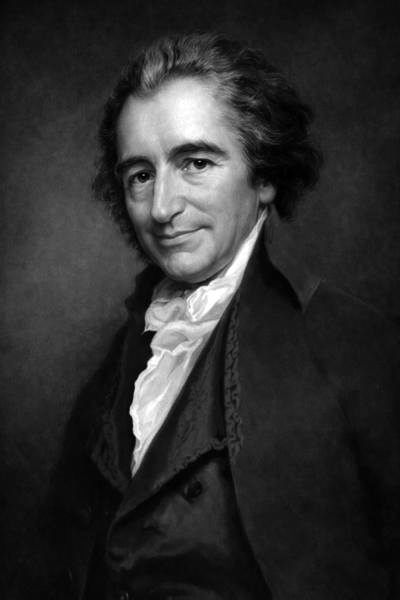
Political Writer and Revolutionary Voice, 1737–1809
“These are the times that try men’s souls.”
Thomas Paine’s role in the American founding was not to design institutions or command armies, but to make a break with Britain thinkable to ordinary people. Writing at the moment when colonial resistance had not yet become revolution, Paine translated Enlightenment ideas into language that could be understood beyond the educated elite. His influence rested not on position or pedigree, but on his ability to give clarity and force to arguments that others had expressed more cautiously. In doing so, he helped shift public sentiment from hesitation to resolve.
Paine was born on January 29, 1737, in Thetford, England, the son of Joseph Paine, a Quaker staymaker (corset-maker), and Frances Cocke Paine, an Anglican. His upbringing placed him at the intersection of two religious traditions, one emphasizing simplicity and equality, the other structure and hierarchy. The household was modest, and like many in provincial England, it demanded steady work and practical discipline. From an early age, Paine was exposed to the realities of labor, the limits of opportunity, and the tension between authority and conscience.
His formal education was limited, ending in his early teens, but like Benjamin Franklin, Paine’s real education came from experience and reading. He apprenticed in his father’s trade, later worked as a sailor, teacher, and excise officer, and repeatedly struggled to find stability. These were not incidental failures. They shaped his view of government as often arbitrary, inefficient, and indifferent to the lives of ordinary people. His dismissal from the excise service—twice—left a lasting impression of bureaucratic injustice.
Paine’s early political writing in England already showed the direction of his thought. In 1772, he authored a pamphlet advocating higher wages for excise officers, arguing not from abstract theory but from lived experience. His argument was direct, practical, and rooted in fairness. It also demonstrated a pattern that would define his later work: he wrote not for elites, but for those who felt the consequences of policy.
His life changed in 1774 when he met Benjamin Franklin in London. Franklin recognized Paine’s potential and provided letters of introduction that enabled him to emigrate to America. Paine arrived in Philadelphia at a moment of rising tension between the colonies and Britain. The dispute was serious, but independence was still a minority position. Most colonists hoped for reconciliation within the empire.
Philadelphia provided Paine with both opportunity and audience. He found work as an editor and contributor to the Pennsylvania Magazine, where he wrote on topics ranging from slavery to commerce to governance. The city’s print culture—dense with pamphlets, newspapers, and debate—suited him. It was an environment where ideas moved quickly and where a clear argument could find immediate readership.
In January 1776, Paine published Common Sense. The pamphlet did not introduce entirely new ideas, but it did something more important: it removed ambiguity. Paine argued that monarchy itself was illegitimate, that the colonies had no rational basis for continued allegiance to Britain, and that independence was both necessary and inevitable. He rejected inherited authority and appealed directly to reason and experience.
The power of Common Sense lay in its language. Paine avoided legalistic argument and philosophical abstraction. He wrote in plain terms, using examples and analogies that ordinary readers could grasp. He framed the conflict not as a dispute over rights within the empire, but as a question of political legitimacy. In doing so, he changed the terms of debate.
The pamphlet spread rapidly. It was read aloud in taverns, passed among soldiers, and discussed in assemblies. Within months, independence moved from a radical idea to a practical objective. Paine had given voice to a position that others had hesitated to state so directly.
His writing during the war continued in the same vein. In The American Crisis, he reinforced morale at moments of uncertainty, most famously with the opening line, “These are the times that try men’s souls.” Washington ordered the first installment read to troops, recognizing its value not as strategy, but as psychological reinforcement.
Paine’s intellectual framework drew from several sources. Enlightenment thought provided the foundation—belief in reason, skepticism of monarchy, and the idea of natural rights. His Quaker background likely reinforced a distrust of hierarchy and a belief in human equality. His personal experiences—economic struggle, bureaucratic dismissal, and social mobility—gave his arguments urgency and credibility. Unlike many political thinkers of his time, Paine wrote from below rather than above.
After the American Revolution, Paine’s career extended into the broader Atlantic world. He defended the French Revolution in Rights of Man, arguing for republican government and social reform. Later, in The Age of Reason, he challenged organized religion, advocating a rational, deist perspective. These works expanded his influence but also made him controversial. By the end of his life, he was less celebrated than he had been at the height of the Revolution.
Paine held no office in the new American government and played no role in drafting its constitutional structure. His contribution was earlier and more fundamental. He helped create the conditions under which independence could occur. Where others negotiated, organized, and fought, Paine persuaded.
His influence also intersected with other founding figures. Franklin enabled his arrival in America and helped set the stage for his entry into public life. Jefferson’s Declaration would later formalize independence in philosophical terms, but Paine’s Common Sense had already prepared the public to accept it. Washington recognized the value of his writing in sustaining morale. Paine operated not within the halls of government, but alongside them, shaping the environment in which decisions were made.
His strength was not diplomacy or institutional design, but force of argument. He possessed a rare ability to compress complex ideas into language that could move a population. In a revolutionary moment, that ability proved decisive.
Thomas Paine died in relative obscurity on June 8, 1809, in New York. Yet his legacy endures in the role he played at a critical turning point. He demonstrated that political transformation requires not only ideas and leadership, but communication that reaches beyond elites. If the American experiment was to begin, it first had to be understood. Paine made it understandable—and in doing so, helped make it possible.
###
Profile written March 22, 2026
Resources
Some resources are linked through our affiliate program with Amazon.com. Buying these items is a simple way to support our work while expanding your own knowledge base.
Books
Common Sense— by Thomas Paine
A short, forceful pamphlet that made the case for independence in language accessible to the general public.
The American Crisis— by Thomas Paine
A series of essays written during the Revolutionary War to sustain morale and reinforce the cause of independence.
Rights of Man— by Thomas Paine
A defense of republican government and a response to critics of the French Revolution.
Thomas Paine: Enlightenment, Revolution, and the Birth of Modern Nations— by Craig Nelson
A modern biography that places Paine within the broader revolutionary movements of the Atlantic world.
Videos
How Thomas Paine's Common Sense Shaped a New World | The American Revolution — PBS
A concise documentary segment explaining how Thomas Paine’s Common Sense attacked monarchy, galvanized colonial opinion, and rapidly transformed the idea of independence into a mass movement.
A brief PBS educational segment introducing Thomas Paine as a powerful revolutionary writer whose clear, persuasive arguments—especially in Common Sense—helped inspire American independence.
How did Thomas Paine's Common Sense shape the American Revolution?
A lecture featuring historian Andrew Shankman explaining how Thomas Paine’s Common Sense reframed colonial resistance into a compelling argument for independence.
The Fall of Thomas Paine: The Rights of Man and The Age of Reason
Overview of Paine's activities after the American Revolution, his troubles in England, his exile, and nearly losing his life for being too moderate during the French Revolution.
Thomas Paine eTexts
A primary source presentation of Thomas Paine’s Common Sense, offering the full text alongside guiding questions that highlight his arguments against monarchy and his case for American independence.
Extensive collection includes one of the most complete catalogues of Thomas Paine’s writings, including some recently disputed works.
Websites
Thomas Paine National Historical Association
A dedicated resource featuring Paine’s writings, historical context, and educational materials.
National Constitution Center – Common Sense (1776)
Primary source excerpts with commentary on the pamphlet’s significance and impact.
American Revolution Institute – Common Sense Overview
An accessible explanation of how Paine’s work influenced public opinion during the Revolution.