
George Washington
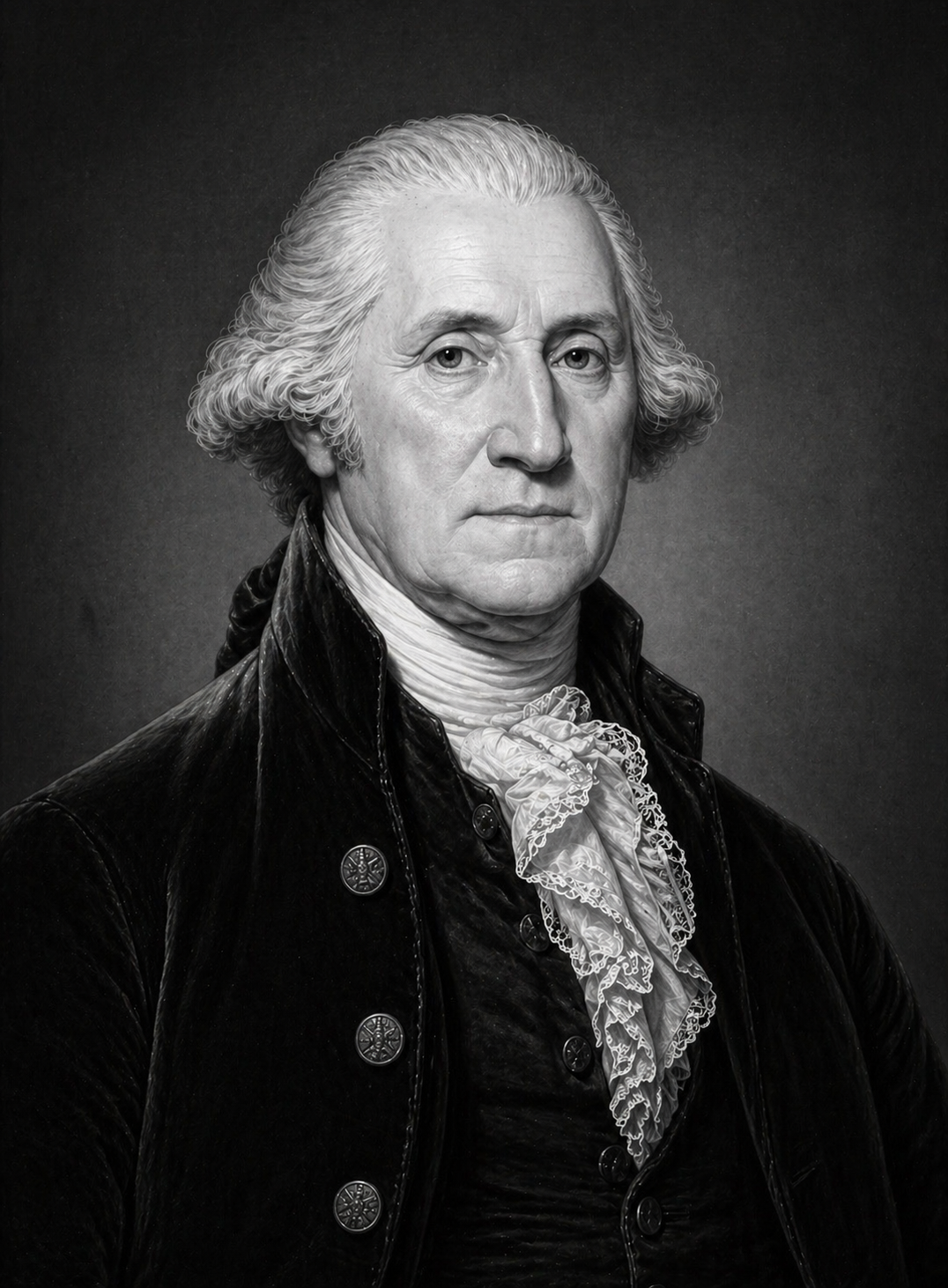
Founding Father • Commander of the Continental Army • First President of the United States, 1732–1799
“The preservation of the sacred fire of liberty, and the destiny of the republican model of government, are justly considered as deeply, perhaps as finally, staked on the experiment entrusted to the hands of the American people.”
George Washington stands as the founding generation’s indispensable leader and its most disciplined architect of power in restraint. Born into the Virginia planter class and shaped by frontier experience and war, he did not create the ideas of the Revolution. He made them work. His life’s work was the steady application of judgment, endurance, and self-command to turn a fragile rebellion into a durable republic.
George Washington was born on February 22, 1732, at his father’s plantation on Pope’s Creek in Westmoreland County, Virginia. He grew up in a world where land, reputation, and self-command defined a man’s standing. His father, Augustine Washington, died when George was eleven. The loss forced early responsibility. His mother, Mary Ball Washington, was strict and demanding. She expected discipline and restraint. These traits stayed with him for life.
Washington lacked formal education. He built himself through experience. As a teenager, he trained as a surveyor and worked the Virginia frontier. He learned to read land, manage risk, and deal with men under uncertain conditions. His half-brother Lawrence shaped his ambitions and introduced him to the Fairfax family. Thomas Fairfax became a key patron, giving Washington opportunity and early exposure to large-scale leadership.
Washington’s military career began in the French and Indian War. In 1754, he led a small force into the Ohio Valley and helped ignite the wider conflict. At Fort Necessity, he faced defeat and learned the limits of inexperience. In 1755, he served under General Edward Braddock. At the Battle of the Monongahela, Braddock’s army collapsed. Washington rode through heavy fire, rallied troops, and helped organize a retreat. His composure marked him as a leader.
These campaigns shaped his approach to war. He rejected rigid European tactics in American terrain. He favored mobility, cover, and patience. He demanded discipline but shared hardship. He learned from failure and adapted. He also saw the limits of British respect for colonial officers. That lesson stayed with him.
In 1759, Washington married Martha Custis, a wealthy widow. The marriage brought land and stability. At Mount Vernon, he built the life of a Virginia gentleman. He expanded his estates, improved farming methods, and managed operations closely. He relied on enslaved labor, a fact that stood in tension with the ideals he later defended. His home life was orderly and controlled, marked by both hospitality and formality.
In 1775, the Continental Congress appointed Washington commander of the Continental Army. He faced an untrained force, weak supply lines, and constant political pressure. His strategy was survival. He avoided decisive defeat and preserved the army as the core of resistance.
The winter at Valley Forge exposed the army’s weaknesses. With the help of Baron von Steuben, a Prussian officer who imposed discipline and standardized training, Washington transformed a loose force into a more effective army. He relied on aides such as Alexander Hamilton and commanders like Nathanael Greene. His relationship with the Marquis de Lafayette helped secure French support. Washington held the army together through repeated setbacks. He understood that if the army survived, the cause survived. The victory at Yorktown in 1781 secured independence.
After the war, Washington resigned his commission, establishing civilian control of the military. In 1787, he presided over the Constitutional Convention. He spoke little but guided the process with authority. His presence gave the convention legitimacy. He worked alongside James Madison and Benjamin Franklin, helping produce a workable system of government.
In 1789, Washington became the first President of the United States. He turned a plan into a functioning government. His cabinet reflected competing visions. Thomas Jefferson and Alexander Hamilton defined the central divide. Washington backed Hamilton’s financial system to stabilize national credit, while recognizing Jefferson’s concerns about concentrated power.
He established key precedents. He enforced federal authority during the Whiskey Rebellion. He maintained neutrality in European conflicts. His administration relied on Henry Knox to build and manage the nation’s early military structure, and on Edmund Randolph to define the legal foundations of federal authority. He faced growing political opposition but kept his focus on stability.
Washington declined a third term and retired in 1797. At Mount Vernon, he returned to private life. He managed his estate, oversaw improvements, and maintained wide correspondence. His Farewell Address warned against factionalism and foreign entanglements. In his final years, he moved cautiously toward opposition to slavery, though he never fully resolved the contradiction in public life. He died on December 14, 1799.
Washington’s life follows a clear arc. A surveyor learns discipline on the frontier. A young officer learns war through failure. A planter builds order at home. A commander preserves an army long enough to win. A statesman shapes a government and then steps away from power. His strength was not brilliance alone. It was judgment, restraint, and the ability to hold steady under pressure.
The following description of Washington was written after his death by another founding father, Thomas Jefferson:
“His mind was great and powerful … as far as he saw, no judgment was ever sounder. It was slow in operation, being little aided by invention or imagination, but sure in conclusion …
“Perhaps the strongest feature in his character was prudence, never acting until every circumstance, every consideration, was maturely weighed; refraining if he saw doubt, but, when once decided, going through his purpose, whatever obstacles opposed.
“His integrity was the most pure, his justice the most inflexible I have ever known …
“He was, indeed, in every sense of the words, a wise, a good and a great man … On the whole, his character was, in its mass, perfect … it may truly be said, that never did nature and fortune combine more perfectly to make a man great …”
One of his officers, Henry Lee, summed up contemporary public opinion of Washington:
“First in war, first in peace, and first in the hearts of his countrymen.”
###
Profile written April 30, 2026
Resources
Some resources are linked through our affiliate program with Amazon.com. Buying these items is a simple way to support our work while expanding your own knowledge base.
Books
Washington: A Life— by Ron Chernow
The definitive modern biography, combining narrative power with deep research to present Washington as both a national icon and a complex, evolving man. Chernow’s work has become the standard starting point for serious readers.
His Excellency: George Washington — by Joseph J. Ellis
A concise and insightful portrait that emphasizes Washington’s character, restraint, and leadership under pressure. Ellis focuses on how Washington held the Revolution together when failure was the more likely outcome.
You Never Forget Your First: A Biography of George Washington— by Alexis Coe
A recent and widely discussed reinterpretation that challenges traditional myths while presenting a more human and critical view of Washington’s life and legacy.
Patriarch: George Washington and the New American Nation— by Richard Norton Smith
Focused on Washington’s presidency, this work explores how he managed factional conflict and shaped the early republic into a functioning government.
George Washington on Leadership— by Richard Brookhiser
A focused study of Washington’s leadership style, drawing lessons from his military command, personal discipline, and presidency.
Adopted Son: Washington, Lafayette, and the Friendship That Saved the Revolution— by David A. Clary
A narrative of the relationship between Washington and Lafayette, showing how their partnership helped secure French support and ultimate victory.
Founding Brothers: The Revolutionary Generation— by Joseph J. Ellis
Though broader in scope, this Pulitzer Prize–winning work places Washington among his peers and reveals how personal relationships shaped the founding era.
Citizen Washington: A Novel— by William Martin
A historical novel that explores Washington’s character through the eyes of those who knew him, blending fiction with strong historical grounding.
Documentaries
American Experience: George Washington: Man Who Wouldn't Be King
A compelling documentary from PBS’s American Experience series, George Washington: Man Who Wouldn’t Be King explores how George Washington resisted the pull of absolute power and instead set the enduring precedent for republican leadership in the United States.
The Real George Washington — National Geographic
A National Geographic documentary that separates myth from reality, presenting George Washington as a disciplined leader shaped by war, ambition, and the demands of founding a new nation.
The American Revolution: A Film by Ken Burns, Sarah Botstein & David Schmidt
A sweeping documentary that brings the Revolutionary era to life through vivid storytelling and historical insight, placing Washington and his contemporaries at the center of America’s founding struggle.
Websites
George Washington’s Mount Vernon
The most authoritative and comprehensive resource on Washington’s life, estate, and legacy, with extensive primary materials and educational content.
The Papers of George Washington (University of Virginia)
A leading scholarly project providing access to Washington’s letters, writings, and documents, offering direct insight into his decisions and character.
Library of Congress: George Washington
A rich archive of original manuscripts, correspondence, and historical materials from Washington’s life.
National Archives: George Washington
Primary documents and contextual material related to Washington’s role in the founding of the United States.s.