
William Clark
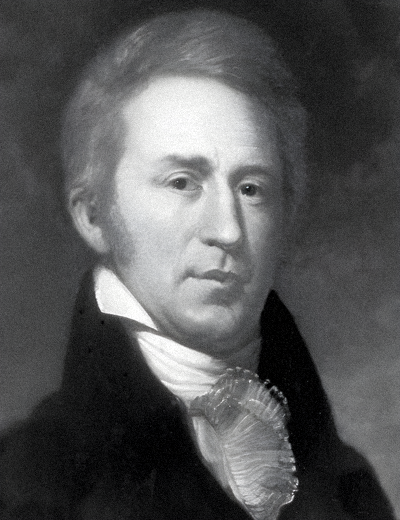
Explorer, 1770–1838
“Great joy in Camp we are in view of the Ocean, this great Pacific Ocean which we been so long anxious to see and the roaring or noise made by the waves braking on the rocky shores (as I suppose) may be heard distinctly.”
—Voyage of Discovery Journal
William Clark, the younger brother of Revolutionary War hero George Rogers Clark, was born in Caroline County, Virginia, on August 1, 1770. The Clark family was large, ambitious, and closely bound. William was the ninth of ten children, raised in a household that valued loyalty, courage, and practical ability. When the family moved west to Kentucky during William’s youth, the frontier became his classroom. His older brothers—especially George Rogers Clark—were already legends of the western campaigns of the Revolution, and their example shaped William deeply. From them he absorbed a sense of duty, boldness in difficult circumstances, and an understanding that leadership required both courage and responsibility for others.
Life on the Kentucky frontier demanded competence. Clark learned surveying, hunting, navigation, and the practical arts of survival that defined early American expansion. Though he briefly served in the militia and later in the U.S. Army, his most important training came through family mentorship and experience on the frontier. The combination of discipline, geographic knowledge, and quiet confidence that developed in these early years would later define his leadership.
In 1803, President Thomas Jefferson secured congressional approval for the Louisiana Purchase and began planning an expedition to explore the vast new territory of the American West. Jefferson selected Meriwether Lewis to lead the mission, and Lewis invited his former Army commander, William Clark, to share command of what became known as the Corps of Discovery. Their mission was ambitious: to chart the geography of the new lands, study plants and animals, establish diplomatic relations with Native nations, and search for a practical route to the Pacific Ocean.
Clark’s role in preparing the expedition was decisive. He helped recruit and train the roughly forty-five men who would form the Corps of Discovery—soldiers, boatmen, and frontiersmen capable of enduring extreme hardship. Clark designed the expedition’s keelboat and managed much of the logistical preparation. More importantly, he established the discipline and cohesion that allowed the group to function as a unit far from the authority of the United States government.
When the expedition departed in May 1804 from Camp Dubois near St. Louis, Clark quickly emerged as the expedition’s steady center of gravity. Where Lewis tended toward scientific observation and intellectual curiosity, Clark provided practical leadership. He was a gifted mapmaker and careful recorder of rivers, distances, and terrain. His maps of the Missouri River basin and the western territories would remain foundational for decades.
Clark’s leadership style combined firmness with fairness. He maintained discipline among the men but also earned their loyalty. His journals reveal a man attentive to the well-being of the Corps—resolving disputes, maintaining morale, and guiding the expedition through hunger, severe winters, and dangerous terrain.
Equally important was Clark’s ability to work with Native nations. Throughout the journey the Corps relied heavily on relationships with tribes such as the Mandan, Hidatsa, Shoshone, Nez Perce, and Chinook. These alliances often meant the difference between survival and disaster. Clark’s practical diplomacy, patience, and willingness to listen helped secure food, horses, and geographic guidance.
Among the expedition’s most important companions was Sacagawea, the Shoshone woman who joined the Corps at Fort Mandan with her French-Canadian husband, Toussaint Charbonneau. Sacagawea’s knowledge of the land and her presence with her infant son signaled peaceful intentions to many tribes. Clark developed a particular affection for the child, Jean Baptiste Charbonneau, whom he nicknamed “Pomp.” That relationship hinted at a side of Clark often overlooked—the capacity for paternal attachment and long-term loyalty.
The Corps of Discovery reached the Pacific Ocean in November 1805 and spent the winter at Fort Clatsop near present-day Astoria, Oregon. When they returned to St. Louis in 1806 after nearly 8,000 miles of travel, the expedition was celebrated as one of the greatest exploratory achievements in American history. For Clark personally, the journey marked a transition from frontier officer to national figure. It broadened his sense of the continent and deepened his experience as a leader responsible for many lives.
In the years that followed, Clark settled in St. Louis and turned toward public service and family life. In 1808 he married Julia Hancock, a woman from a respected Virginia family with whom he shared a deep affection. Their marriage brought stability after years of frontier travel, and together they had five children. Clark proved devoted to his family, though tragedy touched them repeatedly; several of their children died young, a common sorrow in the early nineteenth century.
Clark’s bond with children extended beyond his own household. He later took responsibility for educating young Jean Baptiste Charbonneau, Sacagawea’s son, honoring the connection formed during the expedition. This gesture reflected Clark’s sense of personal loyalty and obligation—traits that had defined his leadership in the field.
After Julia Hancock Clark died in 1820, William Clark eventually remarried Harriet Kennerly Radford, the cousin of his first wife. Their marriage brought renewed companionship, and together they had three additional children. Clark’s home in St. Louis became a lively household and an important gathering place for political leaders, explorers, traders, and visiting Native delegations.
Clark’s public career continued to expand. In 1813 he was appointed governor of the Missouri Territory, where he helped guide the region during a period of rapid expansion. Later he served for nearly three decades as Superintendent of Indian Affairs, one of the most influential positions in the western territories. In that role Clark attempted to maintain diplomacy and negotiation with Native nations, though his work inevitably became tied to the larger forces of American expansion and displacement moving across the continent.
Through all these roles—explorer, governor, diplomat, and father—Clark remained known for the qualities that had shaped him since childhood: steadiness, loyalty, and a sense of responsibility for the people around him. Friends remembered him as generous and approachable, a man whose authority came less from rank than from personal character.
William Clark died in St. Louis on September 1, 1838, at the age of sixty-eight. He left behind a legacy not only as co-leader of the Lewis and Clark Expedition but also as a builder of the early American West—a mapmaker who helped reveal the continent, a public servant who shaped its early governance, and a family man whose life reflected the values of loyalty, duty, and leadership learned within the Clark household.
###
Profile originally written August 1995 | Revised February 15, 2026
Resources
Some resources are linked through our affiliate program with Amazon.com. Buying these items is a simple way to support our work while expanding your own knowledge base.
Books
The Journals of Lewis and Clark – Meriwether Lewis, William Clark, Frank Bergon (Editor)
A richly detailed record of the journey from St. Louis to the Pacific.
Undaunted Courage: Meriwether Lewis, Thomas Jefferson and the Opening of the American West – Stephen Ambrose
A biography of Clark’s Co-leader of the Voyage of Discovery, Meriwether Lewis based on both leaders’ journals, supported by the author’s retracing of their route.
Lewis and Clark: Across the Divide – Carolyn Gilman, Robert A. Robertson, James P. Ronda
Official companion to the Lewis and Clark National Bicentennial Exhibition.
Documentaries & Films
National Geographic – Lewis & Clark: Great Journey West (2002)
National Geographic’s dramatization of the expedition.
Lewis & Clark – The Journey of the Corps of Discovery (1997)
Ken Burns documentary on the expedition, weaving historical accounts with visuals.
Videos
Lewis & Clark: Explorers of the New Frontier — Full Documentary | Biography
Lewis & Clark: Captains of Discovery | Into the Wild Frontier
The Lewis & Clark Expedition, Part 1 — History in a Nutshell (PBS / SCETV)
Lewis & Clark in Missouri (2001) — Lewis & Clark National Historic Trail / MO Conservation
Lewis & Clark: An Overview of the Expedition — University of Virginia Lecture (Alan Taylor)
Searching for York — Full documentary | Oregon Experience