
Buddha
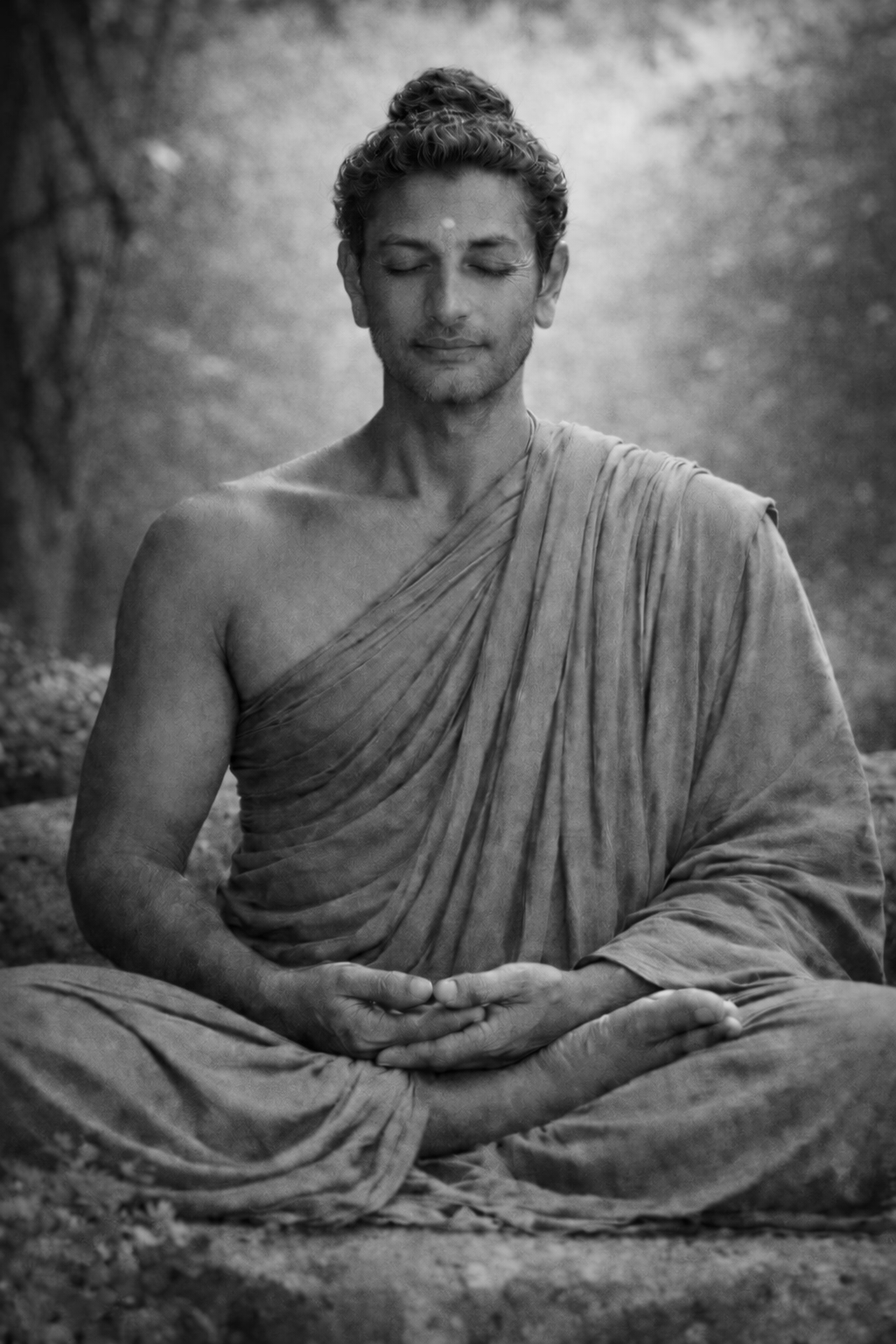
The Awakened One, Founder of Buddhism, c. 563 - c. 483 BCE
“I look upon the judgements of right and wrong as the serpentine dance of a dragon, and the rise and fall of belief as traces left by the four seasons.”
— Attributed to the Buddha
The word Buddha is a title, not a name. It comes from the Sanskrit budh, “to know.” It means “one who is awake” — awakened to the nature of reality.
This title was first given to Siddhartha Gautama, who lived roughly 2,500 years ago in the northeastern plains of the Indian subcontinent, in what is now southern Nepal and northern India.
Siddhartha was born into the Śākya clan, a small warrior aristocracy organized as a regional republic rather than an absolute monarchy. His father, Śuddhodana, was a leading figure within that clan. Later tradition calls him a king, though historically he was more likely a chief within a governing council. Siddhartha grew up with status, education, and a clear path toward leadership. He was trained as a kshatriya (warrior aristocrat) in governance, discipline, and ritual life.
The broader world around him was unstable and intellectually alive. The ritual-centered Vedic religion still dominated, but renunciants, skeptics, and ascetics were challenging inherited authority. Questions about suffering, rebirth, and liberation were actively debated. Siddhartha matured within this atmosphere of political uncertainty and spiritual experimentation.
He married Yaśodharā, a woman of his own clan, and they had a son, Rāhula. Tradition interprets the name Rāhula as meaning “bond” or “fetter,” reflecting the tension Siddhartha felt between family life and his growing existential urgency. By his early thirties, he was not a sheltered youth but a thoughtful man confronting the fragility of status, health, and life itself.
His decision to leave home was disruptive but not culturally unprecedented. Renunciation was an established path in his era. Still, his departure left his wife and infant son behind. What began as a personal quest created fractures within his household.
He studied under respected meditation teachers and mastered advanced states of concentration. Finding them insufficient, he turned to extreme asceticism, reducing his body nearly to collapse. This too failed. He came to see that self-mortification was another form of attachment — attachment to spiritual achievement.
Seated beneath a bodhi tree near Uruvela, he resolved not to rise until he understood the roots of suffering. By dawn, he experienced a decisive insight into impermanence, causation, and the conditioned nature of existence. Awakening did not present itself as revelation, but as clarity.
Abandoning extremes, he began eating nourishing food and regained his strength. This shift formed the foundation of what he later called the Middle Way — neither indulgence nor self-denial, but disciplined clarity.
For the next forty years, he traveled throughout northern India teaching a structured path of ethical conduct, mental discipline, and insight. He gathered followers across social divisions and formed the Sangha, a monastic community sustained by lay support.
Years later, he returned to Kapilavastu. His father reportedly struggled to accept seeing his son live as a mendicant, yet reconciliation followed. His wife, Yaśodharā did not publicly confront him. Instead, she allowed their son Rāhula to ask his father for his inheritance. Siddhartha responded by ordaining Rāhula into the monastic order. Rāhula became one of the earliest novices and later earned a reputation for his discipline. Yaśodharā herself eventually entered the women’s monastic community. The family he left was gradually integrated into the movement he founded.
Siddhartha died at approximately eighty years of age in Kusinagara. His final reported words underscored both impermanence and disciplined effort: “All conditioned things are subject to decay. Strive on with diligence.”
Buddha’s teaching is summarized in the Four Noble Truths, which diagnose suffering and identify craving as its root. The path is practical and structured. The goal, Nirvana, literally means “blowing out” — the extinguishing of craving and attachment.
Seen historically, Siddhartha Gautama was neither mythic abstraction nor detached symbol. He was shaped by the political instability of northern India, by an era of intellectual ferment that challenged religious orthodoxy, by confrontation with aging and death, by the burden of privilege within a warrior household, and by the tension between family obligation and existential urgency. From that pressure emerged not a prophet claiming revelation, but a teacher offering method — a disciplined way to experience life.
###
Profile originally written June 1996 | Revised February 27, 2026
Resources
Some resources are linked through our affiliate program with Amazon.com. Buying these items is a simple way to support our work while expanding your own knowledge base.
The Essence of Buddha’s Teaching
Books About Buddha
The Long Discourses of the Buddha: A Translation of the Digha Nikaya (Teachings of the Buddha) —Maurice Walshe (Translator)
Thirty-four discourses that are among the oldest records of the Buddha’s original teachings. An invaluable collection of teachings that reveal his gentleness, compassion, and wisdom.
The Way of Zen — Alan W. Watts
Watts follows Buddhism through the development of the early Mahayana school, and then the birth of Zen from Buddhism’s marriage with Taoism. He concludes with Zen’s unique expression in Japanese culture.
Awakening the Buddha Within: Tibetan Wisdom for the Western World — Lama Surya Das
Covers the traditional three trainings for enlightenment: ethics, meditation, and wisdom. Includes all the major concepts of Tibetan Buddhism from the Eight Steps to Enlightenment to the Six Principles of Enlightened Living, setting them in the context of Western civilization, and showing how this wisdom can be integrated into life here and now.
Before He Was Buddha — Hammalawa Saddhatissa
This biography portrays Buddha, first as a boy named Siddhartha, then as a man who leaves home in search of truth, and finally as an elderly teacher.
Buddha: Life and Work of the Forerunner in India — Maurice Walshe (Translator)
This book documents the travels and experiences that led Siddhartha to the enlightenment. Filled with images of rural India’s wilderness, animals, people, and legends.
Jesus and Buddha: The Parallel Sayings — Ray Riegert (Editor)
Jesus and Buddha were separated by five hundred years, three thousand miles, and two drastically different cultures. Yet this book juxtaposes passages from the New Testament and ancient Buddhist scriptures to illuminate the striking similarity between their lives, deeds, and teachings.
Documentaries about Buddha/Buddhism
Reveals the fascinating story of Prince Siddhartha and his spiritual transformation into the Buddha.
Zen Buddhism: In Search of Self
This beautifully produced documentary follows two dozen Zen Buddhist nuns as they practice a 1000-year old tradition of 90-day fasting, meditation and contemplation, seeking enlightenment.
A great introduction to Tibetan Buddhism.
A set of four videos that collect a series of lectures on the Four Noble Truths given by His Holiness the XIV Dalai Lama in 1997 in England. Each of the four videos includes a brief introduction by Tibetan Buddhism scholar Robert Thurman, who contextualizes the lectures within the many Buddhist traditions.
Videos
What Is ENLIGHTENMENT? | The BUDDHA’s Discovery Explained
Explores the concept of enlightenment as taught in early Buddhist tradition, emphasizing that awakening is not about extraordinary visions but about perceiving everyday reality without distortion.
Zen Meditation observing the moment
A brief instructional video demonstrating Zen meditation practice, focusing on posture, breath, and the disciplined awareness of the present moment.
Ten lessons from the Buddha.
Websites
BuddhaNet — Buddhist Information Network
BuddhaNet is a comprehensive online Buddhist information network offering free teachings, eBooks, articles, guided meditations, and resources covering multiple Buddhist traditions for both beginners and advanced practitioners.