
Thich Nhat Hanh
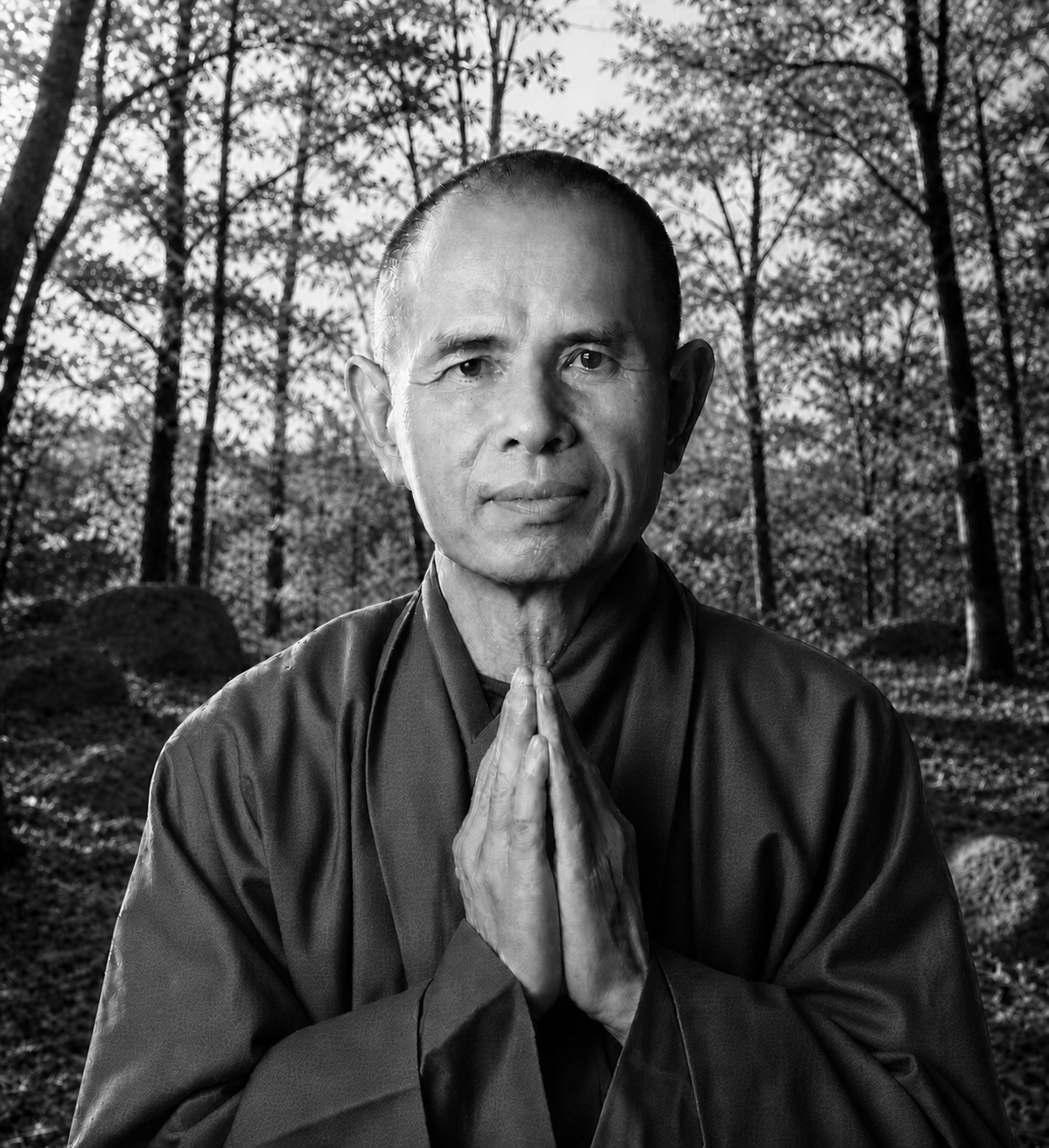
Monk, Poet, Peace Activist, and Community Builder. 1926–2022
“Patience is the mark of true love.”
Thich Nhat Hanh was born in central Vietnam on October 11, 1926. He would become a monk, poet, peace activist, exile, community builder, and one of the modern world’s most influential teachers of mindfulness.
Vietnam was part of French Indochina when he was born. His father worked in the colonial administration, placing the family between Vietnam’s inherited culture and the foreign bureaucracy imposed upon it. As a child, Thich Nhat Hanh saw an image of the Buddha seated peacefully on the grass. The figure appeared calm and free in a way others around him did not. He wanted to know how a human being could live like that.
At sixteen, against his parents’ initial wishes, he entered Từ Hiếu Temple. Temple life taught patience through the body: rising early, sweeping courtyards, carrying water, memorizing texts, and sitting through discomfort. Practice meant returning to the same breath and task without demanding an immediate result.
Outside the temple, Vietnam was becoming increasingly violent. Japanese occupation and French colonial exploitation contributed to a devastating famine. Japan’s defeat was followed by Hồ Chí Minh’s declaration of independence, and France’s attempt to regain control in the First Indochina War.
The young monk saw that suffering couldn’t be treated as a private problem. Hunger, foreign domination, and violence entered the monastery with the people seeking help.
Traditional Buddhist education seemed inadequate to the crisis. Thich Nhat Hanh wanted monks to study history, literature, science, and foreign languages. He left the Temple whose curriculum he considered too narrow, studied secular subjects in Saigon, and joined a movement to renew Vietnamese Buddhism.
He wrote poetry and essays, edited Buddhist journals, and taught young monks. Although impatient with institutions that failed to recognize the urgency of their times, he learned that renewal couldn’t be forced. An idea had to be cultivated and sustained by a community. You couldn’t shout a seed into becoming a tree.
France’s defeat in 1954 ended the colonial war but divided Vietnam. A communist government controlled the North; an anti-communist government, increasingly supported by the United States, controlled the South. Each side claimed the country’s future and treated neutrality with suspicion.
Thich Nhat Hanh refused to choose between the armed camps. He understood the conflict not simply as a contest between communism and freedom, but as a civil war, a struggle for independence, and an arena for foreign powers. His position was morally consistent and politically dangerous.
After studying and teaching in the United States, he returned to Vietnam in 1963 as the conflict intensified. Villages were bombed, peasants displaced, and young men pulled toward opposing armies.
Monks and nuns faced a choice: remain in monasteries preserving contemplation, or leave them to relieve suffering. Thich Nhat Hanh rejected the choice itself. Meditation, he argued, wasn’t an escape from society. It allowed people to act without being controlled by fear, anger, or ideology.
This approach became known as Engaged Buddhism. Its roots extended through earlier Asian reform movements, but Thich Nhat Hanh gave it a name and became its leading international voice.
He helped establish the School of Youth for Social Service. Its volunteers rebuilt bombed villages, opened schools and clinics, and assisted displaced families. Entering territory controlled by opposing forces without weapons, they were threatened, abducted, and killed.
Patience under these conditions didn’t mean waiting for violence to end. It meant acting without reproducing the violence around them. Thich Nhat Hanh taught the volunteers to return to their breathing so despair wouldn’t consume them. If peace workers learned to hate, the war had already infected them.
In 1965 he wrote to Martin Luther King Jr., describing the suffering of the Vietnamese people and urging him to oppose the war. They met the following year. King called the monk an “apostle of peace and nonviolence” and nominated him for the Nobel Peace Prize in 1967.
Thich Nhat Hanh helped King see the war from beneath the bombs; King gave his appeal a moral audience in the United States. Their friendship connected the struggles against racism, colonialism, and militarism.
In 1966 Thich Nhat Hanh left Vietnam to call for a ceasefire, an end to the bombing, and a settlement free from foreign domination. The South Vietnamese government prevented his return, while the communist North also distrusted him. At forty, he became an exile, and patience became the structure of his life.
Thich Nhat Hanh led a Buddhist delegation to the Paris Peace Talks, but the agreement reached in 1973 didn’t bring him home. Nor did reunification two years later. The new government continued to regard him with suspicion.
Exile wounded him. Friends died, students scattered, and the Vietnam he carried in memory changed without him. He had to accept the present without abandoning the possibility of change—to make a home elsewhere without denying what he had lost.
In 1982, he founded Plum Village in the French countryside. From old farm buildings and poor soil, he reshaped the way many Westerners encountered Buddhism. He taught people to sit, walk, eat, wash dishes, and answer a telephone with full attention. A red light could become an invitation to breathe; a ringing telephone, a bell of mindfulness.
The teaching was simple because he made it simple. He had watched ideology reduce people to categories and strategic objectives. Mindfulness restored attention to the person, breath, meal, tree, or wound immediately present. Patience became freedom from the compulsion to be somewhere else.
His idea of “interbeing” gave the practice a wider meaning. Nothing existed alone. A sheet of paper contained the cloud that made rain, the soil that fed the tree, the logger, and the food that sustained the logger. Harming others or the natural world meant damaging conditions that also sustained oneself.
These teachings informed his work with veterans, refugees, prisoners, environmentalists, political leaders, and people on opposing sides of conflicts. He asked them to listen without preparing a rebuttal and to recognize suffering even in an opponent. Such listening required patience because it surrendered the immediate satisfaction of being right.
Plum Village grew into a global network. Thich Nhat Hanh trained teachers and wrote scores of books, bringing Buddhist practice to questions of work, consumption, violence, and care for the Earth. His appeal grew as modern life accelerated and attention fragmented. Into that world he carried a small bell: stop, breathe, notice that you are here.
Thich Nhat Hanh never separated inner peace from social responsibility. Practice should reveal the causes of suffering, including the systems in which the practitioner participated. Peace within a person who remained indifferent to others was incomplete.
In 2005, after thirty-nine years, the Vietnamese government permitted him to return. Some dissidents and exiles criticized him for engaging with an authoritarian state that restricted religious activity and could use his presence to advertise tolerance.
He accepted the risk. Reconciliation, he believed, required contact. He led ceremonies for the dead of all sides and called for greater religious freedom. When authorities later drove hundreds of his followers from a Vietnamese monastery, the limits of his approach became clear. Patience couldn’t guarantee cooperation from power. It could only preserve possibilities that anger might close.
In 2014, Thich Nhat Hanh suffered a severe brain hemorrhage. He survived but lost the ability to speak and walk independently. For a teacher who had reached the world through language, the loss was profound. Yet he had always taught that the greatest gift one person could offer another was presence. Students now cared for the teacher who had taught them how to care.
Four years later, he returned to Từ Hiếu Temple. Everything he had learned converged in that homecoming. The novice knew practice began again each day. The reformer knew institutions changed slowly. The peace worker had learned to act without hatred. The exile had discovered how to carry home within him.
“I have arrived, I am home” had been one of his best-known meditations. Home was the present moment, available through a conscious breath. Yet he still chose to return to the actual temple, land, and country from which he had been separated. Spiritual freedom didn’t make exile painless.
Thich Nhat Hanh died at Từ Hiếu Temple on January 22, 2022. He was ninety-five.
His life stretched from colonial rule through occupation, war, reunification, globalization, and the digital age. He answered a century of violence and acceleration by teaching people to stop.
Patience, as he lived it, wasn’t the belief that time would solve everything. It was the capacity to remain awake inside time—to act without being ruled by urgency, to suffer without passing suffering onward, and to plant what one might never live to harvest.
###
Written August 23, 2026
Resources
Some resources are linked through our affiliate program with Amazon.com. Buying these items is a simple way to support our work while expanding your own knowledge base.
The Essence of Buddha’s Teaching
Books by Thich Nhat Hanh
The Miracle of Mindfulness: An Introduction to the Practice of Meditation — by Thich Nhat Hanh
A classic, practical introduction to bringing mindfulness into ordinary activities such as breathing, walking, eating, and washing dishes.
Peace Is Every Step: The Path of Mindfulness in Everyday Life — by Thich Nhat Hanh
Short teachings showing how moments of irritation, pressure, and routine can become opportunities for awareness and peace.
Being Peace — by Thich Nhat Hanh
One of his clearest statements that inner transformation and social peace are inseparable. The revised edition includes a foreword by Jane Goodall.
No Mud, No Lotus: The Art of Transforming Suffering — by Thich Nhat Hanh
A guide to recognizing, holding, and transforming suffering rather than fleeing from it—an essential text for understanding his patient approach to pain.
The Heart of the Buddha’s Teaching — by Thich Nhat Hanh
A broad introduction to foundational Buddhist teachings, including the Four Noble Truths, Noble Eightfold Path, mindfulness, and interbeing.
At Home in the World: Stories and Essential Teachings from a Monk’s Life — by Thich Nhat Hanh
Eighty-one autobiographical stories spanning his childhood, novice years, wartime peace work, exile, teaching, and meetings with world leaders.
Books About Thich Nhat Hanh and His Community
Thich Nhat Hanh: Essential Writings — edited by Robert Ellsberg
A compact selection of his writings framed by Sister Annabel Laity’s biographical introduction.
Thich Nhat Hanh: Buddhism in Action — by Maura D. Shaw
A short, illustrated biography for younger readers connecting his life, Vietnam peace work, mindfulness, and founding of Plum Village.
Documentaries & Films
Filmed over three years inside Plum Village, this meditative documentary follows its monastic community through daily practice and a teaching tour. Benedict Cumberbatch narrates passages from Thich Nhat Hanh’s journals.
A set of four videos that collect a series of lectures on the Four Noble Truths given by His Holiness the XIV Dalai Lama in 1997 in England. Each of the four videos includes a brief introduction by Tibetan Buddhism scholar Robert Thurman, who contextualizes the lectures within the many Buddhist traditions.
Videos
Plum Village’s biographical documentary, narrated by Peter Coyote, traces the war, exile, Engaged Buddhism, community building, and Thich Nhat Hanh’s international legacy.
A brief instructional video demonstrating Zen meditation practice, focusing on posture, breath, and the disciplined awareness of the present moment.
A concise excerpt in which Thich Nhat Hanh explains why meditation and compassionate social action belong together.
Loving Speech and Deep Listening
A short teaching on patient communication, listening without preparing a rebuttal, and reducing suffering in relationships.
Speaking with children at Blue Cliff Monastery, Thich Nhat Hanh uses a cloud and a cup of tea to make impermanence and continuation immediately understandable.
A brief contemporary film built around his teaching on interbeing, continuation, and humanity’s inseparability from the natural world.
Websites
Thich Nhat Hanh: Extended Biography—Plum Village
The most detailed official chronology of his childhood, monastic formation, Buddhist renewal, peace work, exile, return to Vietnam, illness, and final years.
A free collection of guided meditations, talks, deep relaxations, chants, and practice resources from Thich Nhat Hanh and his community.
An accessible overview of his life and continuing work, including the international practice centers and programs carrying his teachings forward.
Martin Luther King Jr.’s 1967 Nobel Peace Prize Nomination
The Nobel Prize archive record confirming King’s nomination of Thich Nhat Hanh as a Vietnamese monk and peace activist.