
The Long View
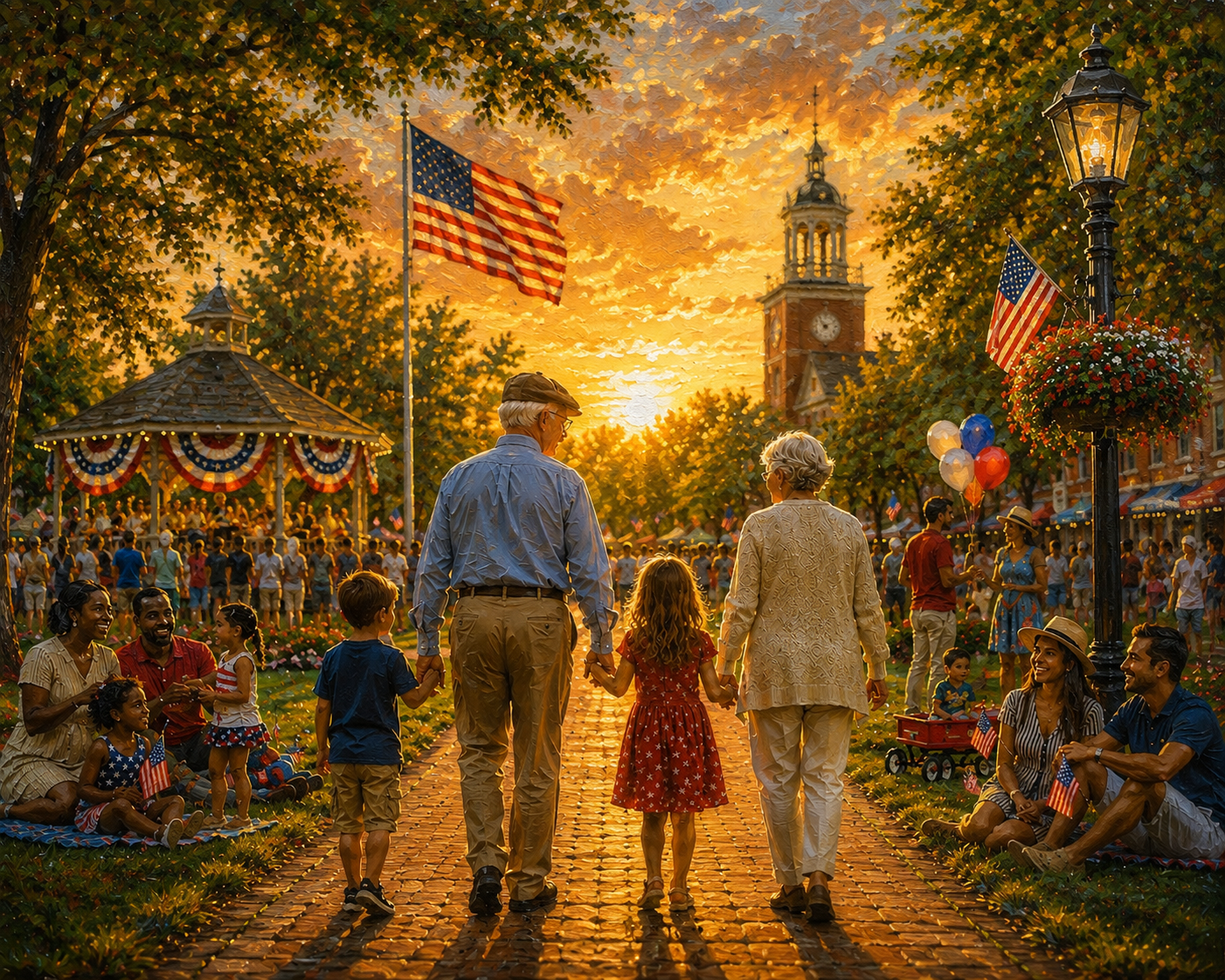
Beyond the glare of the present moment, the long course of history still bends toward greater freedom, opportunity, and human flourishing.
“May it be to the world…the signal of arousing men to burst the chains…and to assume the blessings and security of self-government.”
— Thomas Jefferson in a letter to Roger C. Weightman, June 24, 1826
Two hundred and fifty years ago, fifty-six men pledged “their Lives, their Fortunes and their sacred Honor” to launch an experiment in self-government. They understood something every generation since has had to rediscover: liberty isn’t self-sustaining. It survives only when free people choose to preserve it.
The Declaration of Independence was the opening chapter of an epic journey. Generation after generation has inherited the American experiment, strengthened it, and passed it onward. That responsibility now falls to us.
Independence Day is more than the anniversary of our nation’s birth. It is the annual reminder that liberty isn’t a possession to be admired, but a responsibility to be renewed. Every Fourth of July invites us not only to celebrate what earlier generations achieved, but to ask what we will contribute to the generations that follow.
One of the clearest measures of what America represents is found not in speeches or political slogans, but in human behavior. For generations, people from every corner of the world have crossed oceans, deserts, and borders—often at tremendous personal risk—for the opportunity to build a life in the United States. Their choices reveal something important. People move toward societies where freedom, opportunity, and the rule of law offer the greatest chance to improve their lives.
I have traveled enough to understand why.
In too many places around the world, corruption is woven into everyday life. Public officials enrich themselves while ordinary citizens struggle simply to survive. Opportunity is limited not by talent or determination, but by institutions that serve the powerful instead of the people.
America is not perfect, and no honest observer would claim it is. But perspective matters. Compared with most of human history—and much of the world today—the United States remains an extraordinary achievement. Our institutions generally function. The rule of law prevails. Millions of people pursue education, build businesses, raise families, worship freely, speak their minds, and improve their lives in ways previous generations could scarcely imagine. These freedoms are so familiar that we often forget how remarkable they truly are. None of this happened by accident.
It was built by generations of citizens who accepted the responsibilities of self-government. They voted. They served. They debated. They volunteered. They challenged injustice. They strengthened their communities, raised their families, and worked to leave the nation better than they found it. They understood that government of the people can endure only when the people remain engaged. That remains our responsibility today.
The Founders never intended Americans to become passive caretakers of a finished system. They expected disagreement. They expected vigorous debate. They expected change. Above all, they expected an engaged citizenry willing to preserve the constitutional framework that allows a free people to govern themselves.
The price of liberty is participation. Stay informed. Vote. Listen to those who disagree with you. Hold your leaders accountable. Volunteer in your community. Teach your children not only the rights they inherit, but the responsibilities that accompany them. Care enough to leave the nation stronger than you found it.
Ten days before his death, Thomas Jefferson reflected on what he hoped the Declaration of Independence would mean—not only for America, but for the world. Looking back over fifty years, he didn’t simply celebrate the birth of a new nation. He expressed the hope that the principles proclaimed in 1776 would inspire people everywhere to “assume the blessings and security of self-government.” It was a remarkable expression of confidence—not only in his country, but in humanity itself.
Two hundred and fifty years later, we can see that much of Jefferson’s hope has been realized. The spread of constitutional government, expanding liberty, broader educational opportunity, scientific progress, rising standards of living, and the enduring attraction of America to millions seeking a better life all testify to the power of those ideas. The journey has never been smooth, and it remains unfinished. But measured across generations instead of news cycles, history offers genuine reason for optimism.
America’s greatest contribution to the world has never been its wealth or its military power. It has been the enduring proof that free people, governed by the rule of law and bound by constitutional principles, are capable of governing themselves.
Beyond the glare of the present moment, I believe the long course of history still bends toward greater freedom, opportunity, and human flourishing. I believe America’s greatest days are not confined to its past but lie in its future—not because success is guaranteed, but because every generation has the opportunity to strengthen what it has inherited and pass it forward.
The promise of America has always rested where it belongs: in the hands of its citizens.
Stay engaged.
Vote.
Care.
The next chapter begins with us.
Robin Chew
Publisher, Lucidcafé
Creator of the USA250 Series
About the Author
Robin Chew is an entrepreneur, writer, and lifelong student of history and leadership. As creator of Lucidcafé’s USA250 series, he has explored the people, ideas, and events that shaped America’s founding—not simply to understand the past, but to encourage thoughtful citizenship in the present. He believes the American experiment remains one of humanity’s greatest achievements, and that every generation inherits both the blessings of liberty and the responsibility to preserve them.
###
Profile written June, 2026
Resources
Some resources are linked through our affiliate program with Amazon.com. Buying these items is a simple way to support our work while expanding your own knowledge base.
Click here to see The Declaration of Independence
Books
Founding Brothers: The Revolutionary Generation— by Joseph J. Ellis
This Pulitzer Prize–winning study explores the personal alliances, rivalries, and political compromises that shaped the founding generation, including Roger Sherman’s often-overlooked role as one of the quiet but indispensable consensus builders within the brotherhood of founders.
Documentaries
The American Revolution: A Film by Ken Burns, Sarah Botstein & David Schmidt
A sweeping documentary that brings the Revolutionary era to life through vivid storytelling and historical insight, placing Washington and his contemporaries at the center of America’s founding struggle.
Websites
The Interactive Declaration of Independence — National Constitution Center
Learn about the Declaration of Independence, and its influence throughout American history and around the world. Explore its text with interactive links to related content; a version of the Declaration annotated by Akhil Reed Amar; essays and videos by leading scholars covering the Declaration’s key principles and history, and biographical essays and videos covering the 56 signers of the Declaration of Independence.
Reading of the Declaration of Independence
A host of celebrities including Mel Gibson, Whoopie Goldberg, and Michael Douglas perform a live reading of the Declaration of Independence in Independence Hall, Philadelphia, PA on August 27, 2009.
1776— Clip from the 1972 Columbia Pictures movie
This memorable scene from the 1972 movie, 1776 dramatizes the Continental Congress vote for independence, capturing the debate, uncertainty, and compromise that preceded one of the most consequential decisions in American history.