
Committee of Five
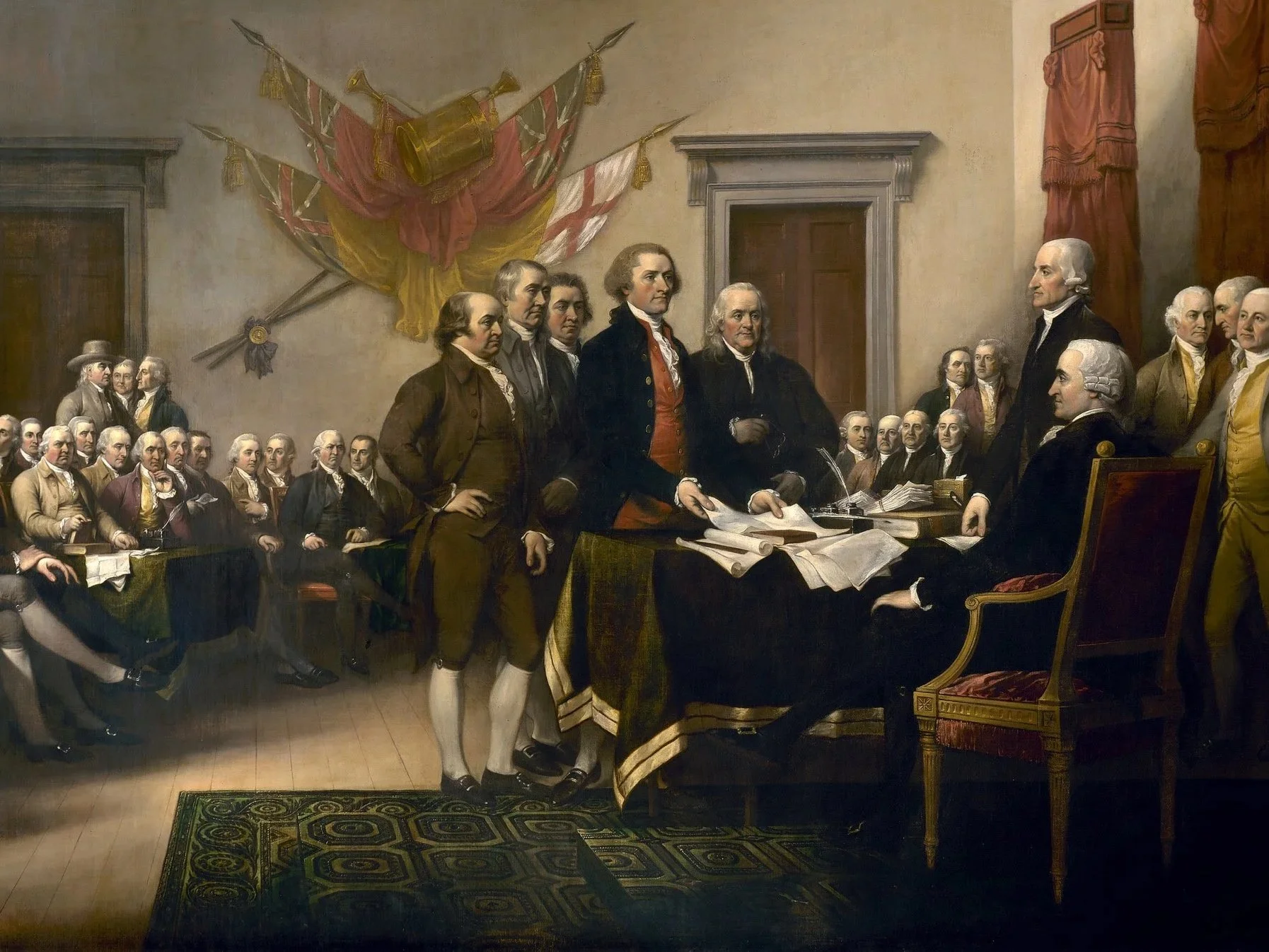
Drafting American Independence
“We must, indeed, all hang together, or most assuredly we shall all hang separately.”
— Benjamin Franklin
Few documents have changed the course of history as profoundly as the Declaration of Independence. Adopted on July 4, 1776, it announced the birth of a new nation and articulated principles that would echo far beyond the thirteen American colonies. Yet while the Declaration is often associated with Thomas Jefferson alone, it was the product of a broader collaboration among some of the most capable minds of the Revolutionary generation. The document emerged from years of growing conflict between Great Britain and its colonies and from the efforts of five men appointed by the Continental Congress to explain why separation had become necessary.
By the summer of 1776, the American colonies had already been at war with Great Britain for more than a year. The battles at Lexington and Concord had been fought. George Washington had taken command of the Continental Army. Blood had been shed on both sides, and many colonists had come to believe that reconciliation with the Crown was no longer possible. Even so, independence remained a radical step. Congress needed more than a military victory. It needed a clear and persuasive explanation of why the colonies were severing their political ties to Britain and why the world should recognize them as a free and independent people.
To accomplish this task, the Continental Congress appointed a committee consisting of five delegates: Thomas Jefferson of Virginia, John Adams of Massachusetts, Benjamin Franklin of Pennsylvania, Roger Sherman of Connecticut, and Robert R. Livingston of New York. Together they became known as the Committee of Five.
Each member brought a different strength to the effort. Jefferson was selected largely because of his exceptional writing ability. His earlier political writings had demonstrated a remarkable talent for expressing complex ideas in clear and elegant language. Adams was one of the leading advocates for independence in Congress and among the most influential voices of the Revolution. Franklin, already famous throughout Europe and America, contributed political wisdom, diplomatic experience, and a practical sense of what language would resonate with readers. Sherman was respected for his judgment, integrity, and ability to build consensus among men who often disagreed. Livingston was one of New York’s most prominent political leaders and helped ensure that the document reflected concerns shared throughout the colonies.
Although all five men participated in the effort, Jefferson soon emerged as the principal author. Adams later recalled that he urged Jefferson to write the first draft. According to Adams, Jefferson possessed a superior talent for composition and, as a Virginian, could help unite northern and southern colonies behind the cause. Jefferson accepted the assignment and began drafting what would become one of the most influential political statements ever written.
Working in Philadelphia, Jefferson drew upon ideas that had been developing for decades within the English political tradition and the Enlightenment. Influenced by thinkers such as John Locke and by colonial experiences with self-government, he argued that all people possess natural rights governments are established to protect. When governments violate those rights, he wrote, the people retain the authority to alter or abolish them and establish new governments better suited to securing their liberty.
Once Jefferson completed his draft, it was reviewed by Franklin and Adams. Both suggested revisions. Franklin’s most famous contribution was changing Jefferson’s phrase “sacred and undeniable truths” to the now immortal “self-evident truths.” The committee then submitted the document to Congress for consideration.
The most difficult stage was still ahead. Congress spent several days debating the draft line by line. Delegates proposed changes, removed passages, and refined the language. One of the most significant deletions involved Jefferson’s criticism of the slave trade and the British Crown’s role in encouraging it. Delegates from several colonies objected, and the passage was removed to preserve unity among the states. The debates revealed a recurring reality of the American founding: even when leaders agreed on broad principles, they often disagreed sharply about details. Compromise was necessary if the colonies were to remain united.
After extensive revision, Congress approved the final text on July 4, 1776. The Declaration announced that the colonies were “Free and Independent States” and no longer subject to British authority. What began as a statement of political necessity soon became something much larger. The Declaration transformed a colonial rebellion into a revolution grounded in universal principles. Its assertion that governments derive “their just powers from the consent of the governed” challenged long-standing assumptions about monarchy, authority, and political legitimacy.
The historical consequences were immense. The Declaration inspired generations of reformers, revolutionaries, and advocates for liberty around the world. Its principles influenced movements in France, Latin America, and beyond. Within the United States, its promises would become a standard against which future generations measured the nation’s progress. Abolitionists, suffragists, civil rights leaders, and countless others would invoke its language in their efforts to expand the meaning of American freedom.
The Committee of Five did not create the ideals expressed in the Declaration, nor did they resolve the contradictions that would continue to challenge the new nation. What they accomplished was equally important. They gave voice to the aspirations of a revolutionary generation and transformed a collection of grievances into a coherent statement of political principle. Jefferson supplied the words, but the document emerged from the collective efforts of five men and the deliberations of an entire Congress. Their work remains one of the defining achievements of the American founding and one of the most influential acts of political writing in human history.
###
Profile written June, 2026
Resources
Some resources are linked through our affiliate program with Amazon.com. Buying these items is a simple way to support our work while expanding your own knowledge base.
Click here to see The Declaration of Independence
Books
Founding Brothers: The Revolutionary Generation— by Joseph J. Ellis
This Pulitzer Prize–winning study explores the personal alliances, rivalries, and political compromises that shaped the founding generation, including Roger Sherman’s often-overlooked role as one of the quiet but indispensable consensus builders within the brotherhood of founders.
Documentaries
The American Revolution: A Film by Ken Burns, Sarah Botstein & David Schmidt
A sweeping documentary that brings the Revolutionary era to life through vivid storytelling and historical insight, placing Washington and his contemporaries at the center of America’s founding struggle.
Websites
The Interactive Declaration of Independence — National Constitution Center
Learn about the Declaration of Independence, and its influence throughout American history and around the world. Explore its text with interactive links to related content; a version of the Declaration annotated by Akhil Reed Amar; essays and videos by leading scholars covering the Declaration’s key principles and history, and biographical essays and videos covering the 56 signers of the Declaration of Independence.
Reading of the Declaration of Independence
A host of celebrities including Mel Gibson, Whoopie Goldberg, and Michael Douglas perform a live reading of the Declaration of Independence in Independence Hall, Philadelphia, PA on August 27, 2009.
1776— Clip from the 1972 Columbia Pictures movie
This memorable scene from the 1972 movie, 1776 dramatizes the Continental Congress vote for independence, capturing the debate, uncertainty, and compromise that preceded one of the most consequential decisions in American history.
Road To Independence — Lucidcafe.com
Imagine a warm Philadelphia evening in the summer of 1776. Candlelight flickers across a cluttered writing desk as a young Thomas Jefferson leans over a sheet of parchment, quill in hand.