
Road to Independence
The Point of No Return
“The object of the Declaration of Independence was not to find out new principles, or new arguments, never before thought of… but to place before mankind the common sense of the subject.”
— Thomas Jefferson
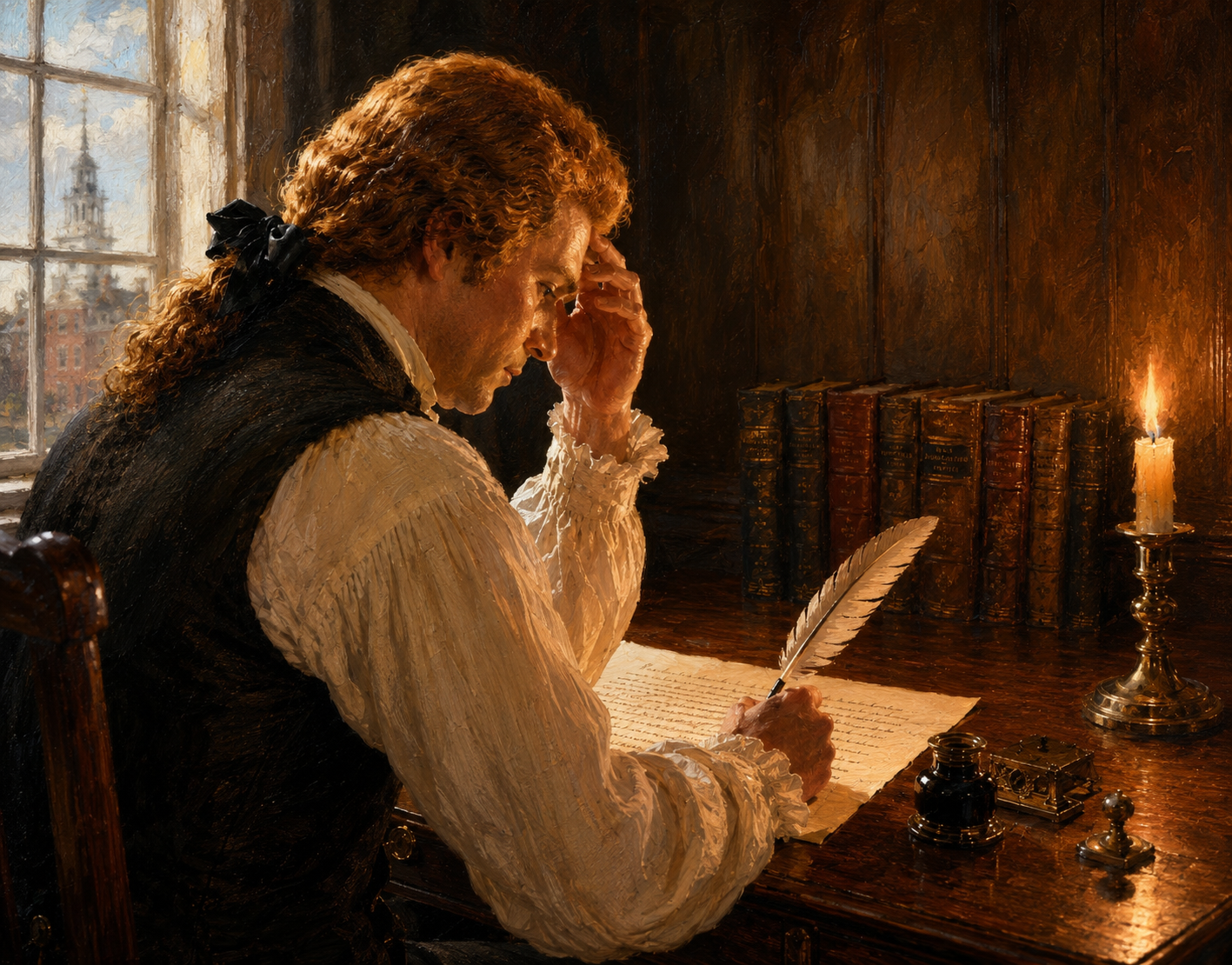
Imagine a warm Philadelphia evening in the summer of 1776. Candlelight flickers across a cluttered writing desk as a young Thomas Jefferson leans over a sheet of parchment, quill in hand. Outside, the city hums with uncertainty. British troops prepare to seize New York, General George Washington struggles to hold together an inexperienced army, and no one can say whether the rebellion will survive another year.
By then, the American colonies had been at war with Great Britain for more than a year. Blood had already been shed at Lexington and Concord. The costly Battle of Bunker Hill had demonstrated that Americans were willing to fight, while the successful siege of Boston showed they could challenge the world’s most powerful empire. Yet despite the fighting, many still hoped reconciliation remained possible.
Those hopes faded steadily. Colonial leaders had petitioned the Crown for redress of grievances. Instead, King George III declared the colonies to be in rebellion and authorized military force to suppress them. News that Britain had hired German mercenaries, known as Hessians, convinced many colonists that the Crown no longer viewed them as subjects with grievances, but as enemies to be subdued.
Public opinion shifted rapidly during the first half of 1776. Thomas Paine’s Common Sense challenged Americans to think beyond reconciliation and consider independence. Colonial assemblies began instructing their delegates to support separation from Great Britain. Momentum built until, on June 7, Richard Henry Lee introduced a resolution declaring “that these United Colonies are, and of right ought to be, free and independent States.”
Inside the Pennsylvania State House, another battle was being fought—not with muskets and cannon, but with ideas and words. Congress appointed a Committee of Five—Thomas Jefferson, John Adams, Benjamin Franklin, Roger Sherman, and Robert R. Livingston—to prepare a declaration explaining the reasons for independence should Lee’s resolution be approved. Jefferson produced the first draft, while Adams and Franklin offered revisions before the document was presented to Congress.
During the closing days of June and the opening days of July, delegates debated not only whether to declare independence but how to explain that decision to the world. Every sentence was examined. Every phrase was weighed. Portions were revised or removed to build consensus among thirteen very different colonies united by a common purpose. The Declaration of Independence was not born in a single stroke of Jefferson’s pen, but through collaboration, compromise, and a shared determination to give voice to a new nation.
On July 2, 1776, Congress voted in favor of independence. Two days later, on July 4, it approved the final text of the Declaration of Independence. The document announced not only the birth of a new nation, but a set of principles that would continue to shape American government and inspire movements for liberty around the world.
The Road to Independence is more than the story of a single document. It is the story of how ideas became convictions, convictions became decisions, and decisions changed the course of history. Understanding that journey helps us better appreciate both the extraordinary achievement of America’s founders and the enduring responsibility entrusted to every generation that follows.
Robin Chew
Publisher, Lucidcafé
Creator of the USA250 Series
About the Author
Robin Chew is an entrepreneur, writer, and lifelong student of history and leadership. As creator of Lucidcafé’s USA250 series, he has explored the people, ideas, and events that shaped America’s founding—not simply to understand the past, but to encourage thoughtful citizenship in the present. He believes the American experiment remains one of humanity’s greatest achievements, and that every generation inherits both the blessings of liberty and the responsibility to preserve them.
###
Profile written June, 2026
Resources
Some resources are linked through our affiliate program with Amazon.com. Buying these items is a simple way to support our work while expanding your own knowledge base.
Click here to see The Declaration of Independence
Books
Founding Brothers: The Revolutionary Generation— by Joseph J. Ellis
This Pulitzer Prize–winning study explores the personal alliances, rivalries, and political compromises that shaped the founding generation, including Roger Sherman’s often-overlooked role as one of the quiet but indispensable consensus builders within the brotherhood of founders.
Documentaries
The American Revolution: A Film by Ken Burns, Sarah Botstein & David Schmidt
A sweeping documentary that brings the Revolutionary era to life through vivid storytelling and historical insight, placing Washington and his contemporaries at the center of America’s founding struggle.
Websites
The Interactive Declaration of Independence — National Constitution Center
Learn about the Declaration of Independence, and its influence throughout American history and around the world. Explore its text with interactive links to related content; a version of the Declaration annotated by Akhil Reed Amar; essays and videos by leading scholars covering the Declaration’s key principles and history, and biographical essays and videos covering the 56 signers of the Declaration of Independence.
Reading of the Declaration of Independence
A host of celebrities including Mel Gibson, Whoopie Goldberg, and Michael Douglas perform a live reading of the Declaration of Independence in Independence Hall, Philadelphia, PA on August 27, 2009.
1776— Clip from the 1972 Columbia Pictures movie
This memorable scene from the 1972 movie, 1776 dramatizes the Continental Congress vote for independence, capturing the debate, uncertainty, and compromise that preceded one of the most consequential decisions in American history.